



Missing an IVF injection—or realizing that a dose may have been late, incomplete, spilled, or prepared incorrectly—can be frightening. Fertility medications are often administered on a carefully coordinated schedule, so it is understandable to worry that one mistake has harmed the cycle. The safest response is to act promptly, report exactly what happened, and let the prescribing fertility clinic decide whether the plan needs to change.
A missed IVF injection does not automatically mean that an IVF cycle will be canceled or unsuccessful. What it means depends on the medication, the amount received, how much time has passed, the stage of treatment, the patient’s monitoring results, and the clinic’s protocol. A delayed stimulation injection is not evaluated in exactly the same way as a missed antagonist, trigger shot, or progesterone dose.
This guide explains what to do after a missed or uncertain fertility-medication dose, why different injections require different responses, what information the clinic needs, which mistakes should be reported, and how to prevent another timing problem. It provides general education only. It cannot determine whether an individual patient should take, repeat, skip, delay, or change a dose.
Quick answer: If you miss an IVF injection, discover that it was administered late, or are unsure how much medication entered your body, contact your fertility clinic or its after-hours line as soon as possible. Have the medication name, prescribed dose, scheduled time, actual time, treatment day, and details of the mistake ready. Do not double the next dose, repeat an uncertain dose, or redesign the schedule unless the prescribing clinic specifically instructs you to do so. A missed or mistimed trigger shot should be treated as time-sensitive and reported immediately.
What Counts as a Missed IVF Injection?
A dose does not have to be completely forgotten to create a medication question. Fertility clinics need to know about any event that may have changed the medication, dose, route, or timing they prescribed.
Report the situation if:
- The scheduled injection was not administered.
- The injection was given earlier or later than the clinic-directed time.
- You cannot remember whether the dose was administered.
- Some medication leaked from the injection site or syringe.
- Medication spilled while a vial was being mixed or transferred.
- The pen, vial, or syringe appeared to contain medication after the injection.
- You selected the wrong pen setting or drew up the wrong amount.
- You used the wrong medication, syringe, needle, injection route, or site.
- The needle was withdrawn before the full dose was delivered.
- You are uncertain whether a multi-step mixing process was completed correctly.
- The medication may have been stored outside its approved temperature range.
- The injection device malfunctioned, jammed, broke, or did not behave as expected.
Do not decide that an event is too small to mention. A few drops on the skin, a delayed alarm, or an unfamiliar pen reading may or may not require a treatment change, but the prescribing team needs the facts to make that judgment. Reporting the event does not mean that you failed. It gives the clinic the best opportunity to protect the treatment plan.
What Should You Do Immediately After Missing an IVF Injection?
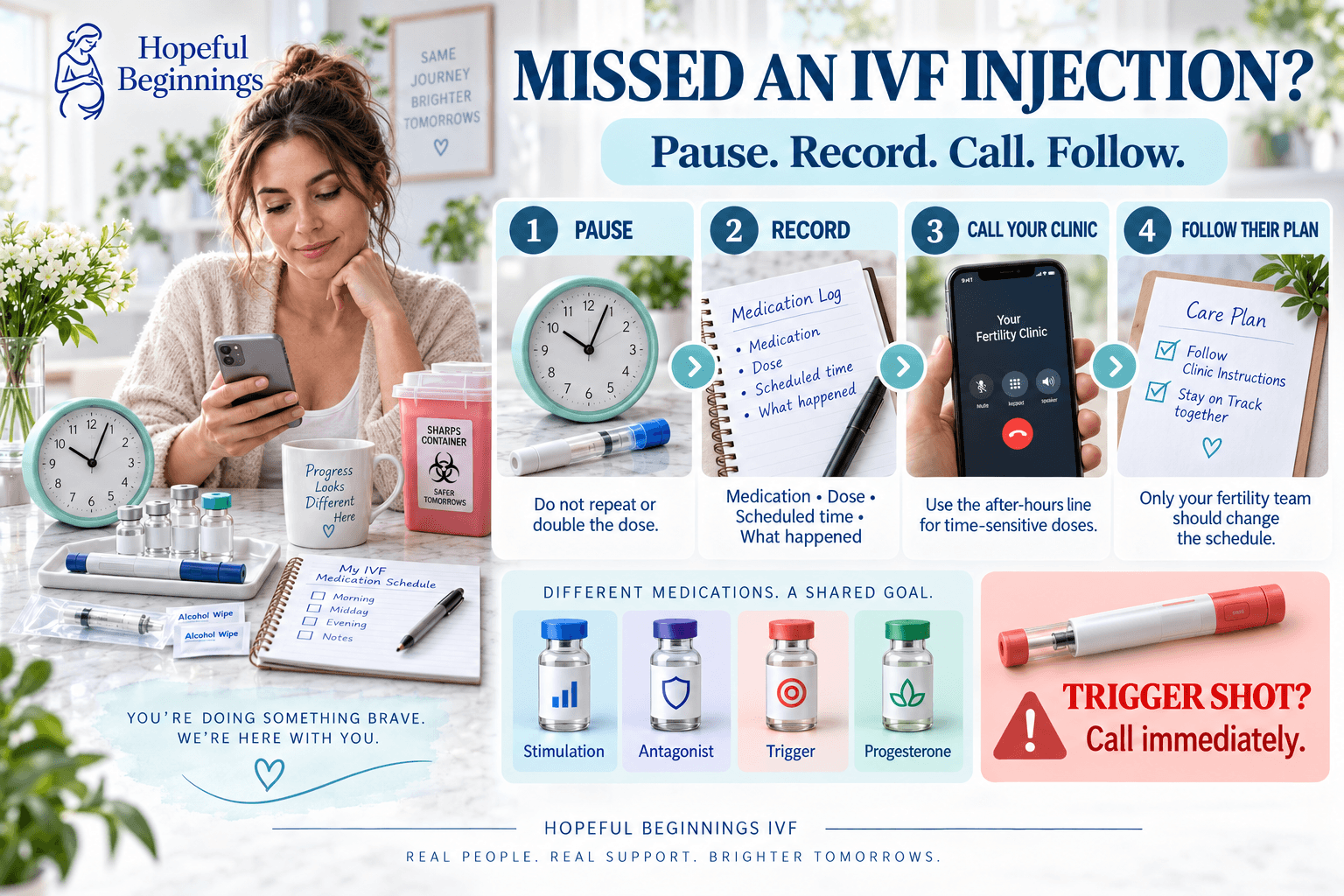
1. Pause Before Taking More Medication
Do not automatically administer the forgotten dose as soon as you notice it. Do not repeat a dose because you are unsure whether the first injection worked. Whether a late dose should be taken depends on the exact product and protocol. Acting before receiving instructions can turn one uncertain dose into a possible double dose or create a new timing problem.
Keep the medication, packaging, pen, vial, syringe, and written schedule available. Do not discard a device involved in a malfunction until the clinic or pharmacy tells you that it no longer needs to be inspected or described. Place used needles in an approved sharps container; never reach into a sharps container to retrieve one.
2. Write Down Exactly What Happened
Stress can make details harder to remember. Record the event before calling. Use the clock time shown on your phone rather than estimating. If another person prepared or administered the injection, compare recollections without changing or concealing details.
Document:
- The medication’s complete name and formulation
- The strength shown on the box, pen, vial, or syringe
- The prescribed dose
- The scheduled administration time
- The actual administration time, if any
- How much medication may have entered the body
- Whether medication leaked, spilled, remained in the device, or was discarded
- The injection route and location used
- The date and day of the treatment cycle
- Other fertility medications taken that day
- Your next scheduled medication and appointment
- Any new symptoms
3. Contact the Prescribing Fertility Clinic
Use the clinic’s daytime number during office hours and its designated urgent or after-hours line when the office is closed. A patient portal message may not be reviewed quickly enough for a time-sensitive dose. If the clinic gave you a medication-error protocol, follow that communication route.
The dispensing or specialty pharmacy can help identify a product, explain device operation, review storage requirements, or document a malfunction. However, the pharmacy generally does not replace the fertility clinic’s role in deciding how the event affects an individualized IVF protocol. When timing or dosage may need to change, the prescribing clinic must direct the plan.
4. Follow the New Instructions Exactly
Write down the clinician’s name, the time of the conversation, and the exact instructions. Read the plan back to confirm it. Ask whether the directions apply only to the affected medication or also change later doses, monitoring, the trigger shot, egg retrieval, embryo transfer, or pregnancy testing.
If the instructions are unclear, ask the clinician to restate them. Do not rely on a social-media post, online forum, friend’s prior cycle, or generic medication calendar. Another patient may use the same medication at a different dose, treatment stage, or time of day.
Why There Is No Universal Grace Period for IVF Medications
Patients often ask whether an IVF injection can be 15 minutes, one hour, or several hours late. There is no single online answer that safely applies to every fertility medication. Some clinics intentionally allow a routine dosing window for certain medicines. Other injections are coordinated much more precisely with hormone suppression, monitoring, or a procedure.
The response can depend on:
- Medication purpose: stimulating follicle growth, preventing premature ovulation, triggering final egg maturation, or supporting the luteal phase
- Medication formulation: different active ingredients, concentrations, devices, and routes have different instructions
- Length of delay: discovering a dose shortly after the scheduled time is different from discovering it the next day
- Treatment day: early stimulation, late stimulation, the trigger window, or the period after retrieval or transfer
- Monitoring results: follicle measurements, hormone levels, ovarian response, and the timing of the next appointment
- Amount received: none, a confirmed partial amount, a possible partial amount, a full late dose, or an accidental extra dose
- Clinic protocol: the same brand can be used differently across patients and cycles
Current U.S. prescribing information illustrates why product-specific guidance matters. The label for GONAL-f states that a missed dose should not be followed by a doubled next dose. The MENOPUR label similarly says not to double the next dose and instructs the patient to call the healthcare provider for further dosing directions. Those statements support an important safety rule, but they do not tell an individual patient whether to take a late dose at a particular time. That decision remains individualized.
How a Missed Dose May Differ by IVF Medication Type
| Medication category | Role in treatment | Why a missed or late dose matters | Safest immediate action |
|---|---|---|---|
| Stimulation medications | Support the development of follicles during ovarian stimulation. | The clinic may consider the medication, delay, treatment day, and ovarian response. | Call for individualized instructions; do not double the next dose. |
| GnRH antagonists | Help prevent a premature luteinizing-hormone surge and ovulation. | Consistent suppression can be important during the mid-to-late stimulation phase. | Treat the question as time-sensitive and contact the clinic promptly. |
| Trigger injections | Coordinate final egg maturation with egg retrieval or another planned event. | The scheduled time may be directly connected to the procedure time. | Call the clinic or after-hours line immediately; do not wait until morning. |
| Progesterone support | Supports the uterine lining after ovulation, retrieval, or embryo transfer, depending on the protocol. | Instructions differ by injectable, vaginal, and oral formulation and by cycle type. | Contact the clinic for formulation-specific instructions; do not apply directions from a different progesterone product. |
This table explains relative urgency; it does not prescribe a dose. Medication categories contain multiple products, and the clinic may use them in different combinations. Always identify the exact brand or generic name, formulation, strength, and route when requesting help.
Stimulation Injections
Gonadotropin medications are used to stimulate follicular development. Examples can include products containing follitropin alfa, follitropin beta, or menotropins. Dosing is individualized according to the patient’s history and response, and the clinic may adjust the plan after ultrasound and hormone monitoring.
If a stimulation injection is missed, do not assume that the entire cycle is lost. The clinic may evaluate how late the dose is, where the patient is in stimulation, previous doses, follicle growth, estradiol results, and upcoming monitoring. The appropriate response cannot be predicted from medication name alone.
Do not “make up” for a missed stimulation dose by combining it with the next dose. Both GONAL-f and MENOPUR prescribing information warn against doubling after a missed dose. Contact the clinic even if an online source or package leaflet appears to give a simple rule, because the rest of the treatment schedule may also need review.
GnRH Antagonist Injections
Antagonists such as cetrorelix or ganirelix are used during controlled ovarian stimulation to suppress a premature luteinizing-hormone surge. A premature surge can lead toward ovulation before the planned retrieval. The current Cetrotide label describes once-daily administration and reports that the 0.25 mg dose every 24 hours maintains its effect. Ganirelix labeling likewise describes daily treatment through the day of hCG administration.
Those product details are not permission to calculate a personal cutoff. If an antagonist is late, missed, spilled, or administered incompletely, call the clinic promptly. The prescribing team may need to consider the delay, follicle development, hormone results, and trigger plan.
Trigger Injections
A trigger injection is in a different urgency category because it is used to coordinate final follicular maturation with egg retrieval or another planned event. The Ovidrel prescribing information states that it is given after adequate follicular development has been confirmed through monitoring. The clinic selects the administration time in relation to the procedure.
If a trigger injection was missed, late, early, spilled, given at the wrong dose, or possibly incomplete, contact the clinic or after-hours line immediately. Do not wait for the office to reopen, silently move the dose, or assume that a small delay is harmless. The clinic may need to evaluate medication exposure and procedure timing.
For a detailed explanation of this specific situation, read IVF Trigger Shot Timing: What Happens If You’re Late, Early, or Unsure?. Keeping trigger-shot questions on that dedicated page also helps patients reach the most relevant guidance quickly.
Progesterone and Other Luteal-Support Medications
Progesterone may be prescribed after retrieval, ovulation, or embryo transfer, depending on the treatment plan. It can be administered in different formulations, including intramuscular progesterone in oil, vaginal products, and oral products. Instructions for one formulation should never be transferred automatically to another.
For example, the current patient information for one progesterone vaginal insert tells patients who forget a dose to use it when remembered without exceeding the prescribed daily amount. That direction is specific to that product; it is not a universal instruction for progesterone-in-oil injections or other formulations. If progesterone is missed or administered incorrectly, identify the exact product and contact the clinic.
Patients using intramuscular progesterone can also review Hopeful Beginnings IVF’s guide to progesterone in oil shots after embryo transfer for route-specific preparation, comfort, and safety information.
What If the Injection Was Late but Not Completely Missed?
Report both the scheduled time and the actual time. Avoid describing the dose only as “a little late,” because that phrase can mean five minutes to one person and several hours to another. Exact times help the clinic interpret the event.
If you already administered the late dose, say so before asking what to do next. The clinic may keep the upcoming schedule unchanged, move a later dose, adjust monitoring, or provide another individualized plan. If you have not yet administered it, ask whether you should take it now or wait. Do not make the decision by comparing your delay with another patient’s experience.
A clinic-approved dosing window should be written down before treatment begins. If a nurse says that a medication may be taken within a particular window, ask whether that window applies every day, only to that medicine, and whether it changes later in the cycle. Trigger-shot timing should always be confirmed separately.
What If Medication Leaked, Spilled, or Remained in the Syringe?
A small drop at the skin does not reveal how much medication was delivered. Likewise, visible liquid in a syringe or pen does not automatically show that the injection failed; some devices contain expected residual volume. The correct interpretation depends on the device and the event.
Do not estimate the missing amount and inject more. Instead:
- Stop and keep the device or packaging available.
- Record whether the needle entered the skin and whether the plunger or pen mechanism was fully activated.
- Note where the liquid appeared: on the skin, around a connection, inside the vial, or within the device.
- Photograph the device or remaining medication if the clinic asks for a picture.
- Call the clinic with the medication name, prescribed dose, time, and best description of the amount involved.
- Contact the pharmacy or device manufacturer when the clinic requests product-specific troubleshooting.
If a powder-and-diluent medication was mixed incorrectly, report every step you completed. Do not add extra diluent, combine new and old vials, reuse a needle, or start another dose unless a qualified clinician or pharmacist gives product-specific instructions.
What If You Took the Wrong Dose or Used the Wrong Medication?
An accidental extra dose, incorrect pen setting, wrong vial, swapped medication, or use of another person’s prescription requires prompt communication. Do not wait for symptoms before reporting it. Do not skip future medication to “balance” the error unless the clinic directs you to do so.
Tell the clinic:
- What was prescribed
- What was actually administered
- The amount and exact time
- Whether the product belonged to the current treatment cycle
- Which medications remain scheduled
- Whether you have symptoms
If you cannot reach the clinic and the event may involve an overdose, follow the emergency instructions supplied by the clinic, medication label, pharmacy, or local poison-control service. Call emergency services for trouble breathing, swelling of the face or throat, loss of consciousness, severe chest pain, sudden neurologic symptoms, or another medical emergency.
Can One Missed IVF Injection Cancel a Cycle?
Not necessarily. A single missed injection does not create the same outcome in every cycle, and patients should not conclude that treatment has failed before the clinic evaluates the event. Some situations may require no change. Others may lead to adjusted dosing, altered monitoring, laboratory testing, a changed trigger or procedure time, or—less commonly—a recommendation not to continue the cycle as originally planned.
The clinic may consider:
- The purpose and expected duration of action of the medication
- The amount of medication definitely or possibly received
- The length and direction of the timing error
- The number and size of developing follicles
- Estradiol, luteinizing hormone, progesterone, or other relevant laboratory results
- Evidence of an ovarian response that is lower or higher than expected
- The risk of premature ovulation
- The planned timing of the trigger injection and egg retrieval
- The type and timing of embryo transfer or luteal support
- The patient’s complete medical history and clinic protocol
Only the treating team has all of this information. Even when the clinic decides that a cycle must change, the decision is based on safety and the realistic chance of a useful outcome—not punishment for making a mistake. Honest, prompt reporting gives the team more options than delayed reporting.
Why You Should Not Double the Next Dose
Doubling may expose the patient to more medication than prescribed without reliably correcting the original timing problem. It may also make the clinical picture harder to interpret. Gonadotropin dosing is adjusted according to ovarian response, and excessive response can be associated with risks such as ovarian enlargement and ovarian hyperstimulation syndrome.
FDA-approved labeling for GONAL-f specifically states not to double the next dose after a missed dose. MENOPUR labeling provides the same warning and directs the patient to call the healthcare provider. These product instructions reinforce the broader rule: do not independently compensate for a fertility-medication mistake.
“Do not double” also does not mean “always skip.” It means the patient needs individualized instructions. Depending on the situation, the clinic may advise a late dose, no dose, a revised schedule, monitoring, or another response.
What Symptoms Require Urgent Medical Attention?
A missed dose by itself does not usually create an emergency symptom. However, a medication error may occur alongside an accidental extra dose, allergic reaction, ovarian hyperstimulation, or another condition that needs urgent evaluation. Follow the emergency plan from your fertility clinic.
Seek urgent medical advice for symptoms such as:
- Rapidly increasing abdominal swelling or severe pelvic or abdominal pain
- Persistent vomiting or inability to keep fluids down
- Shortness of breath, difficulty breathing, or chest pain
- Markedly decreased urination
- Rapid weight gain when the clinic has instructed you to monitor weight
- One-sided leg pain, swelling, redness, or warmth
- Widespread hives or swelling of the lips, tongue, face, or throat
- Loss of consciousness, sudden weakness, difficulty speaking, or another severe neurologic symptom
Call emergency services for severe breathing difficulty, swelling that threatens the airway, loss of consciousness, signs of a stroke, severe chest pain, or another life-threatening emergency. An online article and a non-emergency messaging system are not substitutes for urgent care.
How to Prepare for an After-Hours Medication Problem
Do not wait for a missed dose to learn how to reach the clinic at night or on a weekend. Before the first injection, save the standard office number, after-hours number, specialty-pharmacy number, and any device-support number listed in the medication materials.
Ask these questions during medication teaching:
- Which medications have a clinic-approved dosing window?
- Which doses require an immediate call if they are late or uncertain?
- How do I reach the clinical team after hours?
- Should I call or use the patient portal for a medication error?
- What information should I have ready?
- What should I do if a pen or syringe malfunctions?
- Whom should I contact about medication replacement or storage?
- What is the backup plan if my usual helper is unavailable?
Store those answers with the current medication calendar. A plan created before stress rises is easier to follow than one assembled while a dose is already late.
How to Prevent Missed IVF Injections
Use One Current Medication Schedule
IVF instructions can change after monitoring. Keep one clearly marked, current schedule and archive outdated versions so they cannot be mistaken for active instructions. When the clinic changes a dose, update the calendar immediately and confirm the change aloud or in writing.
Set Layered Alarms
Use a preparation alarm and a separate administration alarm. The first creates time to wash hands, review the order, gather supplies, and ask a question before the dose is due. The second confirms the actual administration time. Label each alarm with the medication rather than using a generic notification.
Record Every Completed Dose
Mark the dose complete only after administration. Record the date, time, medication, amount, site, and initials of the person who gave it. This reduces the risk of both forgotten and duplicate doses. If a partner helps, agree on who is responsible for documenting completion.
Organize Without Pre-Mixing
Group the unopened medication and supplies needed for each time of day, but do not pre-mix or prefill injections unless the fertility clinic, pharmacist, and product instructions specifically allow it. Some reconstituted medicines must be used immediately. Keep look-alike products separated and read the label at preparation, measurement, and administration.
Build a Backup Plan
Decide what will happen if a partner works late, the power fails, a device breaks, the patient travels, or anxiety makes self-injection difficult. Keep clinic and pharmacy contacts accessible. Refill medication early enough to resolve delivery issues, but follow the clinic’s instructions about quantities and storage.
For medication refrigeration, air travel, time zones, and emergency packing, use the dedicated guide to storing and traveling with IVF medications. Patients who become overwhelmed around needles can also review the guide to managing IVF injection anxiety.
Practice New Devices Before the Dose Is Due
Complete clinic-directed training before the first scheduled injection. If a medication, dose, needle, pen, syringe, route, or mixing process changes, request updated instruction. Do not assume that skill with one IVF injection transfers automatically to another.
How Professional In-Home Injection Support Can Help
Professional support cannot independently prescribe medication, change a dose, or guarantee that a timing problem will never occur. It can help a patient carry out the fertility clinic’s written plan with a consistent verification and documentation routine.
In-home injection support may be useful when:
- A patient is starting an unfamiliar medication or injection device.
- Medication must be mixed before administration.
- A partner or usual helper is unavailable.
- Needle anxiety makes preparation or self-injection difficult.
- An intramuscular injection site is difficult to reach.
- The schedule includes evening, weekend, or precisely timed medication.
- The patient wants a clear administration record to share with the clinic.
Hopeful Beginnings IVF provides clinic-directed fertility injection services in Raleigh, Cary, Apex, Durham, Wake Forest, Knightdale, Wendell, Wake County, Franklin County, Johnston County, and surrounding North Carolina communities. The prescribing fertility clinic remains responsible for medication selection, dose changes, monitoring, and treatment decisions.
Do Not Let Embarrassment Delay the Call
A missed or uncertain dose deserves accurate information—not blame. Write down what happened, keep the medication and device available, and contact the prescribing team promptly. If you would like professional help following your clinic’s injection plan at home, contact Hopeful Beginnings IVF to ask about availability in your area.
Medical disclaimer: This article is for general educational purposes only. It does not provide individualized medical advice, medication dosing, diagnosis, or emergency guidance. IVF protocols and medication instructions differ by patient, product, formulation, route, treatment stage, and clinic. Contact the prescribing fertility clinic for every missed, late, early, spilled, incorrect, or uncertain dose. Do not double, repeat, skip, or reschedule medication unless the clinic specifically directs you to do so. Call emergency services for a medical emergency.
Information reviewed: September 9, 2026. Medication labels and clinical guidance can change; verify the current instructions supplied with your exact product.
Frequently Asked Questions About Missed IVF Injections
What should I do if I miss an IVF injection?
Contact your fertility clinic or its after-hours line promptly. Report the medication name, prescribed dose, scheduled time, current time, treatment day, and whether any medication was administered. Do not double the next dose or take a late dose unless the clinic directs you to do so.
How late can an IVF injection be?
There is no universal grace period for all IVF medications. The answer depends on the exact medication, its purpose, the stage of treatment, the length of the delay, and the clinic’s protocol. Use only the dosing window given by your own fertility clinic and call when the dose falls outside it.
Will one missed IVF injection ruin the cycle?
Not necessarily. Some missed or delayed doses may not require a major change, while others can affect medication coverage, monitoring, or procedure timing. The clinic must evaluate the exact event and the patient’s response before determining what happens next.
Should I take a missed IVF injection as soon as I remember?
Do not assume that “take it when remembered” applies to your injection. Some product instructions and clinic protocols differ. Call the prescribing team before taking a late dose so it can tell you whether to administer it, skip it, or follow another plan.
Can I double my next fertility-medication dose?
No—not unless the prescribing clinician has explicitly created that plan for your specific situation. GONAL-f and MENOPUR prescribing information warns patients not to double the next dose after a missed dose. Call the clinic for individualized instructions.
What if I cannot remember whether I took the injection?
Treat it as an uncertain dose. Check your written log and ask anyone who may have helped, but do not repeat the injection based only on doubt. Contact the clinic with the medication, scheduled time, and reason for uncertainty.
What if some IVF medication leaked out after the injection?
Do not estimate the leaked amount or inject extra medication. Note whether the plunger or pen mechanism was fully activated, where the liquid appeared, and how much remained visible. Contact the clinic; the pharmacy or manufacturer may also help troubleshoot the device when requested.
What happens if I miss a Cetrotide or ganirelix injection?
These antagonist medications help prevent a premature luteinizing-hormone surge during stimulation. Contact the clinic promptly if a dose is missed, delayed, spilled, or uncertain. Do not invent a new schedule or calculate a cutoff from general online information.
What should I do if I miss my IVF trigger shot?
Call the fertility clinic or its urgent after-hours line immediately. Trigger timing may be coordinated directly with egg retrieval or another procedure. Do not wait until morning, move the procedure time yourself, or administer the dose without instructions.
What if I miss a progesterone-in-oil injection after embryo transfer?
Contact the clinic for product- and protocol-specific instructions. Do not apply missed-dose directions from a vaginal or oral progesterone product to progesterone in oil. Tell the clinic the exact formulation, dose, scheduled time, and current time.
Should I call the pharmacy or the fertility clinic?
Call the fertility clinic for decisions about dose, timing, monitoring, and the treatment schedule. A specialty pharmacy can help with product identification, storage, replacement, mixing instructions, or device problems, but it does not have all of the clinical information used to manage the IVF cycle.
Can an in-home injection professional change my dose after a mistake?
No. An injection-support professional follows the prescribing clinic’s current written instructions and should not independently change the medication, dose, route, or timing. The fertility clinic must issue any revised order.