


What to Check Before an IVF Injection: IVF Injection Checklist
An IVF injection checklist is a short pause before you open, mix, draw up or give a prescribed fertility medication. Compare the current written order from your prescribing fertility clinic with the medication label, expiration date, packaging, storage history, appearance, preparation requirements, supplies, route and timing. A careful medication check and a few injection safety checks can make fertility medication preparation calmer before IVF injection time arrives. If anything is missing, damaged, expired, unclear, improperly stored or inconsistent, stop and contact the prescribing clinic or dispensing pharmacy before preparing or injecting. Do not guess, substitute a similar-looking medication, change the dose or timing, repeat a dose or double up.
Quick Answer
Before an injection, verify the current clinic order, the exact medication, the labeled route, the scheduled time and whether the medication needs mixing or reconstitution. A medication check is not a chance to reinterpret the order; it is a safety pause to confirm that what is in front of you matches what your clinic prescribed. If the label, appearance, storage history, supplies or instructions do not match, call the clinic or pharmacy before continuing.
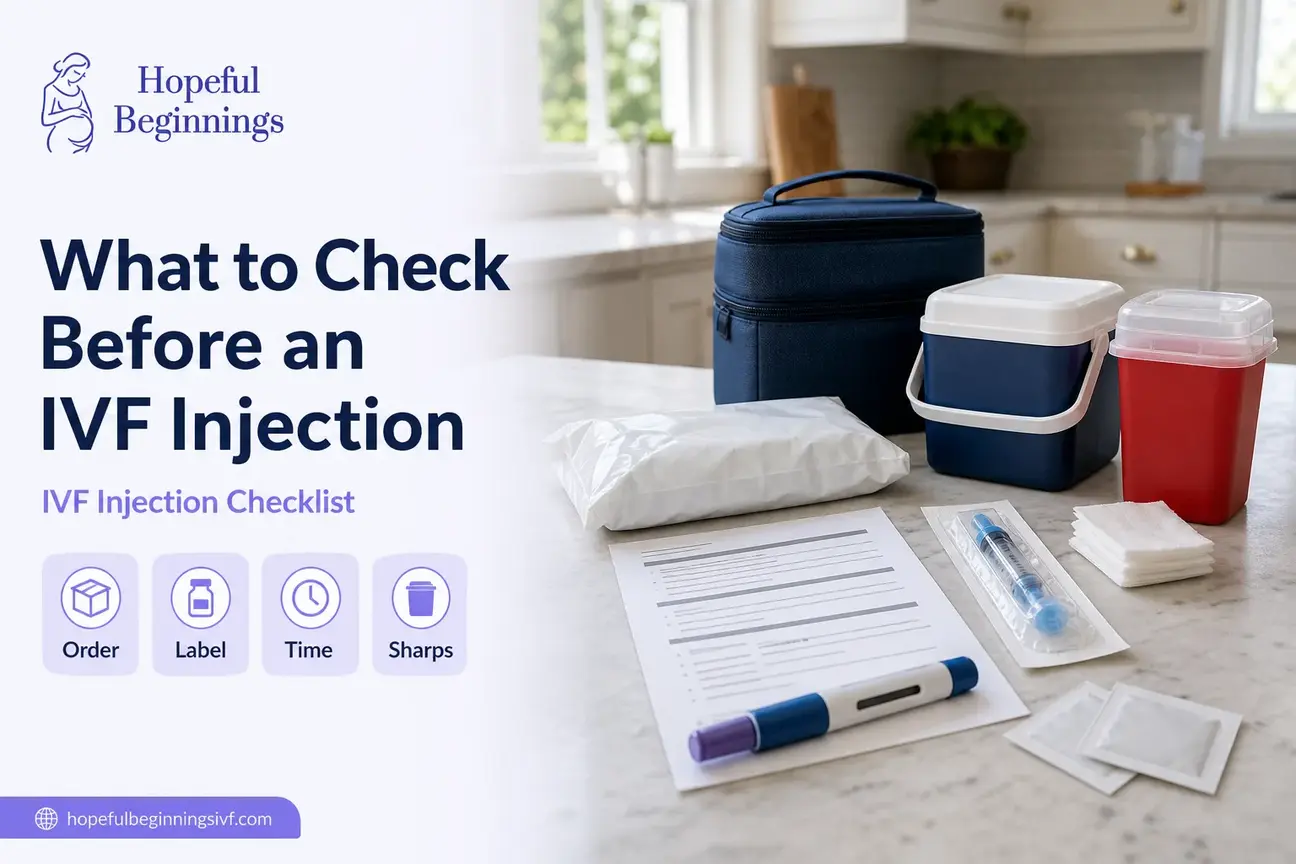
Use the same short routine every time: order, label, expiration, packaging, storage, appearance, preparation, supplies, route, timing and questions. Those injection safety checks are meant to slow the moment down before IVF injection preparation starts, especially when a dose is time-sensitive or you are tired, anxious or doing the shot without a partner.
What is the difference between checking an injection and deciding how to give it?
Checking means confirming that the medication and instructions in front of you match the current order from your prescribing fertility clinic. Deciding means choosing the dose, route, time, preparation method or whether to proceed when something is uncertain. Those decisions belong to the prescribing clinic, not to a checklist, a previous cycle, a package photo or another patient’s routine.
This distinction matters because IVF medication routines can change from one cycle day to the next. Your clinic may adjust the plan based on monitoring, bloodwork, ultrasound findings or the goal of that specific medication. Hopeful Beginnings IVF is not a fertility clinic. Your prescribing fertility clinic diagnoses, prescribes, sets doses, monitors the cycle and performs retrieval or transfer. Hopeful Beginnings provides in-home injection support for medications your clinic has already prescribed.
For general IVF context, ReproductiveFacts explains the in vitro fertilization treatment process, including the role of medications used to stimulate the ovaries and support the cycle, but your own clinic’s written instructions control your individual plan. Use patient education from trusted sources as background, not as a replacement for your current order from the clinic.
A practical way to think about it: you may verify that the vial name matches the order, that the route says subcutaneous or intramuscular, and that the scheduled time is the one your clinic gave you. You should not independently recalculate the dose, switch the route, move the time, use a different component or decide that questionable medication is “probably fine.” A medication check confirms; it does not prescribe.
The IVF injection checklist: 11 essential safe checks
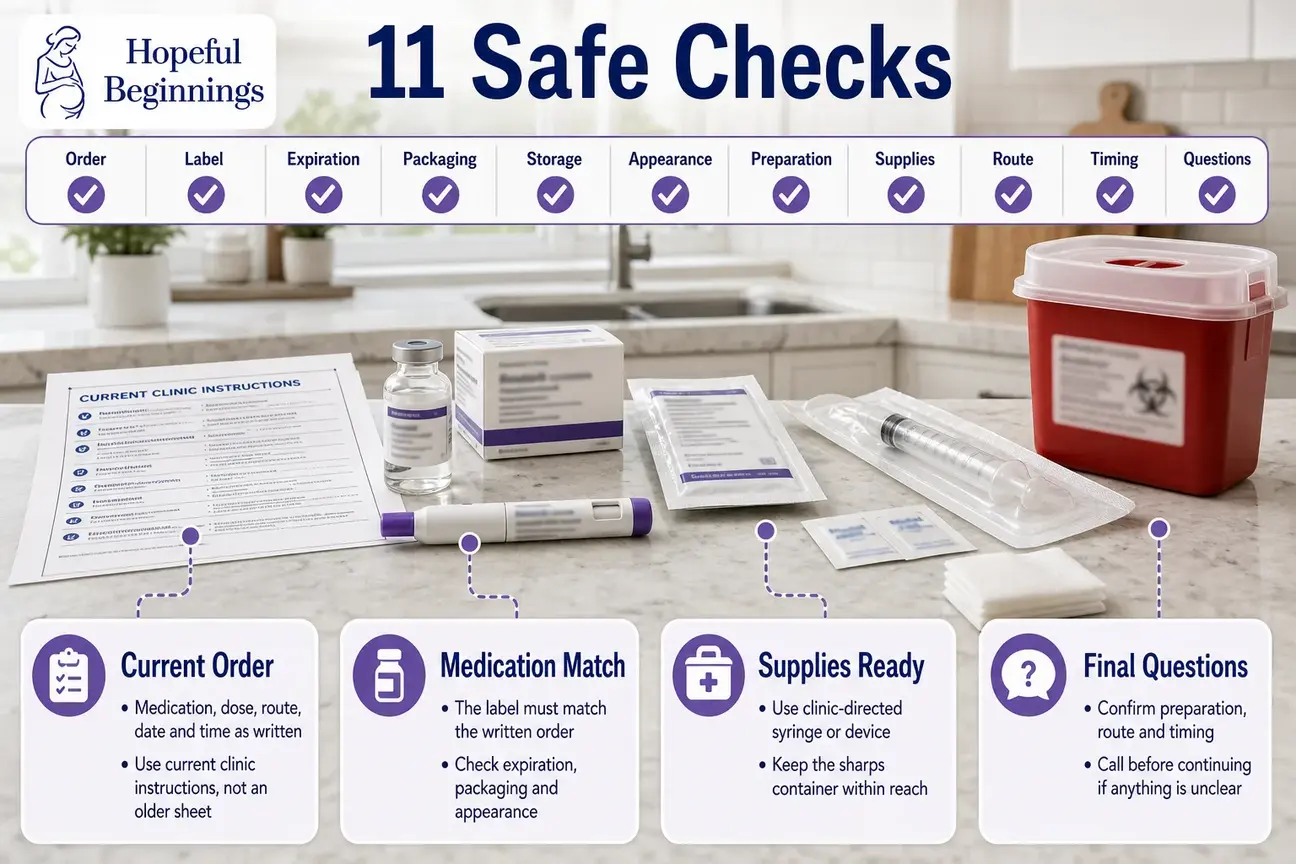
Use this IVF injection checklist as a calm pause before fertility medication preparation. It is intentionally focused on verification, not dosing advice. Keep your clinic’s written instructions visible and check each line before opening, mixing or injecting anything.
| Check | What to verify | Stop and call if… |
|---|---|---|
| Written order | Medication, formulation, dose as written, route, date, time and preparation instructions | The order is missing, outdated, conflicting or unclear |
| Medication identity | Name, strength or concentration, dosage form and matching components | The label does not match the written order |
| Expiration | Product and relevant components are in date | The date is expired, unreadable or absent |
| Packaging | Seals, vial, ampule, syringe, device, diluent and container are intact | Anything is leaking, cracked, punctured, open or appears tampered with |
| Storage history | The labeled storage conditions were followed as far as you know | Heat, freezing, light exposure or time outside the labeled range is possible or unknown |
| Appearance | The medication looks the way the product labeling and clinic instructions say it should | You see unexpected particles, discoloration, cloudiness, crystals, leakage or damage |
| Preparation | Required diluent, mixing step, reconstitution step or device step is clearly described | A component is missing or the instructions conflict |
| Supplies | Clinic-directed syringe, needle or device, skin-prep supplies, gauze if directed and sharps container | A required supply is missing or you are unsure what equipment your clinic intended |
| Route | Subcutaneous or intramuscular as prescribed, with the clinic-directed site | The route or site is uncertain |
| Timing | Exact clinic-directed time or time window for this medication and cycle day | The dose is late, the time is unclear or instructions conflict |
| Questions | Clinic after-hours instructions and pharmacy contact information are available | No safe answer can be confirmed before the dose |
How do you check the written clinic order?
The written clinic order is the anchor for every medication check. Before IVF injection preparation starts, read the current instructions from your prescribing fertility clinic, not an older message, a printed sheet from a prior cycle or a memory of what happened last time. If your clinic updated the plan, use the most current instruction.
Look for the medication name and formulation, the prescribed dose exactly as written, the route, the injection site if specified, the date, the scheduled time and whether the medication is single-dose, multi-dose or part of a sequence. If the order says the medication requires reconstitution, dilution or another preparation step, confirm that the matching instructions are present before you begin.
Do not independently recalculate or reinterpret the dose. If the prescription label, pharmacy label and clinic message do not seem to agree, that is a stop signal. Call the prescribing clinic or dispensing pharmacy and describe exactly what you see. A careful medication check should slow the process down before a mistake is possible.
If a partner is helping, read the order aloud together. One person can point to the instruction while the other reads the label. This simple “read-back” habit can make injection safety checks feel less rushed, especially during evening or time-sensitive medication windows. It also gives both people a shared way to pause before IVF injection preparation continues.
Medication check: how to verify the label and packaging
A medication check starts with identity. Compare the medication name, strength or concentration, dosage form and formulation with the clinic order. Fertility medications may come as vials, prefilled syringes, pens, ampules, cartridges, diluents or multiple components packaged together. Similar packaging is not enough; the label must match the order.
Use the exact product label and the pharmacy label together. The pharmacy label may show patient-specific dispensing information, while the manufacturer labeling describes product-specific handling, appearance and preparation. DailyMed is a public source for FDA-approved drug labeling, and the DailyMed drug labeling database can help patients and clinicians search for the exact medication, formulation and label when the product name is known. Because the database itself is general, use the label for the exact product you were dispensed, not a similar medication or a different formulation.
Inspect the packaging before you open anything. Check that seals are intact, containers are not cracked, the syringe or device is not leaking and the package does not look punctured, crushed or tampered with. If any part of the medication package looks damaged, stop and ask the clinic or pharmacy whether it should be used.
Do not substitute a similar-looking vial, a different diluent or a component from another package unless your prescribing clinic or dispensing pharmacy specifically tells you to do so. Some products require a matching component, and an apparently small mismatch can matter. Repeating the same medication check before each dose helps you catch those differences before fertility medication preparation begins.
Injection safety checks for expiration and storage history
Injection safety checks should include the expiration date on the medication and any relevant component. Check the date before mixing, drawing up or injecting. If the expiration date is past, missing or unreadable, do not assume the medication is usable. Contact the prescribing clinic or dispensing pharmacy.
Storage history is just as important. Product labeling controls whether a medication is stored refrigerated, at room temperature, protected from light or handled another way. Because requirements vary by product, avoid applying a universal rule to every fertility medication. If a medication may have overheated, frozen, sat out longer than allowed, been exposed to direct light or had an unknown storage history, stop and ask for guidance.
Some medications have different instructions before and after mixing or reconstitution. A product may also have a discard instruction after a certain condition is met, but those details are medication-specific. The safe approach is to look at the exact product labeling and the clinic order. If the two are confusing or incomplete, call before proceeding.
A useful fertility medication safety habit is to write down what you know about storage when something unusual happens. For example, note when a shipment arrived, whether ice packs were still cold if included, how long the package sat out and whether you noticed heat, freezing or moisture. Give that information to the clinic or pharmacy rather than deciding on your own.
These injection safety checks do not need to be dramatic or complicated. They simply ask, “Is this the right medication, in usable condition, handled the way the label requires?” That question belongs before IVF injection timing, not after the medication has already been mixed or administered.
What should the medication look like?
There is no single appearance rule for every IVF medication. Some products are supplied one way, some are mixed before use, and appearance standards differ by product and formulation. The correct reference is the exact product labeling and your clinic’s instructions.
Before IVF injection steps continue, pause and look for unexpected changes: particles, flakes, crystals, discoloration, unusual cloudiness, visible contamination, leakage, cracks or damage to the vial, syringe, ampule or device. If the medication has been mixed, check whether the mixed product looks the way the product directions say it should.
Do not try to “fix” questionable medication by filtering it, diluting it, shaking it more, warming it without instructions or transferring it to another container. If the appearance does not match the label or you are unsure what normal looks like, stop and contact the prescribing clinic or pharmacy.
This is one area where a pause can protect you from guessing. Your clinic may ask for the medication name, lot information, expiration date, storage history and what you are seeing. They may also direct you to the dispensing pharmacy for product-specific guidance. A medication check is especially helpful here because it gives you clear details to report instead of a vague concern.
Fertility medication preparation: what requirements should be confirmed?
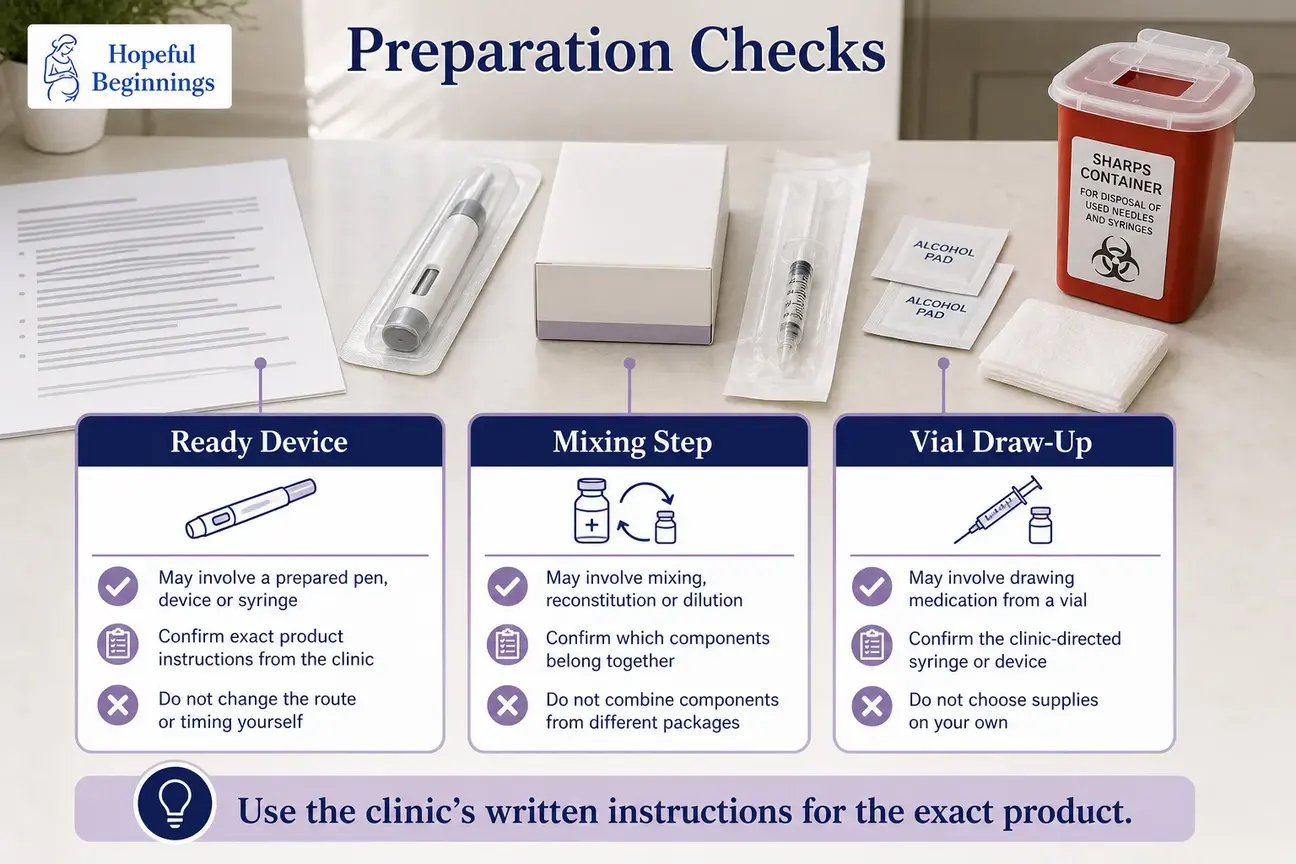
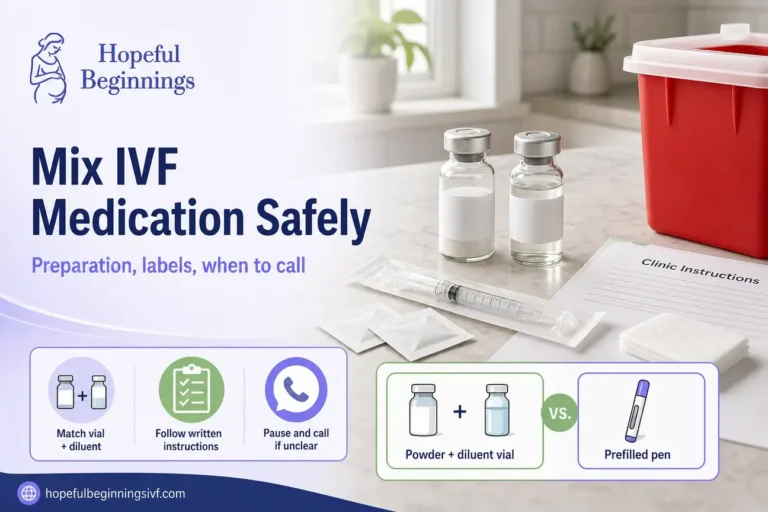
Fertility medication preparation can involve very different steps depending on the medication your clinic prescribed. Some products may be ready to administer in a device or syringe; others may require mixing, reconstitution, dilution or drawing medication from a vial. This article does not replace product-specific teaching from your clinic.
Before preparation begins, confirm which components belong together. If a diluent is required, verify that it is the one supplied or directed for that medication. Check whether the clinic provided written instructions for the exact product, including any order of steps, timing after mixing or discard instruction. Do not combine components from different packages unless your clinic or pharmacy specifically directs it.
MedlinePlus patient instructions for giving yourself a shot describe general preparation concepts, including having supplies ready and following instructions, but product-specific fertility medication preparation still comes from your prescribing clinic and the medication label. If the steps are unclear, stop and ask rather than trying to learn a medication-specific process from memory or a generic video.
Hopeful Beginnings IVF can help with prescribed medication preparation and administration during an in-home visit. A licensed medical professional can review the clinic’s orders, prepare the medication as prescribed and provide comfort coaching, but the clinic remains the source for protocol decisions. Learn more about what a visit may include on the fertility injection service page.
What should be ready before preparation begins?
A good setup reduces last-minute scrambling. Place your current written clinic instructions where you can see them. Gather only the medication and components your clinic directed for that dose. Add the clinic-directed syringe, needle or administration device, skin-preparation supplies if instructed, gauze or a small dressing if directed and a sharps container.
The point is not to build a large supplies station. The point is to confirm that the supplies match the route and medication your clinic prescribed. Do not choose a needle size, syringe size, injection site or substitute device on your own. If the supply list seems incomplete or does not match the medication package, call the clinic or pharmacy before continuing.
Choose a clean, stable preparation surface with good lighting. Wash hands as your clinic instructed. Keep pets, food, clutter and distractions away from the immediate preparation area. If a partner is helping, decide who will read the instructions, who will handle supplies and who will watch the time. This setup is part of fertility medication preparation, not a separate chore.
Sharps readiness is part of injection safety checks. The FDA says used sharps should be placed in a sharps disposal container immediately after use, and its guidance on the best way to get rid of used needles and other sharps says not to put loose needles or other sharps in household trash or recycling. The FDA also says used needles and sharps should never be flushed down the toilet. Use an FDA-cleared sharps container if possible and follow community guidance for final disposal.
Before IVF injection timing: how do route and schedule fit into the checklist?
Before IVF injection timing arrives, confirm the route and schedule from the current clinic order. Route means how the medication is given, such as subcutaneous or intramuscular. Timing means the exact time or time window your clinic directed for that medication and cycle day.
Do not infer the route from the medication name, the needle, the package, a prior cycle or another patient’s instructions. A subcutaneous stimulation medication, an antagonist, a trigger medication and progesterone-in-oil can involve different routes and preparation expectations. Your clinic’s current written order controls what applies to you.
Timing can be especially important for certain medications, including trigger medications. If preparation is delayed, the time is uncertain or you realize the dose may be late, contact the clinic’s after-hours line promptly. Do not move the injection earlier or later, skip it, repeat it or double it unless your prescribing clinic specifically instructs you.
For patients who want help understanding their prescribed injection schedule or practicing the clinic-taught process, Hopeful Beginnings offers injection plans that can include one-on-one instruction for patients or partners. Evening, weekend and holiday appointments may be scheduled around clinic-directed dosing times, including after-10 p.m. appointments when booked. Call for pricing; after-10 p.m. and holiday visits are priced separately.
When should you stop and call the prescribing clinic?
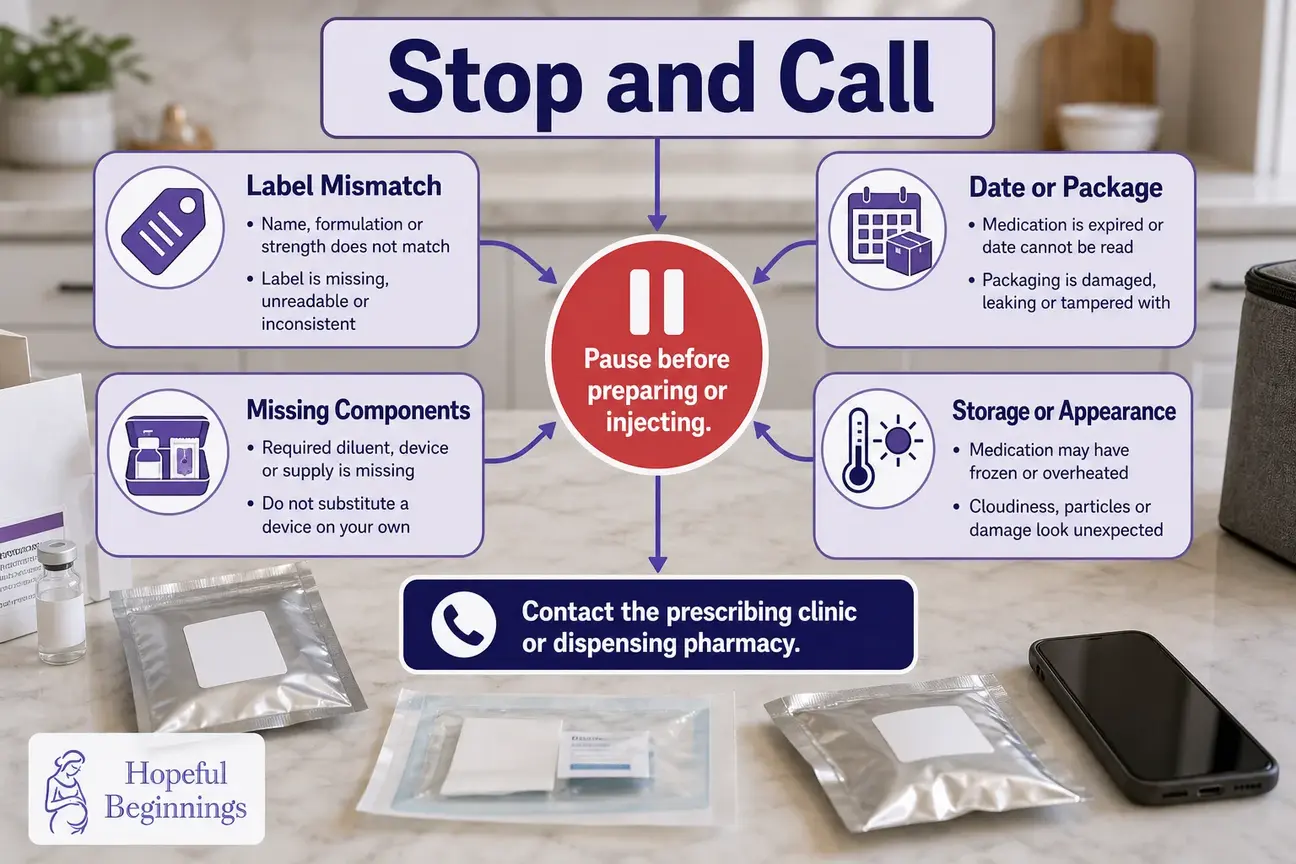
Stop and contact the prescribing clinic or dispensing pharmacy before preparing or injecting if the medication name, formulation, strength or concentration does not match the written order. Also stop if the label is missing, unreadable or inconsistent with the clinic instructions.
Call before proceeding if the medication is expired, the expiration date cannot be read, packaging is damaged, a seal is broken, a vial or syringe is leaking, or anything appears punctured or tampered with. Do the same if a required component, diluent, device or clinic-directed supply is missing.
Storage questions are also stop signals. If the medication may have frozen, overheated, been exposed to direct light or moisture, sat outside labeled conditions or has an unknown storage history, do not guess that it remains usable. Describe what happened and let the clinic or pharmacy advise you.
If the product’s appearance does not match its labeling, stop. Unexpected particles, discoloration, cloudiness, crystals, flakes, contamination, cracks or leakage should be reported before use. Do not filter, dilute, warm, shake or transfer questionable medication unless the clinic or pharmacy tells you to.
If the route, site, timing or preparation instructions are unclear, stop and call. If a dose was spilled, dropped, partially lost or already administered uncertainly, call the clinic right away and do not guess, repeat or double up. If you are unsure whether an injection was given, the clinic should guide the next step.
It can help to keep a short “call before continuing” list with your supplies. Put medication mismatch, damaged package, questionable storage, changed appearance, missing component, unclear route, unclear timing and spilled dose on that list. That turns your medication check into a practical decision point: continue only when the clinic’s instructions are clear.
What symptoms need urgent medical attention?
A medication check is different from urgent medical care. If you have severe abdominal pain or swelling, shortness of breath, rapid weight gain, very little urine, chest pain, fainting or signs of an allergic reaction, use your clinic’s after-hours line or seek emergency care, including 911 when appropriate. Do not wait for a home visit for urgent symptoms.
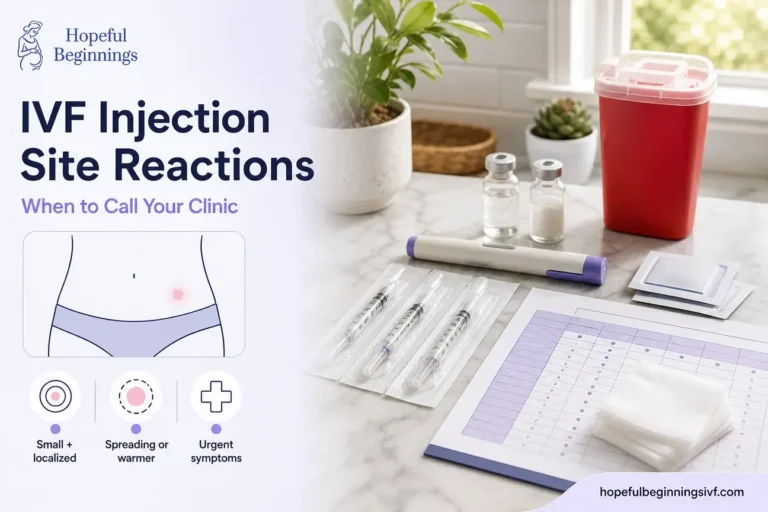
Injection-site concerns should also be taken seriously. Spreading redness, warmth, fever or a hard painful lump should be reported to the prescribing clinic or another clinician. If symptoms feel urgent or severe, follow the clinic’s urgent instructions or seek emergency care.
ReproductiveFacts describes ovarian hyperstimulation syndrome as a possible complication of fertility medications and lists symptoms that can require prompt medical attention. Use your clinic’s instructions for your specific cycle, because they know your medications, monitoring results and risk factors.
How can patients or partners make the routine easier?
The easiest checklist is the one you will actually use. Keep it short, repeatable and tied to the clinic order. Many patients find it helpful to say the same sequence each time: order, label, date, package, storage, appearance, preparation, supplies, route, time, questions.
If a partner is helping, create a two-person pause. One person reads the current order aloud while the other points to the medication label and supplies. Then switch roles for the final time and route check. This does not change the prescription; it simply makes the verification step more visible.
Set up before the scheduled time rather than waiting until the last few minutes. Place the written instructions, medication components, supplies and sharps container together. Confirm that your clinic’s phone number and after-hours instructions are easy to find. If you know you are anxious around needles, build in extra time for breathing, positioning and reassurance.
Hopeful Beginnings IVF serves patients in Cary and Raleigh with home visits across the Triangle for prescribed fertility injection support. If you would like a licensed medical professional to come to your home to prepare and give the injection as prescribed, or to teach you and a partner using your clinic’s instructions, visit in-home fertility injections for more information.
For scheduling questions, you can request an appointment, call 910-200-2337 or email info@hopefulbeginningsivf.com. Have your clinic’s written medication instructions ready when you reach out. Hopeful Beginnings cannot prescribe, change doses, provide emergency care or guarantee appointment availability, but it can support comfort, preparation and on-time administration as prescribed when an appointment is scheduled.
How to keep the checklist from becoming overwhelming
A checklist should reduce stress, not add another layer of fear. If you are already carrying a lot emotionally, focus on the purpose of the pause: matching what your clinic ordered with what is in front of you. You are not expected to become your own pharmacist or fertility clinician.
Use plain words on your personal checkoff sheet. For example: “Does the name match?” “Is it in date?” “Was it stored as labeled?” “Does it look right?” “Do I know the route?” “Do I know the time?” “Do I have the sharps container?” These simple prompts can be easier to follow during a late evening or early morning dose.
If you notice that the same question makes you anxious every night, write it down and ask the clinic in advance. For example, ask what the label should look like, where the expiration date is located, which component belongs with which medication or what number to call after hours. Getting clarification before the next scheduled dose is often less stressful than trying to solve it during the dosing window.
In-home support can also help when a partner is unavailable, the injection is time-sensitive or the preparation steps feel difficult to manage. The benefit is support, comfort, correct preparation and administration as prescribed by the clinic. It is not a guarantee of pregnancy, live birth or IVF success.
When the routine feels like too much, simplify the language without removing the safety pause. A brief medication check, repeated the same way, can be easier to follow than a long page of notes. The goal of injection safety checks is clarity, not perfection.
Final safety note
The final check is simple: if the order, medication, package, storage history, appearance, preparation step, supplies, route or timing does not make sense, pause and contact the prescribing clinic or dispensing pharmacy. Do not guess, substitute, repeat, double up or change the plan without your clinic’s direction.
An IVF injection checklist works best when it is calm, consistent and clinic-centered. Keep the current written order in front of you, use reliable product labeling when needed and ask for clarification early when something does not match. For patients in North Carolina who need in-home support, Hopeful Beginnings IVF can help with prescribed fertility medication preparation and injections when an appointment is scheduled.
This article is for general education and is not medical advice. Follow the written instructions from your prescribing fertility clinic, and contact your clinic before changing any dose, medication, injection time or technique.
Frequently Asked Questions
What is the first thing to check before an IVF injection?
Check the current written order from your prescribing fertility clinic. Compare it with the medication label, formulation, route and scheduled time before opening, mixing or injecting anything.
Can I use fertility medication if the package is damaged?
Stop and ask the prescribing clinic or dispensing pharmacy. Do not assume that a damaged seal, leaking container, cracked vial or questionable package is usable.
What if I do not know whether the medication was stored correctly?
Do not guess. Contact the prescribing clinic or dispensing pharmacy and describe the medication name, what you know about the storage history and any possible heat, freezing, light or moisture exposure.
What should I do if the medication looks different than expected?
Compare it with the exact product labeling and your clinic’s instructions. If the appearance does not match or you see particles, discoloration, leakage or damage, stop preparation and contact the clinic or pharmacy.
How do I know whether an IVF injection is subcutaneous or intramuscular?
The route must come from your clinic’s written instructions and product-specific directions. Do not infer the route from the needle, medication name, package style or a prior cycle.
What if I spill, drop or lose part of a dose?
Call your prescribing clinic right away. Do not guess how much was lost, repeat the injection or double up unless the clinic specifically tells you what to do.
Can Hopeful Beginnings IVF decide whether my medication is still usable?
No. The prescribing clinic or dispensing pharmacy should decide what to do with expired, damaged, improperly stored or questionable medication. Hopeful Beginnings can help prepare and administer prescribed injections when the clinic’s instructions are clear.
Should I keep a sharps container ready before every injection?
Yes. Have a sharps container ready before the injection begins so used needles and syringes can be contained immediately after use, following FDA and local disposal guidance.