


Mix IVF Medication Safely: 8 Essential Home Checks
If you have been told to mix IVF medication at home, the safest starting point is this: there is no universal recipe. Some fertility medications come as a powder that must be combined with a specific diluent, while others arrive in prefilled or ready-to-use formats. Your prescribing fertility clinic’s written instructions and the product’s current labeling control the medication, diluent, timing, handling, storage, and injection method. Hopeful Beginnings IVF can help with medication preparation and injection support at home, but your fertility clinic decides what you take, how much you take, and when you take it.
Quick answer: how to mix IVF medication without guessing
To reconstitute fertility medication means preparing certain powdered products by adding the specific liquid diluent directed for that product. The amount and method are product-specific and are not the same as choosing your prescribed dose. If anything is unclear, spilled, contaminated, unexpected, or different from your written instructions, stop and contact your prescribing clinic or dispensing pharmacy instead of improvising, repeating, or changing a dose.
What does it mean to reconstitute fertility medication?
To reconstitute fertility medication, you are generally taking a medication that is supplied as a powder and adding the designated liquid diluent so it becomes a preparation that can be administered as directed. In everyday language, many patients call this “mixing,” but that word can be misleading. It does not mean casually combining medications, substituting liquids, changing concentration, or adjusting the drawn-up amount.
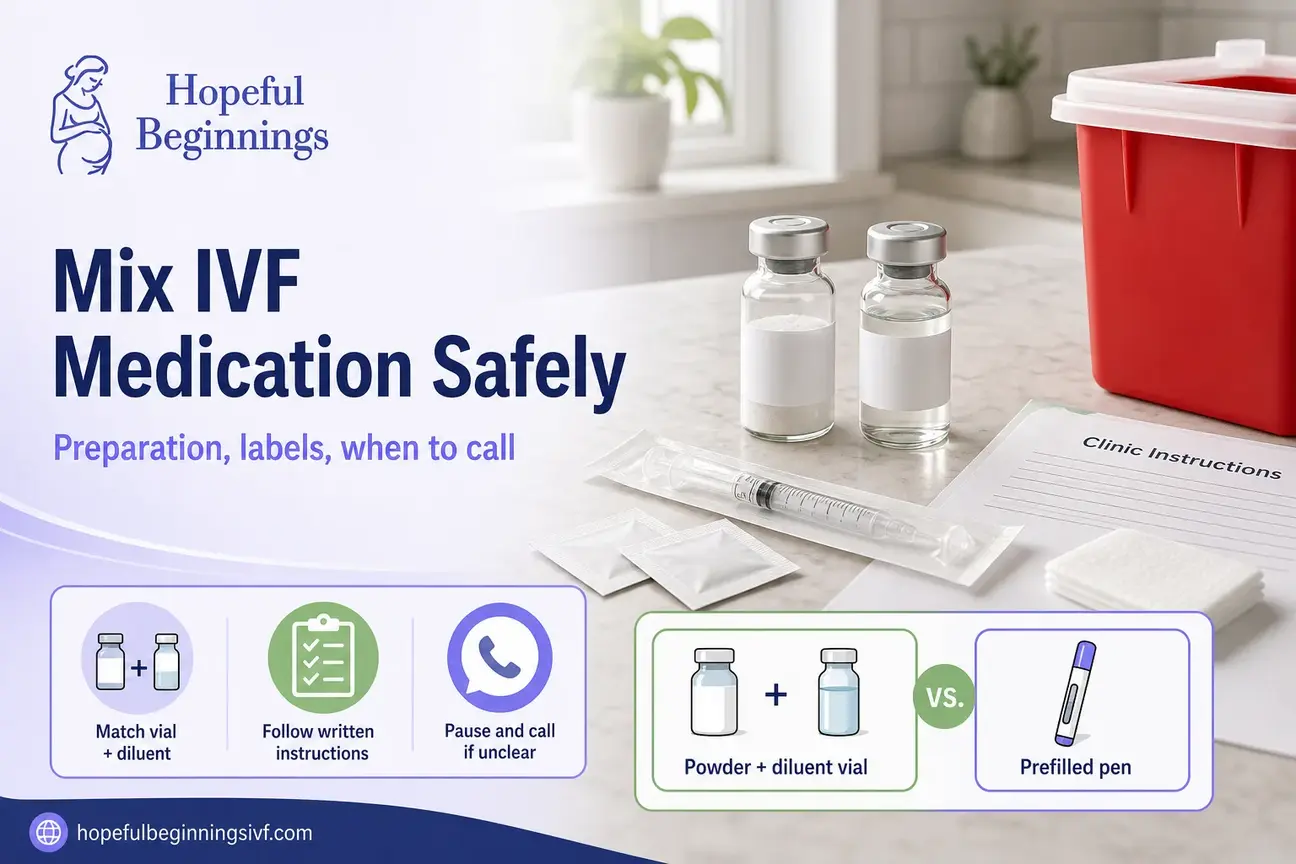
Fertility medications are not all packaged the same way. Some may involve powder-and-diluent vials. Others may be supplied as a liquid, cartridge, prefilled syringe, pen, or other device. The ReproductiveFacts patient education page on medications for inducing ovulation explains that fertility treatment may use medications that affect ovulation, but it does not replace your clinic’s product-specific instructions.
That distinction matters because a powdered IVF medication can have very different preparation directions from a prefilled product. The diluent, appearance after preparation, usable period, handling instructions, and storage rules can vary by medication, manufacturer, strength, and presentation. The safest habit is to treat each prescribed medication as its own set of instructions, not as a general skill you can copy from another medication or another patient.
Hopeful Beginnings IVF provides medication preparation and reconstitution as part of its in-home fertility injection service. During a scheduled visit, a licensed medical professional follows the prescribing clinic’s orders and written instructions. The service does not prescribe medications, choose doses, monitor follicles, or replace your fertility clinic or pharmacy.
Why IVF medication preparation is different from dose selection
IVF medication preparation means making the medication ready to give as prescribed. Dose selection means deciding the medication, amount, concentration, frequency, timing, and protocol. Those are different jobs, and they belong to different people.
Your prescribing fertility clinic diagnoses, prescribes, sets doses, monitors your cycle, and determines the timing of medications. Hopeful Beginnings IVF can prepare and administer the fertility injections your clinic prescribed, and can teach patients or partners how to prepare and give injections. It does not decide which medication should be used, how much should be drawn up, or whether a dose should be repeated after a problem.
| Medication preparation | Dose selection |
|---|---|
| Makes the prescribed product ready for use according to the label and clinic directions. | Determines which medication and amount the patient receives. |
| May involve a vial, a specific diluent, a prefilled device, or other product-specific packaging. | Depends on the treatment plan, monitoring, lab results, and clinic judgment. |
| Follows the product label and the clinic’s written instructions. | Is decided by the prescribing fertility clinic. |
| Should not change the concentration, medication amount, or timing. | Must not be changed by the patient, partner, or home-support provider. |
Never use another patient’s mixing volume, vial count, concentration, drawn-up amount, or calendar as a shortcut. Even if two people are using medications with similar names, the prescribed instructions can differ. If your pharmacy package, product labeling, and clinic handout do not seem to match, pause and ask your clinic or dispensing pharmacy which instruction applies.
Thinking of IVF medication preparation as a safety process can lower the pressure. You are not expected to redesign the plan; you are expected to follow the written plan and ask for help when something is unclear.
8 essential checks before opening anything
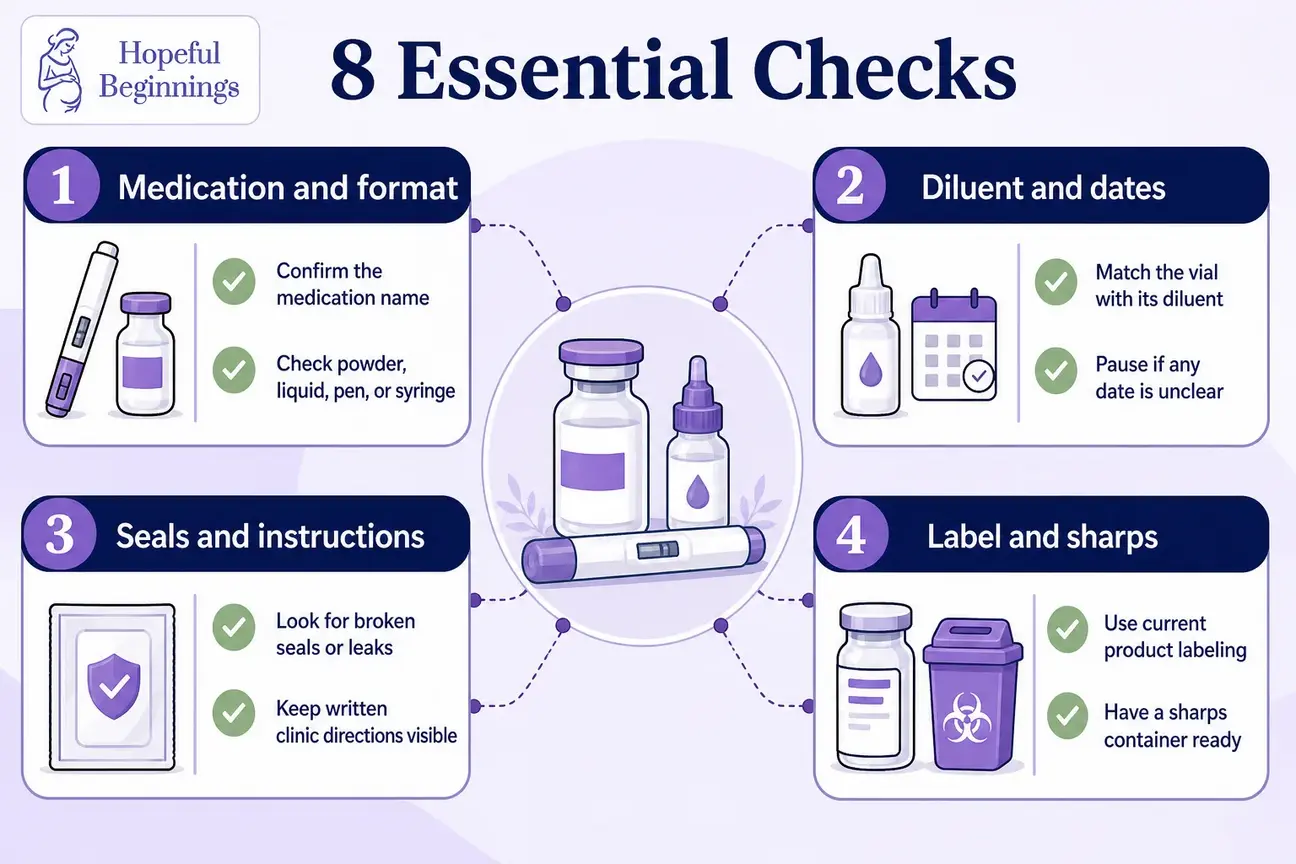
Before IVF medication preparation begins, slow down enough to confirm that the medication and supplies in front of you match your clinic’s written directions. This is not a dose-selection step; it is a preparation safety check. If something does not line up, do not open vials or begin drawing up medication until you have guidance from the clinic or pharmacy.
Check 1: Medication name
Confirm the medication name exactly as written in your clinic’s instructions and on the product packaging. Many fertility medications have similar-looking packaging or similar-sounding names, so read the label rather than relying on memory.
Check 2: Strength and formulation
Check whether the product is a powder, liquid, cartridge, pen, prefilled syringe, or another format. A powdered IVF medication may require a reconstitution step, while a ready-to-use product may have different handling instructions.
Check 3: Vial and diluent identity
Confirm that the diluent belongs with that medication, if a diluent is supplied or directed. Do not substitute a different liquid or borrow a diluent from another product unless your clinic and the product labeling direct that use.
Check 4: Expiration dates
Check the medication, diluent, and supplies before use. If anything is expired or the date is unclear, pause and ask the prescribing clinic or dispensing pharmacy before preparing the medication.
Check 5: Packaging and seal condition
Look for damaged packaging, broken seals, cracked vials, leaking containers, or labels that do not match. Keep the packaging available if you need to call the clinic or pharmacy with a question.
Check 6: Written clinic instructions
Keep the clinic’s medication schedule and preparation directions in front of you. Do not rely on a screenshot from an older cycle, another patient’s directions, or a video that does not match your clinic’s written plan.
Check 7: Product-specific labeling
Use the current product label for handling, storage, appearance, and administration information. For product-specific information, DailyMed provides FDA labeling information for prescription and over-the-counter drugs. DailyMed can be useful when you and your clinic or pharmacy are identifying current product labeling, but it is not a substitute for individualized instructions from your prescribing fertility clinic.
Check 8: Sharps plan
Have a sharps container ready before any needle or syringe is used. This helps avoid scrambling after the injection and lowers the chance that a used sharp is set down loose on a counter or placed somewhere unsafe.
Do not assume a universal syringe size, needle size, diluent volume, number of vials, withdrawal method, or injection volume. Those details depend on the product and prescription. If the clinic’s instructions say one thing and a supply bag appears to contain something different, ask before proceeding.
These checks are especially important with fertility medication mixing because the medication name, diluent, and packaging may look familiar from another cycle while the actual instructions have changed. Treat each day’s medication set as a fresh review.
How fertility medication mixing works with vials and diluent
Fertility medication mixing sometimes involves a vial of powdered medication and a separate diluent. The diluent is the liquid used to prepare that medication. The product label and the prescribing clinic’s written directions determine which diluent is appropriate, how it is used, whether one or more vials are involved, and whether the prepared medication should be used right away or handled in a specific way.
It is not safe to substitute sterile water, saline, or another liquid unless the product labeling and prescribing clinic specifically direct that product and use. “It looks similar” is not enough. The wrong diluent or wrong preparation can make the medication unusable or require a clinic-specific decision about what to do next.
The same caution applies to vial counts and concentration. A patient should not decide to use an extra vial, less diluent, more diluent, or a different amount because a video, friend, online forum, or previous cycle seemed to show that method. Your clinic’s written instructions and the product labeling control the preparation.
Fertility medication mixing is also not the same thing as combining multiple medications together. Unless the label and your clinic’s written directions specifically say to combine products, keep each medication process separate and ask before changing the sequence.
When Hopeful Beginnings IVF provides in-home fertility injections, the clinician asks patients to have the clinic’s written medication instructions available. The purpose is to prepare and administer what the fertility clinic prescribed, not to reinterpret or redesign the medication plan.
What to know about powdered IVF medication and product labels
A powdered IVF medication can feel intimidating because there is an extra preparation step before the injection. The powder may need to be reconstituted, but the exact process is not interchangeable from product to product. Some labels may describe a specific diluent, handling technique, appearance, storage requirement, or time window after preparation. Others may use a different delivery system entirely.
Because the exact label matters, patients should avoid product-specific assumptions. Do not infer that a powder should dissolve in a certain number of seconds, that every finished preparation should look identical, or that a delayed dose can still be used. Those questions depend on the medication, the instructions, and sometimes the pharmacy’s guidance.
If you are trying to reconstitute fertility medication and the product does not behave as expected, do not “fix” it by heating, shaking vigorously, adding more liquid, filtering, straining, or remaking it on your own. Keep the medication, packaging, and supplies available so the clinic or pharmacy can help identify what happened.
A powdered IVF medication may also have instructions about how it should be stored before preparation and how it should be handled after preparation. Follow the medication label and clinic directions rather than copying storage habits from a different medication in the same cycle.
Some patients find that the mechanics of IVF medication preparation are manageable once someone calmly walks through the labels and the sequence with them. Hopeful Beginnings offers injection teaching for patients or partners who want one-on-one instruction for prescribed fertility injections, including preparation steps when those steps are part of the clinic’s written plan.
Are prefilled products part of fertility medication mixing?
Not every fertility medication is a powder-and-diluent vial. Some products come in prefilled devices, cartridges, pens, or other ready-to-use formats. A ready-to-use product should still be handled exactly as its label and your clinic direct. “Ready to use” does not mean “safe to open, dilute, transfer, or combine.”
Prefilled products should not be opened, emptied into another syringe, diluted, combined with another medication, or used differently unless the product labeling and prescribing clinic specifically instruct that action. If you are unsure whether a product is prefilled, already prepared, or still requires a step before use, stop and ask your clinic or dispensing pharmacy.
This is one reason fertility medication mixing should be discussed medication by medication. A patient may use one product that requires reconstitution and another that should never be transferred or diluted. The safest routine is to read the label, compare it to the clinic’s written instructions, and call before acting on assumptions.
If your medication schedule includes both a powdered IVF medication and a prefilled product, keep them physically separated until you are ready to review each instruction. That simple setup can help prevent accidental transfers, wrong-supply use, or mixing steps being applied to the wrong product.
What should the prepared medication look like?
The acceptable appearance of a prepared medication is product-specific. Some instructions may describe what the solution or suspension should look like; others may include different language. Follow the product label and clinic instructions rather than relying on a general rule such as “clear is always fine” or “cloudy is always wrong.”
That said, certain findings should make you pause until the clinic or pharmacist confirms what to do. Do not inject an uncertain product just because the dosing time is close. Do not discard and remake it unless the clinic or pharmacy tells you to do so.
| What you notice | What to do |
|---|---|
| The solution remains cloudy when the label says it should be clear. | Pause and contact the prescribing clinic or dispensing pharmacy before using it. |
| You see unexpected particles, flakes, crystals, discoloration, or separation. | Do not filter, strain, heat, add liquid, or inject unless instructed. |
| The vial, diluent, label, seal, or package appears damaged. | Keep the package available and ask the clinic or pharmacy how to proceed. |
| The amount of liquid or powder does not match the written directions. | Stop before mixing or injecting and call for clarification. |
| The product does not dissolve or prepare as expected within the label’s instructions. | Do not shake vigorously or improvise; contact the clinic or pharmacy. |
| You are unsure whether the correct medication or diluent was used. | Do not inject it or prepare another dose on your own. Call promptly. |
If you are uncertain after preparation, use this practical rule: if you are not sure what you mixed, how much was used, whether it was contaminated, or whether it was stored correctly, do not inject it and do not prepare another dose on your own. Contact your prescribing fertility clinic’s regular or after-hours instructions promptly.
Appearance questions are common during IVF medication preparation, especially when a patient is handling a product for the first time. A quick call for clarification is safer than trying to make a product look “right” through extra steps that were not prescribed.
What if medication spills, drops, or the preparation seems wrong?
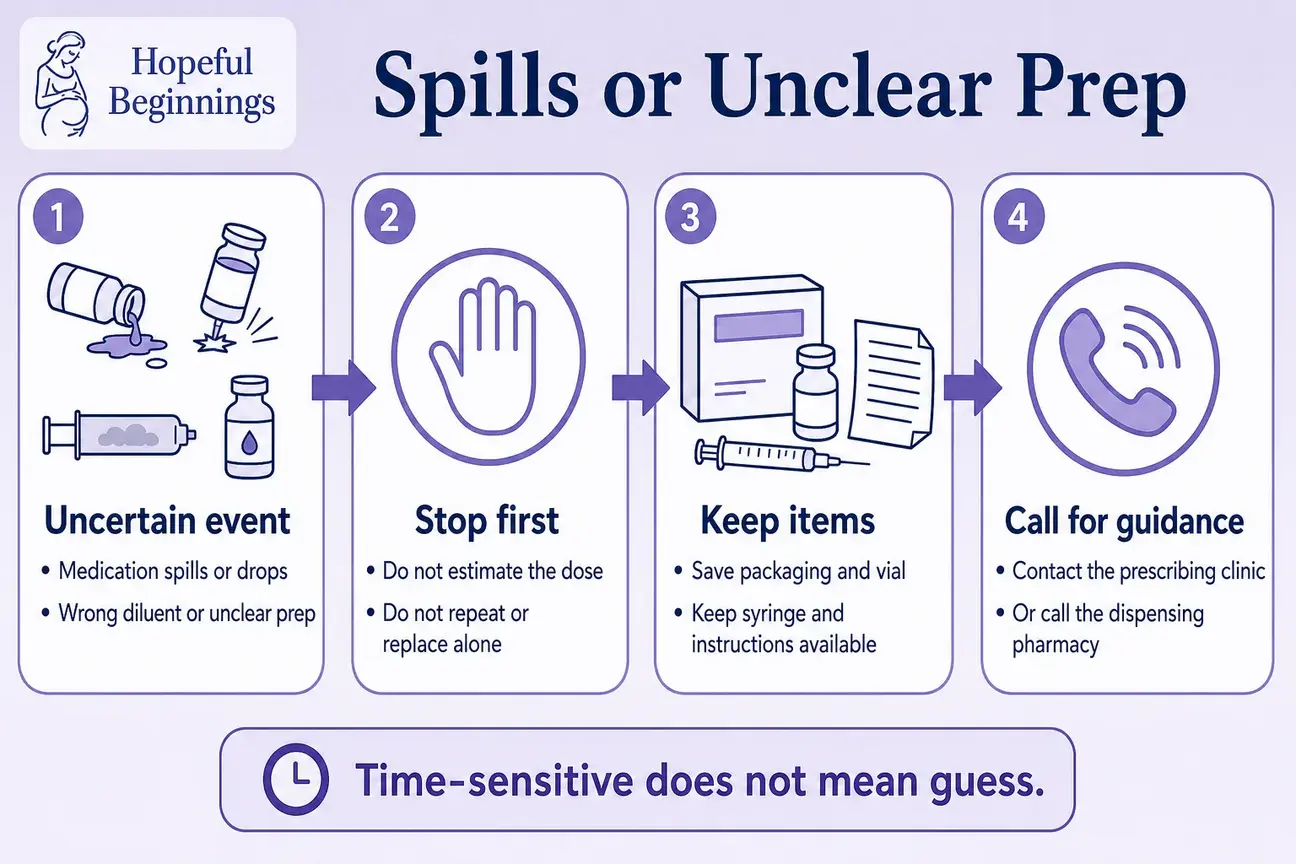
Spills and preparation errors are stressful because IVF medications are often time-sensitive and emotionally loaded. Still, the next step is not to estimate, replace, or repeat the dose on your own. A spill, dropped vial, contaminated syringe, wrong diluent, incorrect volume, or uncertain preparation should be treated as a reason to stop and call the prescribing clinic or dispensing pharmacy.
Keep the medication, packaging, vial, syringe, and written instructions available if it is safe to do so. The clinic or pharmacy may need to know exactly what product was involved, what step had already happened, and how much uncertainty there is. The response may depend on the medication, timing, amount involved, and product labeling.
- Do not guess how much medication was lost.
- Do not draw up a replacement amount unless your clinic instructs you to do so.
- Do not repeat the preparation on your own.
- Do not repeat the injection or double a later dose unless your clinic directs it.
- Do not use a product if you are unsure whether it was contaminated.
If a problem happens while trying to reconstitute fertility medication, the safest next step is the same: pause, preserve the information, and contact the clinic or pharmacy. Do not try to correct a preparation error by changing diluent, changing volume, or preparing an extra dose.
If a needle or syringe is involved, the FDA guidance on safely using sharps at home, work, and travel says used sharps should be placed immediately in a sharps disposal container and should not be placed loose in household or public trash cans or recycling bins. This sharps guidance supports disposal safety; it does not tell you whether a fertility dose can be salvaged.
The FDA’s DOs and DON’Ts of proper sharps disposal also says to use an FDA-cleared sharps container if possible, follow community guidelines for getting rid of a sharps container, and not try to remove, bend, break, or recap needles used by another person. If local disposal rules differ by program, follow current community guidance.
What if preparation makes a dose late?
Medication preparation and administration may need to happen in relation to a clinic-specified dosing time. Some fertility injections are especially time-sensitive, including trigger medications, but your clinic’s instructions control timing. Do not independently move an injection time because mixing took longer than expected.
If preparation is delayed, the dose is late, medication spills, or you are unsure whether the medication was prepared or given correctly, contact the prescribing clinic promptly. Do not guess, skip, repeat, or double the dose unless the clinic tells you to do so. If the clinic has an after-hours line for medication timing questions, use the clinic’s instructions for reaching it.
Urgent symptoms are different from preparation uncertainty. Severe abdominal pain or swelling, shortness of breath, rapid weight gain, very little urine, chest pain, fainting, or signs of an allergic reaction require the clinic’s after-hours line or 911/emergency care. Do not wait for an in-home appointment for urgent symptoms.
For general injection concepts, MedlinePlus patient instructions on giving injections can help patients understand why training and clean technique matter. IVF medication preparation, however, remains product-specific and clinic-directed.
How should you organize supplies for IVF medication preparation?
A calm setup can make IVF medication preparation easier, especially on nights when the timing feels tight. Choose a clean, uncluttered surface; keep the clinic’s written instructions visible; and group each medication with its matching supplies. Do not mix supplies from different medications unless your clinic’s instructions clearly direct that setup.
For a powdered IVF medication, keep the powder vial, matching diluent, pharmacy label, and any product instructions together. For a prefilled product, keep the device and its instructions separate from powder-and-diluent materials so you do not accidentally apply a reconstitution step to a ready-to-use item.
Many preparation problems happen when patients are tired, rushed, or trying to remember instructions from memory. Before fertility medication mixing begins, take a moment to read the medication name and the written directions out loud or have your support person read them with you. If either person notices a mismatch, pause and call for clarification.
This organization is not about perfection. It is about creating enough order that you can notice when something does not match your clinic’s plan.
What to prepare for injection teaching or an in-home visit
If you want help with IVF medication preparation, an organized setup makes the teaching visit calmer. Keep the medication, diluent, supplies, pharmacy labels, and clinic instructions together. If your partner or another support person may give injections later, include that person in the teaching session when possible.
Before a scheduled visit, write down the part that feels uncertain. Some patients are comfortable with the injection but unsure how to read the vials. Others understand the reconstitution step but feel anxious drawing up the prescribed amount. Some want a partner to learn the process, while others prefer a licensed medical professional to prepare and administer the injection in their home.
During an injection-teaching appointment, the clinician can walk through the clinic’s written instructions, identify the medication and supplies, discuss preparation steps that apply to the prescribed product, and provide comfort-focused guidance. The clinician cannot decide to change a dose, substitute a diluent, alter timing, or tell you to repeat a dose after an error without your clinic’s direction.
- Have your clinic’s current written medication instructions available.
- Keep each medication with its own label, diluent, and supplies.
- Do not open or mix anything early unless your clinic instructions direct that timing.
- Ask what to do if a vial, package, or solution looks different than expected.
- Ask how to reach the clinic for medication questions after regular hours.
- Have a sharps container ready before the injection begins.
Hopeful Beginnings IVF also supports prescribed stimulation injections, progesterone-in-oil injections, and trigger injections as part of its scheduled home services. The specific medication, dose, route, and timing still come from your prescribing clinic.
Local in-home support for Cary and Raleigh patients
For patients in Cary, Raleigh, and across the Triangle in North Carolina, Hopeful Beginnings IVF offers scheduled in-home injection support for prescribed fertility medications, including medication preparation, reconstitution, injection administration, and patient or partner teaching. Appointments may be scheduled around clinic-directed dosing times, including evening, weekend, after-10 p.m., and holiday appointments, but Hopeful Beginnings does not set the dose or timing.
If you would like help preparing or giving a prescribed IVF injection at home, request an appointment, call 910-200-2337, or email info@hopefulbeginningsivf.com. Have your prescribing clinic’s written medication instructions ready. Call for pricing; after-10 p.m. and holiday visits are priced separately.
You can also review Hopeful Beginnings’ general IVF injections service information and flexible injection scheduling options if your clinic has given you a time-sensitive injection plan. These services are meant to support comfort, correct preparation as prescribed, and precise timing according to the clinic’s instructions. They are not fertility clinic services and do not improve or guarantee pregnancy, live birth, or IVF success rates.
Safety note before preparing any fertility medication
The safest response to uncertainty is to pause. If the medication, diluent, amount, appearance, storage, timing, or injection instructions are unclear, contact your prescribing fertility clinic or dispensing pharmacy before proceeding. If a dose is missed, late, spilled, contaminated, or uncertain, call your clinic promptly and do not guess, repeat, or double up.
Whether you are learning fertility medication mixing for the first time or reviewing a new medication later in your cycle, the key is the same: follow the product label and the clinic’s written instructions. Ask for help before opening or injecting anything that does not match.
When you need to mix IVF medication, support can make the process feel less rushed and more organized, but it does not replace your clinic’s medical decisions. Hopeful Beginnings IVF can help with in-home preparation, teaching, and injection administration for prescribed fertility medications, while your clinic remains responsible for the treatment plan.
This article is for general education and is not medical advice. Follow the written instructions from your prescribing fertility clinic, and contact your clinic before changing any dose, medication, injection time or technique.
Frequently Asked Questions
What does it mean to reconstitute fertility medication?
It means preparing certain powdered medications by combining them with the specific diluent and following the product’s instructions. The exact method depends on the medication and the prescribing clinic’s written directions.
Is reconstituting medication the same as choosing my IVF dose?
No. Reconstitution prepares the prescribed product for use. The prescribing fertility clinic decides the medication, dose, timing, and protocol.
Can I use a different diluent if I run out of the supplied one?
Do not substitute a liquid on your own. Contact the prescribing clinic or dispensing pharmacy for product-specific instructions.
What should I do if the mixed solution is cloudy or has particles?
Pause and do not inject it until the prescribing clinic or pharmacist confirms what to do. Do not filter, strain, add liquid, or remake the dose independently.
What if I accidentally spill part of the medication?
Do not estimate the amount lost or repeat the dose. Contact the prescribing clinic promptly and follow its instructions.
Can I prepare a prefilled IVF medication differently?
No. Follow the product label. Do not open, dilute, transfer, or combine a prefilled product unless the labeling and clinic specifically direct that action.
What if I am unsure whether I prepared or injected the medication correctly?
Contact the prescribing clinic’s regular or after-hours line. Do not repeat or double the dose unless the clinic instructs you to do so.
Can someone help me mix and administer my IVF medication at home?
Hopeful Beginnings IVF offers scheduled in-home medication preparation, injection support, and teaching for patients or partners using medications prescribed by their fertility clinic. The service does not prescribe medication or determine doses.