


Spilled IVF medication: 7 Essential Safe Actions if Overheated or Dropped
If you are dealing with spilled IVF medication, a dropped vial, a pen left in heat, a frozen medication, or a prepared dose that may be contaminated, pause before using it. Quick Answer: preserve the medication and packaging when it is safe to do so, do not inject the affected product, and call your prescribing fertility clinic or dispensing pharmacy for product-specific instructions. Do not guess, double up, repeat an injection, change the dose, or independently replace or discard medication. If the scheduled dose time is close, tell the clinic both facts: the product may be compromised and the injection may become late.
This kind of moment feels stressful because IVF injections are time-sensitive, costly, and emotionally loaded. But a spill, drop, heat exposure, freezing event, leak, cracked container, or questionable preparation is not something to solve by appearance alone. A clear liquid can still have an uncertain storage history, and a package that looks mostly intact may still need a product-specific decision. Your clinic and pharmacy are the right places to determine what happens next because they can match the medication, formulation, prescription, timing, and cycle plan.
Spilled IVF medication: what are the 7 essential safe actions?
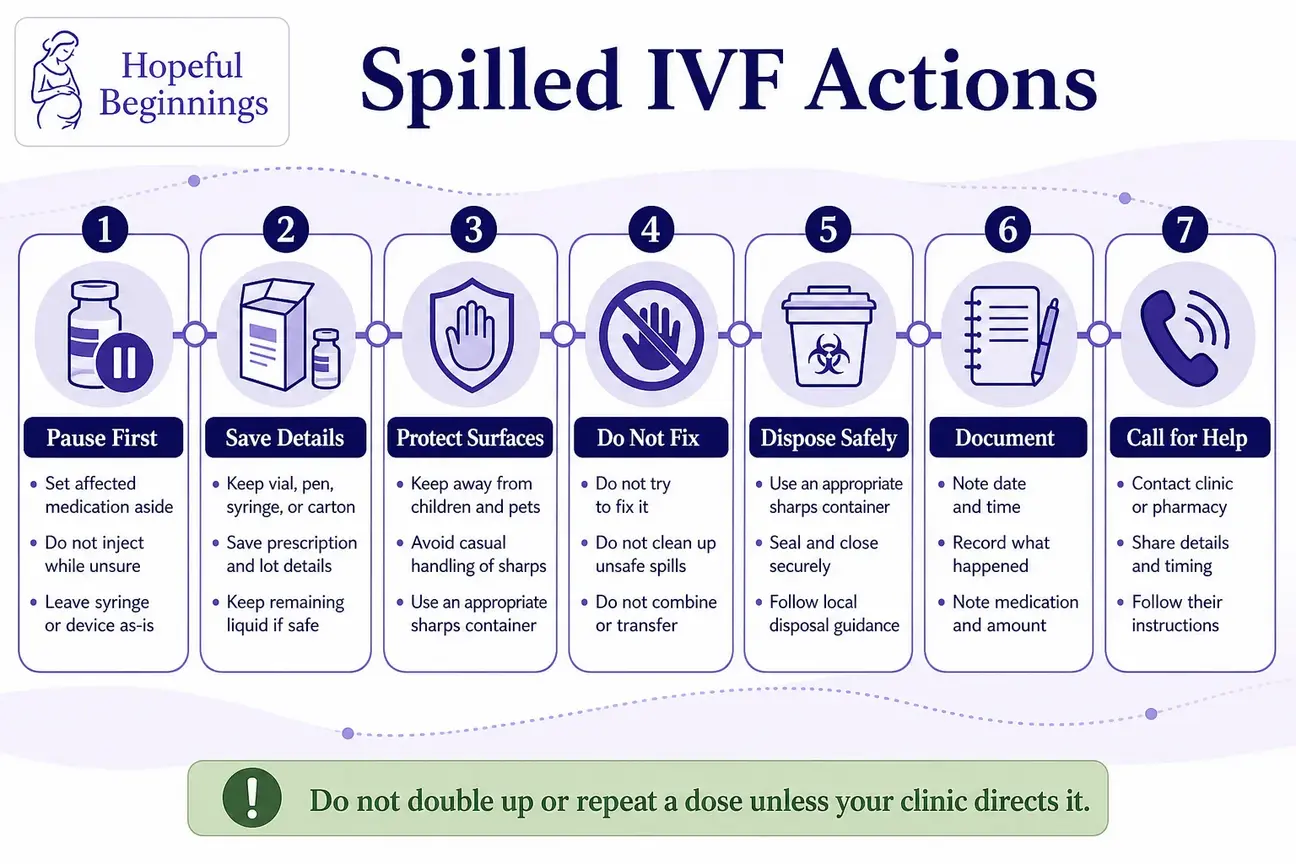
The first priority after spilled IVF medication is to slow the situation down without delaying the call for help. Do not inject the affected medication while you are unsure whether it is usable. Do not try to “make up” the loss by estimating what spilled, pulling from another vial, combining leftovers, changing the injection time, or repeating a dose unless your clinic specifically tells you to do so.
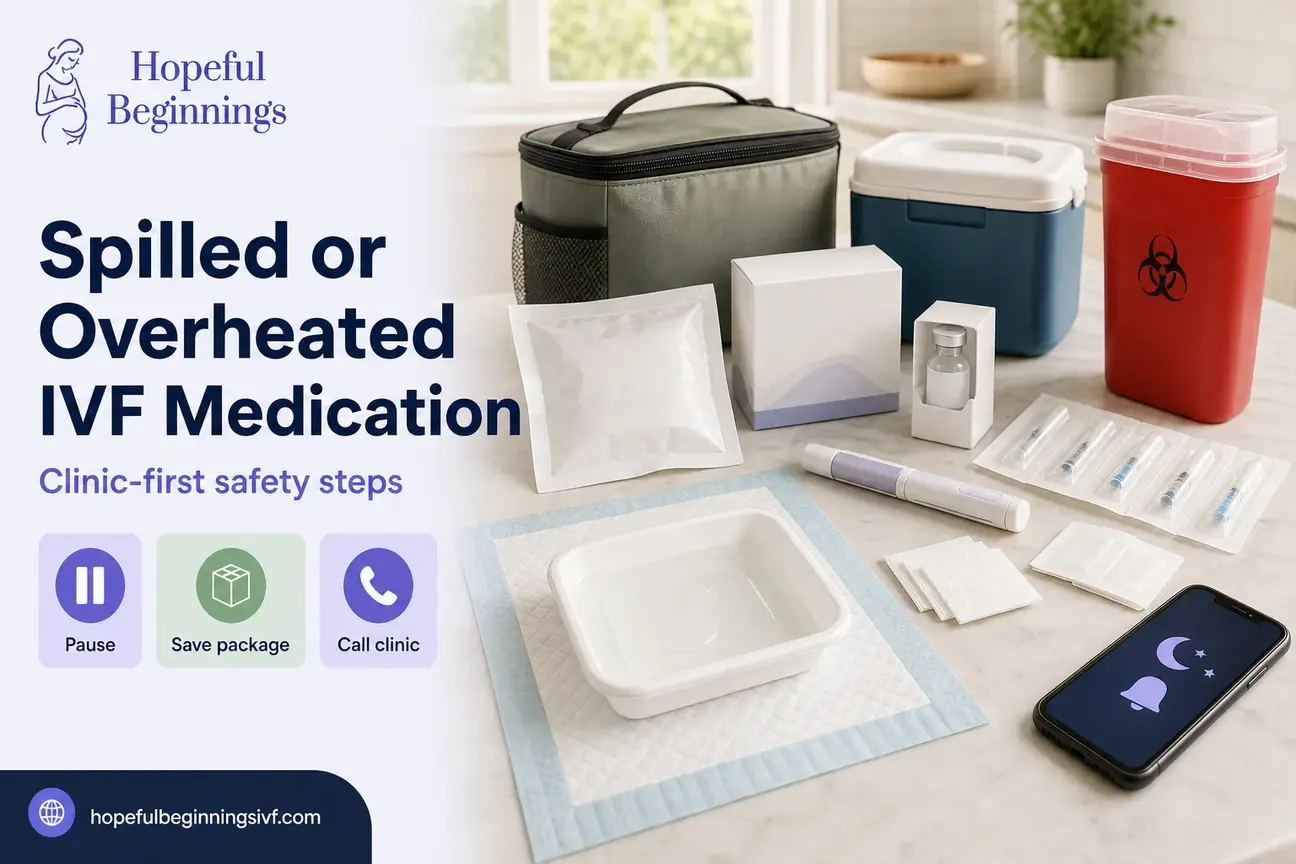
Use this clinic-first action plan.
1. Pause the injection
Set the affected product aside and do not administer it until the clinic or pharmacy gives instructions. If the medication is already in a syringe or device, leave it as-is unless there is an immediate safety issue such as broken glass, a leaking needle, or a surface that children or pets could reach.
2. Keep the packaging and prescription details
Save the vial, pen, syringe, cartridge, diluent, carton, prescription label, lot number, expiration date, and any remaining liquid if it is safe to do so. Those details help your clinic or pharmacy identify the exact medication and formulation that was dispensed.
3. Limit handling and avoid trying to fix the product
Do not clean, repackage, shake, warm, cool, transfer, or manipulate the medication unless the product instructions or your clinic tell you to. Trying to correct a heat, cold, spill, or contamination problem on your own can make the situation harder to evaluate.
4. Protect people, pets, and surfaces
Keep medication, glass, needles, and leaked liquid away from children, pets, food surfaces, and shared counters. If a needle is exposed or a container is broken, avoid unnecessary handling. The U.S. Food and Drug Administration explains that used needles and other sharps should be placed in an appropriate sharps disposal container rather than handled casually or placed loose where someone could be injured; see the FDA guidance on safely using sharps at home and during travel.
5. Document exactly what happened
Write down the time, location, temperature concern, container damage, appearance, and whether any medication was injected. If the medication was in a car, freezer, suitcase, hotel refrigerator, cooler, or direct sunlight, include that detail. If you do not know the temperature or duration, say that clearly instead of guessing.
6. Call the prescribing clinic or dispensing pharmacy promptly
Contact your prescribing fertility clinic or dispensing pharmacy. If it is after regular hours, use the clinic’s after-hours instructions. The clinic decides how the event affects your prescribed cycle plan, and the pharmacy can help interpret product-specific storage, device, and dispensing information.
7. Report dose timing clearly
Tell the clinic when the dose is due or whether it is already late. A product-quality question can become a dose-timing question, and both matter. Do not double up, repeat a dose, change the time, or use a different medication unless your clinic specifically directs it.
If the medication is damaged but the needle has not been used, still ask your clinic or pharmacy what to do with the specific product and supplies. For urgent symptoms such as severe abdominal pain or swelling, shortness of breath, rapid weight gain, very little urine, chest pain, fainting, or signs of an allergic reaction, use your clinic’s after-hours line or call 911. Do not wait for an in-home injection appointment for urgent symptoms.
What information should you give the clinic or pharmacy?
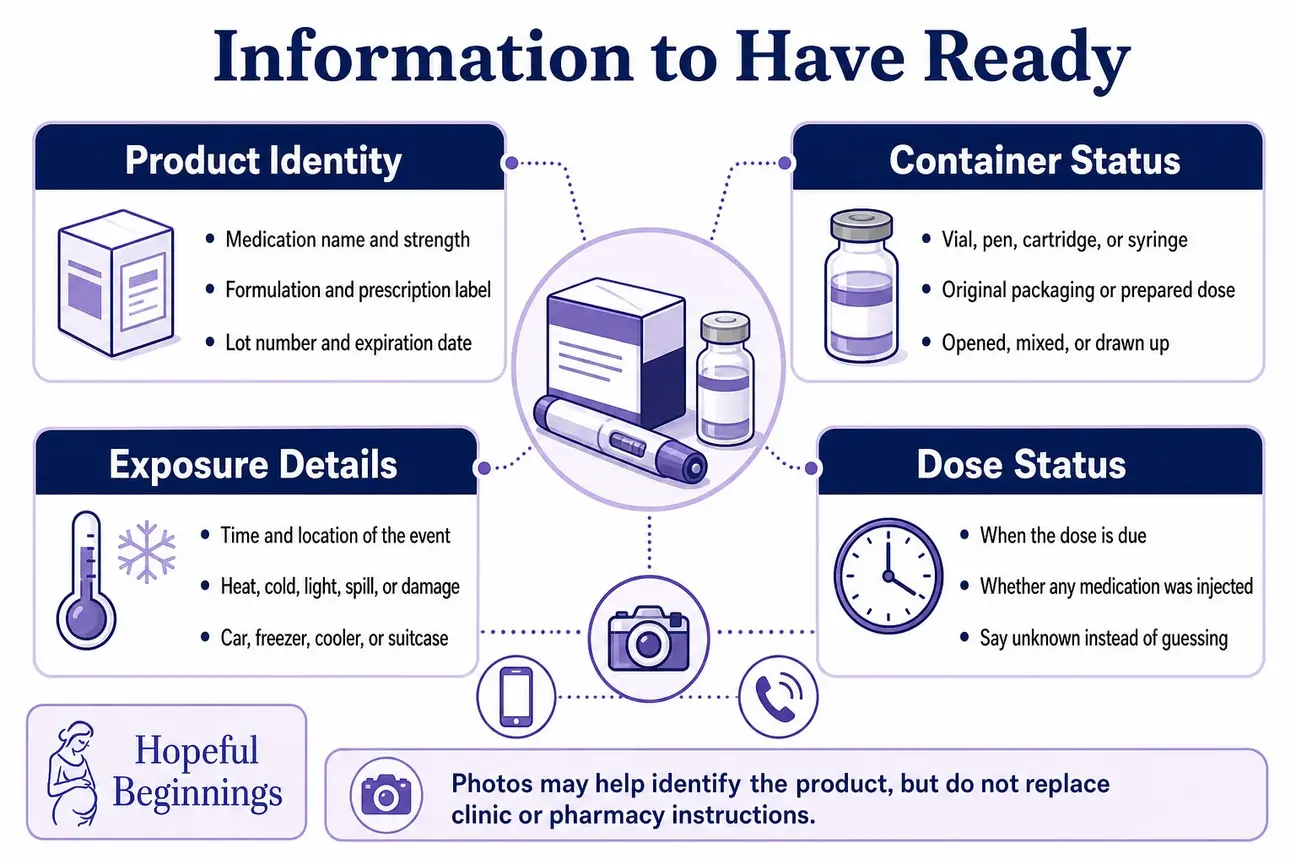
Your clinic or pharmacy can make a better product-specific decision when the facts are clear. If you feel shaken, put the medication safely aside and read from the label while you call. A photograph of the label or damaged package may help identify the product, but it does not replace a clinic or pharmacy decision.
| Information to have ready | Why it matters |
|---|---|
| Medication name, strength, and formulation | Storage and handling rules can differ between products, even within fertility treatment. |
| Container type: vial, pen, cartridge, prefilled syringe, diluent, or mixed preparation | A product in its original packaging may have different instructions from a prepared dose. |
| Prescription label and dispensing pharmacy | The pharmacy may be able to identify the exact product dispensed and its instructions. |
| Lot number and expiration date | These details may be needed if the package is damaged or the pharmacy needs to verify the product. |
| Time of the event and scheduled injection time | The clinic needs to know whether the medication issue also creates a timing issue. |
| Temperature or location details | A medication left in a car, freezer, suitcase, hotel refrigerator, or warm counter may require different assessment. |
| What the medication looks like now | Cloudiness, particles, color change, leaking, wet packaging, or a cracked container should be reported. |
| Whether any amount was injected | A partial or uncertain injection should never be repeated unless the clinic specifically directs it. |
| Your clinic’s written medication instructions | The written plan connects the product problem with your cycle timing and prescribed protocol. |
When you call, try not to summarize the situation as only “the dose is late” or only “the vial fell.” Give the full sequence. For example: the vial was mixed, the syringe was prepared, some liquid spilled, the injection was due at a specific time, and you are unsure whether any amount was administered. That gives the prescribing clinic the context needed to advise you.
For general injection handling, MedlinePlus patient instructions for subcutaneous injections emphasize following instructions for the medicine and supplies and checking the medication before use. IVF medication decisions still need to be product-specific, especially when a drug was overheated, frozen, spilled, dropped, mixed, or partly administered.
IVF heat exposure: overheated, frozen, or left in a car
IVF heat exposure is not a single universal category. “Too hot” depends on the medication, formulation, container, light exposure, time out of recommended conditions, and whether the product was unopened, in use, or already prepared. A dose left in a parked car may have a very different question from a carton sitting on a kitchen counter for a short time. Your clinic or pharmacy needs the exact product information before deciding what should happen.
Do not apply a generic room-temperature rule from one medication to another. Some products have strict refrigeration instructions, some have limited room-temperature allowances, some include light-protection instructions, and some have different rules after first use or preparation. Because this article is not about one named medication, no single FDA or DailyMed drug label should be treated as applicable to every fertility product. Ask your clinic or dispensing pharmacist to check the exact label for the product and formulation you were prescribed.
If a medication froze, became warm, sat in direct sunlight, traveled in luggage, or spent time in an uncertain refrigerator, write down the approximate time and location. If you do not know the temperature, say that. It is better to report uncertainty than to guess. The clinic or pharmacy may ask whether the product was in its carton, whether the seal was intact, whether the liquid looks different, and whether the dose time is approaching.
IVF heat exposure can be especially confusing when the medication looks normal. Appearance is useful information, but it is not proof of potency, sterility, or device function. Do not warm a cold product, cool a warm product, return a product to the refrigerator, or attempt to “fix” the storage event unless the exact instructions for that product tell you to do so or your clinic or pharmacist instructs you.
If IVF heat exposure is discovered shortly before a timed dose, explain both issues in the same call: the medication may have been outside recommended conditions, and the prescribed injection time may be approaching. If the medication was in a car, on a sunny counter, near a heater, against an ice pack, or in a refrigerator that may have frozen items, those details help the clinic and pharmacy decide what questions to ask next.
A common mistake after IVF heat exposure is trying to rescue the product by changing its temperature again. Unless your product label, pharmacy, or clinic specifically tells you to do that, avoid moving it between heat, cold, freezer, and refrigerator conditions in an attempt to correct the exposure. Keep the medication available for identification and wait for product-specific guidance.
Dropped IVF medication: vial, pen, syringe, or carton damage
Dropped IVF medication can mean several different things. A carton may fall while the inner container remains protected. A vial may bounce but not crack. A pen or prefilled syringe may look intact but have a damaged mechanism. A container may crack, leak, lose sterility protection, or become contaminated. The safest next step is to report the details rather than decide from appearance alone.
Do not inject from a cracked, leaking, open, visibly contaminated, or questionable container unless your prescribing clinic or dispensing pharmacy specifically tells you what to do. If glass is broken, a needle is exposed, or medication has leaked onto a surface, avoid unnecessary contact. Preserve the label and packaging details if you can do so safely, because those details help identify the product.
A dropped IVF medication situation can also involve a device question. Pens, cartridges, prefilled syringes, and mixing syringes are not just containers; they may also be part of how the medication is measured or delivered. If a device hits the floor or malfunctions, tell the clinic or pharmacy exactly what happened, whether the device appears damaged, and whether any medication was delivered.
If the drop happened during a scheduled injection, also report whether the needle entered the skin, whether the plunger moved, whether liquid leaked, and whether the full amount may or may not have gone in. Do not repeat the injection unless your clinic specifically directs you to do so.
When dropped IVF medication involves a vial or ampule, avoid picking through broken glass or wiping up medication without protecting yourself from sharp edges. When dropped IVF medication involves a pen or cartridge, do not assume that the device still measures accurately just because the outside looks normal. The pharmacy or clinic may need to know the product name, lot number, and what part of the device hit the floor.
If dropped IVF medication happened away from home, such as during work, travel, or a hotel stay, still keep the clinic’s written instructions and prescription label nearby. A calm, exact description is more useful than trying to recreate the dose from memory.
Medication storage mistake with mixed or prepared fertility medicine
A medication storage mistake can be more complicated after a medication has been mixed, reconstituted, drawn into a syringe, opened, or otherwise prepared. The original vial, powder, diluent, cartridge, or pen may have one set of handling instructions, while a prepared dose may have another. That is why the clinic or pharmacy will often ask whether the product was unopened, already mixed, or already drawn up.
Tell the clinic which components were mixed, when the mixing happened, who prepared the medication, how it was stored afterward, and what happened next. For example, a prepared syringe left out, a mixed vial placed in the wrong area, a dose exposed to heat, or a syringe that touched an unclean surface each raises a different question. Do not use, discard, remake, replace, or repeat a prepared dose based on guesswork.
Medication preparation can feel like a lot to manage, especially when powder, diluent, injection supplies, timing, and anxiety all meet in the same few minutes. Hopeful Beginnings IVF offers fertility injection service support that may include reviewing the clinic’s orders, medication preparation and reconstitution, administering the prescribed injection, and comfort coaching. That support does not replace your prescribing fertility clinic’s decision about whether a damaged, spilled, or temperature-exposed product is usable.
If you have a planned injection later and want help with medication preparation after your clinic has clarified the product issue, in-home support may reduce the pressure of doing the mixing and injection alone. The medication, dose, and timing still come from your prescribing clinic.
A medication storage mistake may also happen when more than one product is stored together. For example, one medication may be in its original carton, another may be opened, and a third may already be mixed. If you are unsure which product had which exposure, tell the clinic that clearly rather than guessing. A medication storage mistake is easier to sort out when the clinic knows what is known, what is uncertain, and when the next injection is due.
Fertility medication spill before, during, or after the injection
A fertility medication spill can happen at different points, and the timing matters. A vial may spill before the dose is drawn up. Liquid may leak while a syringe is being prepared. Medication may drip from a needle. A dose may partly inject and then leak back, or a device may malfunction. Each version gives the clinic different information.
If nothing was injected, say that clearly. If some amount may have been injected, describe what you saw without estimating more than you know. If the medication spilled onto a counter, floor, clothing, bedding, or an unclean surface, report that. If the dose was prepared but then contaminated, that is different from an unopened vial that fell while still sealed.
A fertility medication spill is not something to solve by pulling extra liquid from another container unless the clinic specifically instructs you. It is also not a reason to automatically repeat an injection. The prescribing clinic needs to decide how the medication problem fits with your protocol and timing.
If you are the partner helping with injections, your job in the moment is not to make a medical decision. Your job is to keep the product and packaging available, write down what happened, support the patient, and help contact the clinic or pharmacy. A calm description is more useful than a rushed attempt to fix the dose.
A fertility medication spill during mixing may involve both the medication and the diluent. A fertility medication spill during injection may involve the needle, syringe, device, skin, or injection site. A fertility medication spill after the injection may be a question about leakage or how much medication actually entered. Those details matter, so report the sequence rather than using only one phrase.
How is damaged medication different from a missed injection?
Damaged or uncertain medication is a product-quality, sterility, storage, or device question. A missed or late injection is a timing and protocol question. Sometimes both happen at once. For example, if a trigger medication spills close to the scheduled time, the clinic needs to know both that the product may be compromised and that the timing may be affected.
| Situation | What to do |
|---|---|
| Vial, pen, syringe, carton, or prepared medication was spilled, dropped, overheated, frozen, contaminated, leaking, or otherwise exposed to uncertain conditions | Do not guess whether it remains usable. Preserve the packaging and contact the prescribing clinic or dispensing pharmacy for product-specific instructions. |
| Dose was missed or may be late | Contact the prescribing clinic promptly. Do not double the next dose, repeat a dose, or change the schedule unless the clinic directs it. |
| A dose was partly injected or the needle or device malfunctioned | Tell the clinic exactly how much, if known, was administered and when. Do not repeat the dose unless the clinic specifically instructs you to do so. |
| Product looks different or the container is cracked | Do not inject until the clinic or pharmacy advises what to do. Report the visible change or damage. |
If your concern is mainly that an injection was missed, late, or uncertain, read Hopeful Beginnings IVF’s guide on what to do after a missed IVF injection after you have contacted your clinic. That resource is not a substitute for the clinic’s instructions, but it explains why guessing, doubling up, or changing the schedule can create more confusion.
This distinction matters because many IVF medications are tied to monitoring and timing decisions made by the prescribing clinic. Hopeful Beginnings IVF is not a fertility clinic and does not diagnose, prescribe, set doses, monitor the cycle, perform retrieval or transfer, or decide whether a questionable medication remains usable.
A medication storage mistake, IVF heat exposure, dropped IVF medication, or fertility medication spill may lead to a late dose, but it should still be reported as both a medication-quality issue and a timing issue. That helps the clinic avoid making a timing decision without knowing why the dose was delayed.
Why storage instructions differ between IVF medications
IVF and fertility treatment can involve several medication types, including stimulation medications, antagonist medications, trigger medications, and progesterone support. The American Society for Reproductive Medicine’s patient education materials describe that assisted reproductive technology often uses medications as part of ovarian stimulation and IVF care; see the ReproductiveFacts assisted reproductive technologies booklet for broad IVF context. The details of storing and preparing your specific medication, however, come from your clinic, pharmacy, and the product label.
Storage rules differ because products differ. One medication may be supplied as a powder with a separate diluent. Another may be a prefilled syringe, a multidose pen, an oil-based medication, or a product that requires reconstitution. Some products may have unopened storage instructions that differ from in-use instructions. Some labels may address light protection, refrigeration, room-temperature limits, freezing, appearance, or timing after mixing.
For handling a particular injectable medication, patients should follow their prescribing clinic’s written instructions and the product-specific label or pharmacy guidance. Do not borrow another patient’s rule, another medication’s rule, or a travel article’s general advice for your product.
A medication storage mistake also depends on formulation. An unopened carton in a refrigerator, a pen that has already been used, a mixed vial, and a syringe prepared for an immediate injection may not be treated the same way. If you are unsure which category your product falls into, say so when you call. The clinic or pharmacist can help identify the product and formulation from the label and packaging.
This is why a medication storage mistake should not be answered with a general internet rule. The important question is not just whether the product became warm, cold, wet, or exposed to light. The important question is how that event applies to your exact medication, formulation, container, preparation status, and prescribed timing.
What should traveling IVF patients do after a medication storage mistake?
Travel adds more chances for temperature and handling uncertainty. A cooler may warm up. A hotel refrigerator may freeze items near the back. Medication may sit in a car, bag, airport bin, or unfamiliar kitchen. If a medication storage mistake happens while you are away from home, use the same clinic-first approach: preserve the product, document the exposure, and contact the prescribing clinic or dispensing pharmacy before injecting.
Do not assume that a travel cooler, ice pack, hotel refrigerator, or vehicle temperature met the product’s label requirements. If you are flying, TSA provides specific screening information for medications and medically necessary liquids; review TSA guidance for medications in liquid form before travel. For a fuller planning checklist, Hopeful Beginnings IVF also has a guide to storing and traveling with IVF medications.
If IVF heat exposure happened during travel, report the best details you have: where the medication was, how long it may have been there, whether it was in original packaging, whether it was with an ice pack, and whether the package became wet, frozen, warm, or damaged. If you crossed time zones, also tell the clinic your local time and the time zone for your written medication schedule.
Travel is also a reason to keep prescription labels and written clinic instructions accessible. If medication is spilled or damaged away from home, the label helps the pharmacy or clinic identify the exact product. Still, a label does not answer every stability or timing question by itself, especially if the medication was mixed or partly administered.
If dropped IVF medication happens in a rental car, airport, hotel room, or relative’s home, do not rush to use it just because supplies are limited. If IVF heat exposure or a fertility medication spill happens away from your usual setup, the same rule applies: keep what you can safely keep, write down the details, and contact the clinic or pharmacy before the next step.
When should you seek urgent medical help?
A medication spill or storage concern is usually a clinic or pharmacy decision, but certain symptoms need urgent medical direction. Use your prescribing clinic’s after-hours line or call 911 for severe abdominal pain or swelling, shortness of breath, rapid weight gain, very little urine, chest pain, fainting, or signs of an allergic reaction. Do not wait for an in-home injection appointment in those situations.
If you notice spreading redness, warmth, fever, a hard painful lump, or another concerning injection-site reaction, contact your clinic or another clinician. If the symptom feels urgent or severe, use emergency care. Hopeful Beginnings IVF can support prescribed injections, teaching, medication preparation, and comfort coaching, but it does not provide emergency care or replace the prescribing clinic’s medical judgment.
How Hopeful Beginnings IVF can help with the injection itself
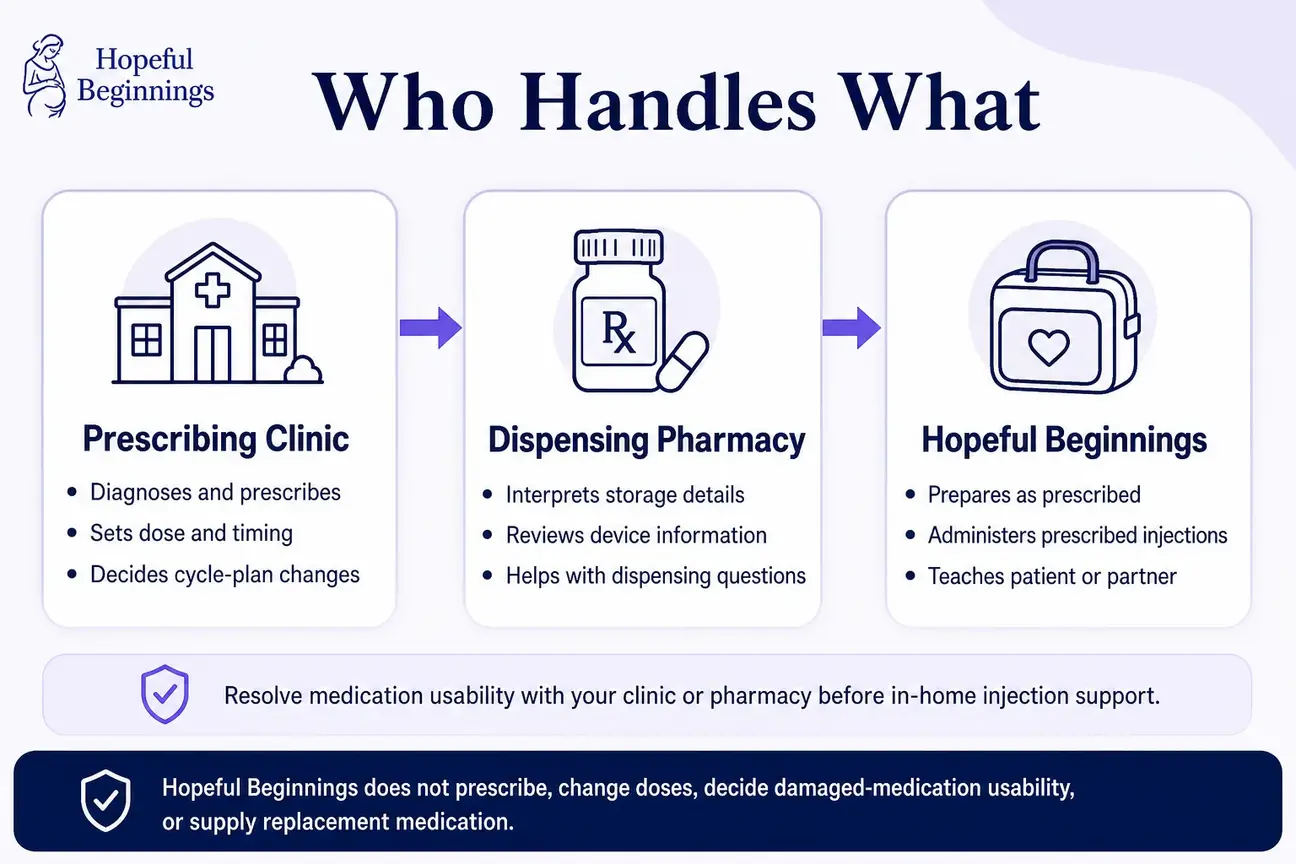
Hopeful Beginnings IVF provides in-home injection support for fertility medications that your own prescribing clinic has ordered. A licensed medical professional can come to the patient’s home to prepare and reconstitute medication as prescribed, administer the prescribed injection, teach a patient or partner, and support comfort and confidence during the process.
That role has clear boundaries. Hopeful Beginnings does not prescribe medication, choose doses, change injection timing, decide whether a damaged product remains usable, supply replacement medication, monitor follicles, or perform IVF procedures. Your prescribing fertility clinic diagnoses, prescribes, sets doses, monitors the cycle, and decides what to do after a medication problem.
Once your clinic or pharmacy has clarified what medication should be used and when, Hopeful Beginnings may help with in-home fertility injections, medication preparation, and injection teaching. Patients who want instruction before a partner gives injections can also review IVF injection plans, including teaching and timed injection support. Appointments can be scheduled around clinic dosing times, including evenings, weekends, and holidays, but Hopeful Beginnings is not an emergency service.
If anxiety rises after a fertility medication spill or device problem, that reaction is understandable. You may find it helpful to have one person gather the packaging while another person calls the clinic. If you later want hands-on reassurance with the injection process, Hopeful Beginnings offers IVF injection guidance focused on preparation, calm technique support, and confidence with the clinic’s written plan.
Hopeful Beginnings can be especially helpful after the clinic has answered the medication question but you still feel uneasy about the next injection. For example, after a medication storage mistake is resolved by your clinic or pharmacist, an in-home visit may help with medication preparation and administration as prescribed. After the appropriate clinic or pharmacy contact gives instructions for dropped IVF medication and confirms what product and timing should be used, injection teaching may help you and your partner feel more organized.
Support for patients in Cary, Raleigh, and the Triangle
Hopeful Beginnings IVF is based in Cary, North Carolina and serves patients in Cary, Raleigh, and the Triangle through home visits. If a medication has been spilled, dropped, overheated, frozen, or contaminated, resolve the medication-usability question with your prescribing clinic or pharmacy first. After the product and dose plan are confirmed, in-home support may help with preparation, teaching, or administration as prescribed.
For patients juggling work, family, travel, and timed injections, scheduling can be part of the stress. Hopeful Beginnings offers flexible injection scheduling, including evening, weekend, and holiday appointments, around the clinic’s dosing instructions. If you would like help after your clinic has confirmed the medication plan, you can request an appointment, call 910-200-2337, or email info@hopefulbeginningsivf.com. Have your clinic’s written medication instructions ready when you reach out.
Call for pricing when you book. After-10 p.m. and holiday visits are priced separately. Medication is not included, and Hopeful Beginnings does not replace your fertility clinic or pharmacy.
Final reminders before you use any questionable medication
If you remember nothing else, remember this: a questionable product needs a product-specific decision. A damaged package, dropped IVF medication, overheated medication, frozen medication, prepared dose, or fertility medication spill should not be handled by guessing. Preserve the packaging, document the facts, and contact the prescribing clinic or dispensing pharmacy promptly.
A spill or temperature problem may also create a timing problem, but those are not the same issue. Tell your clinic both what happened to the medication and when the dose was due. Do not double up, repeat an injection, change the dose, change the timing, or independently replace or discard medication unless your clinic or pharmacy specifically instructs you.
Whether the concern is spilled IVF medication, IVF heat exposure, dropped IVF medication, a medication storage mistake, or a fertility medication spill, the safest next step is the same: pause, preserve what you can, document the facts, and call the right clinical or pharmacy contact before using the product.
This article is for general education and is not medical advice. Follow the written instructions from your prescribing fertility clinic, and contact your clinic before changing any dose, medication, injection time or technique.
Frequently Asked Questions
What should I do if I spill IVF medication?
Pause the injection, preserve the product and packaging when safe, and contact your prescribing fertility clinic or dispensing pharmacy for product-specific instructions. Do not inject, replace, discard, or repeat the medication based on guesswork.
Can I use IVF medication if it was dropped but the vial or pen looks fine?
Do not decide based only on appearance. A dropped vial, pen, syringe, or cartridge may have a product-quality, sterility, or device concern even if it looks intact. Report what happened and wait for guidance from the clinic or pharmacy.
What if my fertility medication got hot?
Keep the packaging and document the approximate location, temperature concern, and duration. Storage limits vary by medication and formulation, so ask your prescribing clinic or pharmacist before using it.
What if IVF medication froze?
Do not assume it remains usable. Tell the clinic or pharmacy which product froze, how long it may have been exposed, whether it was unopened or prepared, and what the medication looks like now.
What if I already injected medication that may have been overheated or contaminated?
Contact your prescribing clinic promptly and report the product, exposure, amount administered if known, and time of injection. Do not repeat the dose unless the clinic specifically directs you to do so.
Is a spilled dose the same as a missed dose?
No. A spill, drop, contamination, or temperature exposure raises a product-quality question. A missed or late dose raises a protocol and timing question. Both require prompt contact with the prescribing clinic.
Should I throw away damaged IVF medication?
Do not independently discard medication if the clinic or pharmacy may need the label, lot number, packaging, or remaining product to identify it. If there is broken glass, a leak, or an exposed needle, avoid unnecessary handling and ask for instructions.
Can Hopeful Beginnings IVF decide whether overheated medication is still usable?
No. Hopeful Beginnings IVF can help with prescribed in-home injection preparation, reconstitution, administration, and teaching, but the prescribing clinic or dispensing pharmacy decides what to do after a spill, drop, heat exposure, freezing event, or contamination concern.