

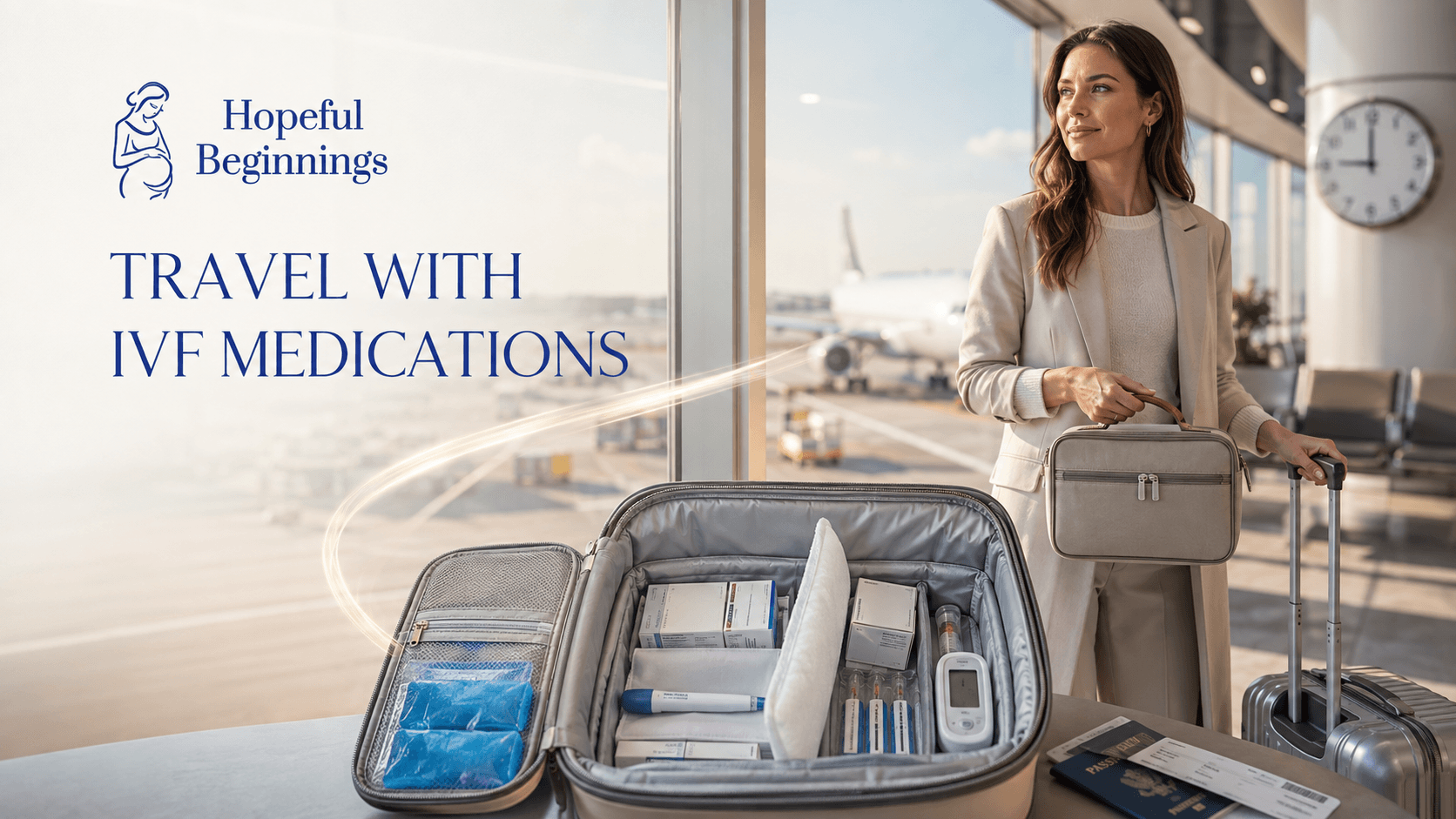

To travel with IVF medications safely, patients need a clear plan for storage, refrigeration, transportation, injection supplies, and medication timing. An ordinary trip, workday, flight delay, or power outage can become stressful when fertility medications must remain within specific temperature limits or be administered according to a clinic-directed schedule.
Some IVF medications require refrigeration, while others may be stored at controlled room temperature. A medication can also have one storage requirement before it is opened or mixed and a different requirement afterward. Airport screening, ice packs, injectable supplies, time-zone changes, and precisely scheduled doses can make the process feel complicated.
This guide explains how to travel with IVF medications, organize fertility drugs at home, prepare refrigerated prescriptions for a trip, pass through a U.S. airport with injectable supplies, prevent heat and freezing, manage time-zone questions, and respond when medication storage or timing becomes uncertain. Always follow the instructions for your exact medication and treatment plan.
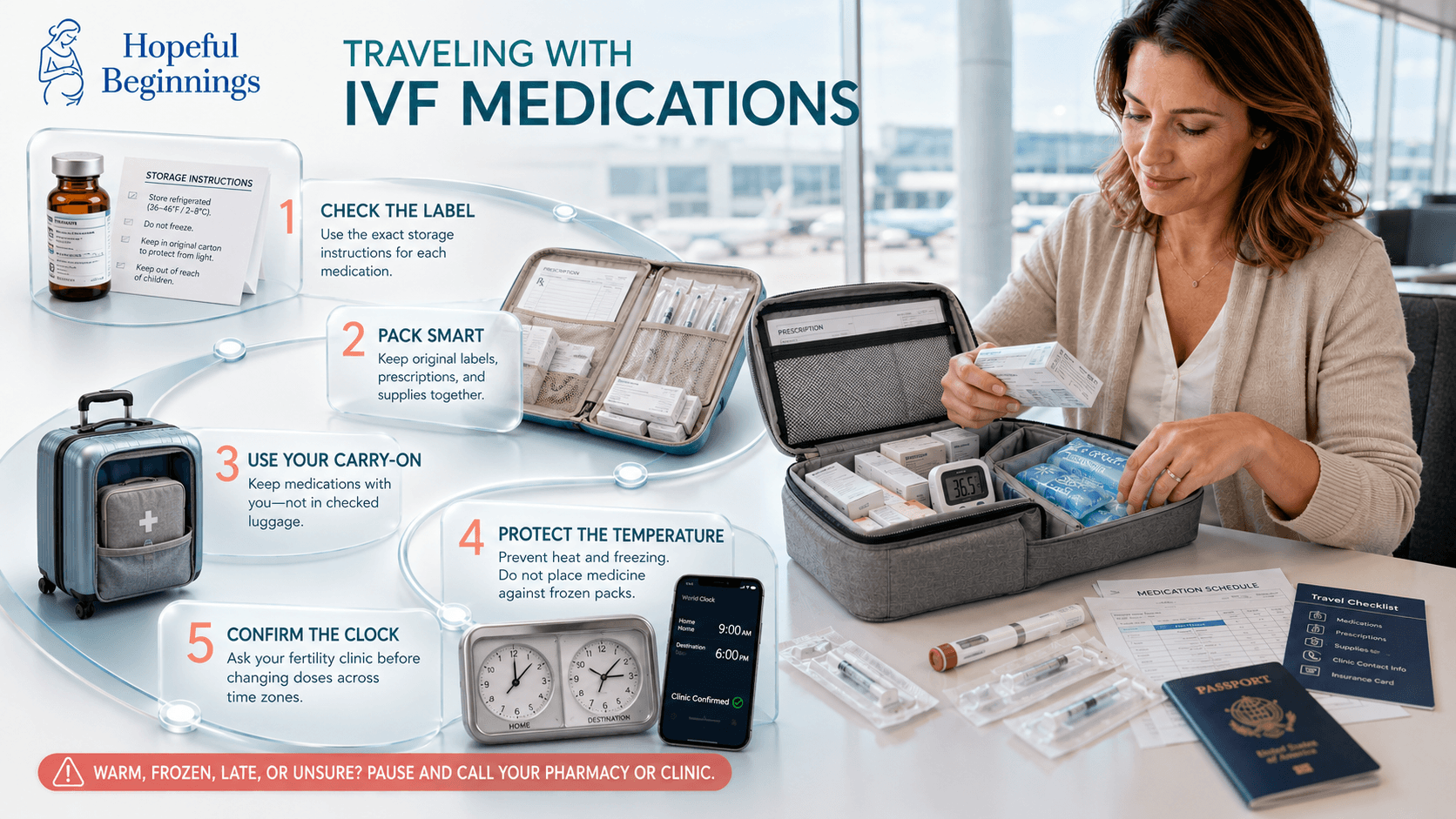
Quick answer: Keep IVF medications in their original labeled packaging, check the product-specific storage range, carry medications and supplies with you rather than placing them in checked luggage, prevent direct contact with frozen gel packs, and confirm any time-zone adjustment with your clinic before departure. If a medication becomes too warm, freezes, is left out longer than allowed, changes appearance, or has uncertain storage history, quarantine it and call the pharmacy or clinic before using it. Do not guess, discard it immediately, or repeat a dose without instructions.
Why IVF Medication Storage Is Not One-Size-Fits-All
“Keep fertility medication cold” sounds like a universal rule, but it is not. IVF and fertility-treatment protocols may include gonadotropins, ovulation-prevention medications, trigger medications, progesterone, estrogen, antibiotics, and other prescriptions. These products can differ in formulation, packaging, stability, light sensitivity, and instructions after first use or reconstitution.
For example, the current U.S. prescribing information for GONAL-f RFF Redi-ject gives patients refrigerated and limited room-temperature storage options, directs them to protect the pen from light, and says not to freeze it. The current label for the Ovidrel prefilled syringe also specifies refrigeration, a limited patient room-temperature period, protection from light, and storage in the original package. These examples demonstrate why the label matters; they are not permission to apply the same limits to another medication.
Storage instructions may change based on:
- The medication’s brand and active ingredient
- The device or formulation, such as a vial, cartridge, pen, or prefilled syringe
- Whether the package is unopened
- Whether a multi-dose product has already been used
- Whether a powdered medication has been mixed with diluent
- The manufacturer’s current label and expiration date
- Instructions supplied by the specialty pharmacy
- Directions from the prescribing fertility clinic
Never rely only on a social-media post, an old cycle’s instructions, a friend’s protocol, or a general online storage chart. A chart may be outdated, may refer to a different formulation, or may omit what happens after opening. When the carton, pharmacy label, medication guide, and clinic instructions appear inconsistent, stop and ask the dispensing pharmacist or fertility clinic to reconcile them.
Build a Medication Storage Plan Before Your IVF Cycle Starts
The best time to solve storage questions is before the first dose. When your medication shipment arrives, open the outer shipping container promptly and compare every item with your written medication list. Confirm the medication name, strength, quantity, expiration date, and required supplies. If anything is missing, damaged, warm when it should be cold, frozen, leaking, cracked, or different from what you expected, contact the dispensing pharmacy before use.
Create a Product-Specific Medication List
Record each medication separately. For every product, note:
- Brand and generic name
- Strength and dosage form
- Storage range before opening
- Storage rules after opening or first use
- Instructions after mixing or reconstitution
- Light-protection requirements
- Whether freezing is prohibited
- Expiration date and, when applicable, discard-after-opening date
- Clinic phone number and specialty-pharmacy phone number
Use the manufacturer information supplied with the medication and confirm questions with the pharmacist. Write the date of first use on multi-dose packaging if your pharmacy recommends it. Keep current dosing instructions separate from general storage information so a dose change does not get lost in your notes.
Choose a Safe Location at Home
Medications labeled for controlled room temperature should be kept in a stable, dry indoor location, away from direct sunlight, heaters, windows, hot vehicles, and humid bathrooms. “Room temperature” does not mean any temperature a room happens to reach. It refers to the range stated on the product label.
For medications that require refrigeration, follow the labeled temperature range. A central refrigerator shelf is generally more stable than a door compartment, which experiences repeated temperature changes. Avoid placing medication against the refrigerator’s cooling element or in a spot where it may freeze. Keep products in their original cartons when the label requires protection from light.
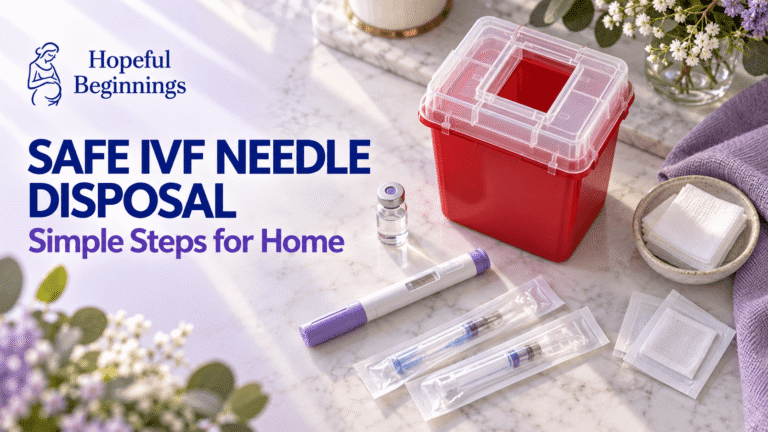
Do not store fertility medication where children, visitors, or pets can reach it. Keep injection supplies together in a clean, organized area, but separate sterile supplies from used sharps. Use an appropriate sharps container and follow local disposal guidance.
Do Not Automatically Move Medication Back and Forth
Some medications allow either refrigeration or a defined period at room temperature, but the exact rules differ. Moving a product repeatedly between environments can make it difficult to know how much allowable room-temperature time has passed. For some products, once a room-temperature period begins, that period may continue even if the medication is later returned to the refrigerator.
Before changing storage conditions, ask the pharmacist whether the medication may be returned to refrigeration and how to track its discard date. Document the date and time a product leaves controlled storage for an extended period.
How to Pack IVF Medications for a Trip
Treat injectable fertility medications as essential medical items, not ordinary toiletries. Pack early enough to identify missing supplies and obtain documentation. A rushed packing process increases the risk of forgotten needles, incorrect temperature control, or leaving a time-sensitive dose in checked luggage.
Use a Dedicated Carry-On Medication Kit
The Centers for Disease Control and Prevention advises travelers to keep medications in original labeled containers, bring written prescriptions, pack enough for the trip plus extra for delays, and carry medication rather than placing it in checked luggage. For injectable IVF treatment, your kit may include:
- Medications in original pharmacy-labeled cartons or packaging
- A copy of the prescription or medication list
- A clinic letter describing the need for injectable medication and supplies, especially for international travel
- Syringes, needles, pen needles, or other manufacturer-specified supplies
- Alcohol pads, gauze, and bandages
- A small travel sharps container
- A clinic-approved insulated medication case if refrigeration is required
- Conditioned gel packs or another pharmacist-approved cooling method
- A simple temperature-monitoring device if recommended by the pharmacy
- Written dosing times in both the departure and destination time zones
- Clinic, pharmacy, airline, and travel-insurance contact details
Bring reasonable extra supplies in case a needle is dropped, packaging is damaged, or a return trip is delayed. Do not bring extra medication or change the prescribed quantity without checking insurance, pharmacy, destination-country, and clinic requirements.
Prevent Both Overheating and Freezing
A cooler is not automatically safe. Medication placed directly against a frozen gel pack can freeze, even while the inside of the case feels cold. Unless the product’s approved instructions say otherwise, freezing may damage a medication. Place a protective barrier between the medicine and cold source, keep the product in its original package, and use the cooling setup recommended by the specialty pharmacy.
A household cooler, hotel ice bucket, car trunk, sunny windowsill, and minibar refrigerator can all create unpredictable temperatures. Hotel refrigerators may freeze items or switch off when the room key is removed. Before arrival, ask the hotel what type of refrigerator is available and whether there is reliable backup storage. On arrival, inspect the refrigerator and verify that the medication is not touching a freezing surface.
Do not leave fertility medication in a parked car, even briefly. Vehicle temperatures can rise or fall quickly. Keep the medication kit with you during rides, security lines, delays, and connections.
Can You Fly With IVF Medications, Needles, and Ice Packs?
In the United States, medically necessary liquid medications are permitted through airport screening under special procedures, and the Transportation Security Administration states that unused syringes are allowed when accompanied by injectable medication. TSA asks travelers to declare these items to an officer for inspection. Medically necessary liquids may require additional screening.
Policies and screening decisions can change, and rules outside the United States may be different. Confirm current requirements with TSA, the airline, and every country involved in your route, including layover countries. International destinations may restrict certain medications or require a prescription, physician letter, medical certificate, translated document, or prior approval.
At the Airport Security Checkpoint
- Keep the medication kit accessible rather than buried under other items.
- Tell the security officer that you are carrying medically necessary injectable medication, syringes, and cooling materials.
- Present medications in original labeled packaging whenever possible.
- Carry supporting documents even when they are not universally required.
- Allow additional time for inspection.
- Ask the officer to change gloves before handling medication if contamination is a concern.
- After screening, confirm that every medication, needle, and cooling component has been returned to the kit.
Security staff determine how an item is screened. Do not conceal syringes or attempt to avoid declaration. Calm, organized presentation reduces confusion and makes it easier to explain why the supplies are necessary.
Why Checked Luggage Is a Poor Storage Plan
Checked bags can be delayed, lost, opened, or exposed to temperatures outside a medication’s permitted range. Even if the flight is short, the bag may spend time outdoors or in an uncontrolled cargo environment. Keeping medication in your carry-on preserves access during delays and allows you to monitor the kit.
If an airline requires a bag to be gate-checked, remove the medication kit and keep it with you. Ask the airline in advance about medical-bag allowances and whether a separate medication bag counts toward standard carry-on limits.
How to Handle IVF Injection Timing Across Time Zones
Traveling across time zones creates a dosing question, not just a clock question. Some fertility medications are taken within a clinic-approved window. Others—especially a trigger injection—may be tied to a procedure at a precise time. You should never shift the schedule simply by choosing the same number on the destination clock.
The CDC advises people crossing time zones to ask their healthcare provider how to adjust medication timing and notes that the interval since the last dose matters. IVF protocols add cycle-specific considerations, so obtain a written plan from your fertility clinic before departure.
Ask Your Clinic These Questions Before Travel
- Should this dose stay at the same absolute time or move to a destination-local time?
- What dosing window, if any, is permitted for each medication?
- Which time zone will the clinic use when sending instructions?
- How should daylight-saving changes be handled?
- What should I do if a flight delay overlaps a scheduled injection?
- Can I administer the medication safely in transit, or should the itinerary change?
- Who should I call after hours if timing becomes uncertain?
- Should travel be avoided around monitoring, trigger, retrieval, transfer, or another procedure?
Create a written schedule that lists the medication name, dose, date, departure-zone time, destination-zone time, and alarm. Set the phone’s automatic time-zone behavior intentionally and consider a second alarm on another device. Use the written plan as the source of truth rather than recalculating while tired or in transit.
Trigger-shot warning: Trigger injections may be scheduled in relation to egg retrieval or another clinic procedure. Never move, skip, repeat, or “round” a trigger-shot time because of a flight, delay, or time-zone conversion. Confirm the exact time with your fertility clinic. For a detailed discussion, read IVF Trigger Shot Timing: What Happens If You’re Late, Early, or Unsure?
What If IVF Medication Gets Warm, Freezes, or Is Left Out?
Temperature exposure does not have one universal answer. The correct response depends on the exact product, temperature reached, duration of exposure, whether it was opened or mixed, and what the manufacturer’s stability information permits.
If storage may have been compromised:
- Separate the medication. Keep it clearly marked so it is not used accidentally.
- Do not discard it immediately. The pharmacy may need the lot number, expiration date, photographs, or temperature history.
- Do not use it until advised. Appearance alone cannot confirm potency or safety.
- Record what happened. Note the medication name, formulation, lot number, exposure time, estimated temperature, and whether it was opened or mixed.
- Call the dispensing pharmacy or manufacturer. Ask for product-specific stability guidance.
- Inform the fertility clinic. The clinic must know if a dose may be delayed or a replacement is needed.
- Follow documented instructions. Do not substitute another medication, double a dose, or improvise a schedule.
If you cannot determine whether a refrigerated product froze, tell the pharmacist exactly how it was packed and whether it touched frozen material. If a product has particles, discoloration, cracks, leakage, a damaged seal, or another unexpected change, do not use it unless a qualified professional confirms that it is acceptable.
What to Do During a Power Outage
Keep the refrigerator door closed to slow temperature change. Do not automatically transfer medication to ice or a freezer. Check the time the outage began, monitor the refrigerator temperature if possible, and call the pharmacy for instructions. If relocation is recommended, use a validated or pharmacist-approved transport method and prevent direct contact with frozen packs.
Patients in areas prone to storms may benefit from making a backup plan before the cycle: identify an alternate location with reliable power, keep pharmacy and clinic numbers available offline, and ask how replacement medication would be obtained after hours.
What If You Miss an IVF Dose While Traveling?
If a dose is late, missed, spilled, incompletely administered, or left behind, contact your fertility clinic as soon as possible. Do not double the next dose unless the clinic specifically directs you to do so. Do not assume that the cycle is automatically lost, and do not use internet anecdotes to decide how to correct the schedule.
Be ready to tell the clinic:
- The medication name and prescribed dose
- The scheduled time and actual time
- Your current location and time zone
- Whether any medication entered the body
- Whether medication leaked, spilled, or remained in the device
- Your current stage of treatment
- Your next monitoring appointment or procedure
- What other medications are scheduled that day
If the issue involves a trigger injection, call immediately using the clinic’s urgent or after-hours instructions. A trigger is unusually time-sensitive because it may be coordinated with egg retrieval.
Can IVF Medications Be Shipped to a Hotel or Temporary Address?
Specialty pharmacies may be able to ship fertility medications to a temporary address, but the details must be confirmed in advance. Delivery timing, signature requirements, insurance authorization, product availability, weekend schedules, weather, and refrigeration all matter.
Before shipping to a hotel, rental, workplace, or family member:
- Confirm the address and accepted delivery hours.
- Ask whether staff can sign for medication.
- Verify how refrigerated packages will be handled immediately after arrival.
- Confirm that the package will not be left outdoors, in a vehicle, or at an unsecured desk.
- Ask the pharmacy how long the validated shipping container maintains the required conditions.
- Track the shipment and assign a responsible person to retrieve it.
- Inspect the package promptly and report delays or temperature concerns.
Do not assume a package is safe because the cold packs are still cool. Follow the pharmacy’s receiving instructions and contact it when shipping duration or package condition differs from expectations.
How to Plan IVF Travel Around Monitoring and Procedures
Medication storage is only one part of IVF travel. Ovarian stimulation often requires ultrasound and bloodwork, and the timing of a trigger injection, egg retrieval, or embryo transfer can change based on clinical results. A trip that looks feasible when booked may conflict with monitoring or a procedure later.
Before making nonrefundable plans, ask the fertility clinic:
- Which cycle dates are predictable and which may change?
- Can monitoring be performed at another qualified facility?
- How will results be transferred and reviewed?
- Could medication doses change while I am away?
- When might a trigger injection be scheduled?
- Are there travel restrictions before or after retrieval or transfer?
- What symptoms would make travel unsafe?
- Where should I seek urgent care at the destination?
Your fertility clinic remains responsible for prescribing, dose changes, monitoring, and treatment decisions. An in-home injection professional can support medication administration according to written orders, but cannot replace clinic monitoring or independently change a protocol.
When Professional In-Home Injection Support May Help
Travel is not required for IVF logistics to feel overwhelming. Work schedules, childcare, a partner’s absence, injection anxiety, limited mobility, unfamiliar devices, and late-evening medication times can all make at-home administration difficult.
Hopeful Beginnings IVF provides in-home injection support based on the patient’s fertility-clinic instructions. Support may be especially useful when a patient:
- Is beginning an unfamiliar injection routine
- Needs help organizing supplies and written instructions
- Has a partner or usual support person who is traveling
- Feels faint, anxious, or overwhelmed around needles
- Needs support with a hard-to-reach intramuscular injection
- Has a time-sensitive dose and wants calm, professional assistance
- Wants help maintaining a consistent routine at home
Patients in Raleigh and surrounding Triangle communities can learn more about fertility injection services, expert guidance, and flexible scheduling. Hopeful Beginnings IVF follows the prescribing clinic’s written instructions and does not determine medication dose, timing, storage exceptions, or treatment changes.
IVF Medication Travel Checklist
One to Two Weeks Before Departure
- Tell the fertility clinic your full itinerary and time zones.
- Confirm whether travel is appropriate during this stage of treatment.
- Request a written dosing and time-zone plan.
- Review storage instructions for each exact product.
- Ask the specialty pharmacy about an approved travel cooler.
- Obtain prescription copies and a clinician letter if advised.
- Check TSA, airline, destination, and layover-country rules.
- Arrange enough medication and supplies for delays.
- Identify a reliable refrigerator and emergency pharmacy plan at the destination.
The Day Before Departure
- Compare every medication with the written list.
- Check expiration and discard-after-opening dates.
- Condition cooling materials according to pharmacy instructions.
- Pack medication in original labeled containers.
- Place documents, sharps container, and supplies in the carry-on kit.
- Set alarms for both time zones.
- Save clinic and pharmacy numbers in the phone and on paper.
- Check for flight delays and extreme weather.
During Travel
- Keep medication with you and out of checked luggage.
- Declare injectable medications, syringes, and medically necessary cooling items at screening.
- Protect medication from direct contact with frozen packs.
- Keep the kit away from sunlight, heaters, and parked vehicles.
- Follow the written dosing plan without improvising.
- Document delays or temperature concerns.
At the Destination
- Inspect the storage location before placing medication inside.
- Keep medication away from freezer plates and unstable door compartments.
- Verify that a hotel refrigerator remains powered when you leave the room.
- Recheck the next dose and time-zone conversion.
- Contact the clinic or pharmacy immediately if storage or timing is uncertain.
Frequently Asked Questions About IVF Medication Storage and Travel
Do all IVF medications need to be refrigerated?
No. Storage requirements vary by medication, formulation, packaging, and whether the product has been opened or mixed. Use the instructions for the exact product dispensed to you and confirm unclear directions with the specialty pharmacist or fertility clinic.
Can IVF medication go through airport security?
In the United States, TSA permits medically necessary medications and allows unused syringes when accompanied by injectable medication, subject to screening. Declare the items to an officer and keep medications clearly labeled. Check current TSA, airline, and destination-country rules before every trip.
Can I take refrigerated IVF medication in my carry-on?
Yes, medically necessary refrigerated medication can generally be carried through U.S. screening with appropriate cooling materials, but it may require additional inspection. Use a pharmacy-approved packing method, prevent the medication from touching frozen packs, and verify current rules before departure.
Should IVF medication be placed in checked luggage?
Carry-on storage is safer because checked luggage can be delayed, lost, or exposed to uncontrolled temperatures. Keep medications, injection supplies, prescriptions, and cooling materials with you. If a carry-on is gate-checked, remove the medication kit first.
What happens if refrigerated fertility medication gets warm?
The answer depends on the exact medication, temperature, duration, and whether it was opened or mixed. Separate the medication, record the exposure details, and call the dispensing pharmacy or manufacturer for product-specific stability guidance. Inform your fertility clinic if a dose may be affected.
What happens if IVF medication freezes?
Do not use a product that may have frozen until the pharmacist or manufacturer provides guidance. Many injectable fertility medications state that they should not be frozen. Keep the product, packaging, lot number, and exposure details available when you call.
Can I use a regular ice pack for IVF medication?
Only use a cooling method that keeps the medication within its labeled range. A frozen pack placed directly against medication can cause freezing. Ask the dispensing pharmacy how to condition and arrange cooling materials for your exact product and trip duration.
How do I take IVF medication when crossing time zones?
Ask the fertility clinic for a written schedule before travel. Do not automatically take the dose at the same local clock time. The allowed timing window and interval since the previous dose can differ by medication and cycle stage.
Can I travel with a trigger shot?
Travel may be possible, but a trigger shot can be precisely coordinated with egg retrieval or another procedure. Confirm the itinerary, time-zone conversion, storage plan, and exact administration time with the fertility clinic. Do not change the time because of a flight delay without clinic instructions.
Do I need a doctor’s letter to fly with IVF medications?
U.S. screening rules do not make a doctor’s letter universally mandatory for every medication, but carrying documentation can simplify screening. International destinations or airlines may impose different requirements. Bring original labels, prescription copies, and a clinic letter when recommended.
What should I do if I miss an IVF injection while traveling?
Call the fertility clinic promptly with the medication name, dose, scheduled time, actual time, time zone, and what happened. Do not double the next dose, repeat an uncertain dose, or change the schedule unless the clinic directs you to do so.
Protect the Medication—and Your Peace of Mind
Traveling with IVF medication is manageable when the plan is product-specific, written, and confirmed in advance. Keep medication labeled and accessible, protect it from heat and freezing, verify airport and destination rules, and let the clinic—not a time-zone calculator or online anecdote—decide how dosing times should change.
If an exposure, delay, missed dose, or packing mistake happens, pause and gather facts. The pharmacy can evaluate medication stability, while the fertility clinic can determine what the event means for the treatment schedule. Prompt communication is more useful than guessing.
For patients who want professional support with fertility injections at home, contact Hopeful Beginnings IVF to discuss availability and scheduling. Always bring your fertility clinic’s current written medication instructions.
Medical disclaimer: This article is for general educational purposes only. It does not provide diagnosis, prescribing, medication-stability decisions, travel clearance, or individualized medical advice. Storage and administration requirements vary by product and patient. Follow the current label and your fertility clinic’s and pharmacist’s instructions. Seek emergency care for severe symptoms or a medical emergency.
Information reviewed: August 21, 2026. Because medication labels and travel rules can change, verify current instructions before use or travel.
Authoritative Sources
- Transportation Security Administration: Medications (Liquid)
- Transportation Security Administration: Unused Syringes
- Centers for Disease Control and Prevention: Traveling Abroad With Medicine
- DailyMed: GONAL-f RFF Redi-ject Prescribing Information
- DailyMed: Ovidrel Prefilled Syringe Prescribing Information
Medically Reviewed By
John Matuscavage
This article was medically reviewed for clinical accuracy, patient safety, and alignment with current fertility-medication and travel guidance. Medical review does not replace advice from a patient’s own fertility clinic or dispensing pharmacist.