

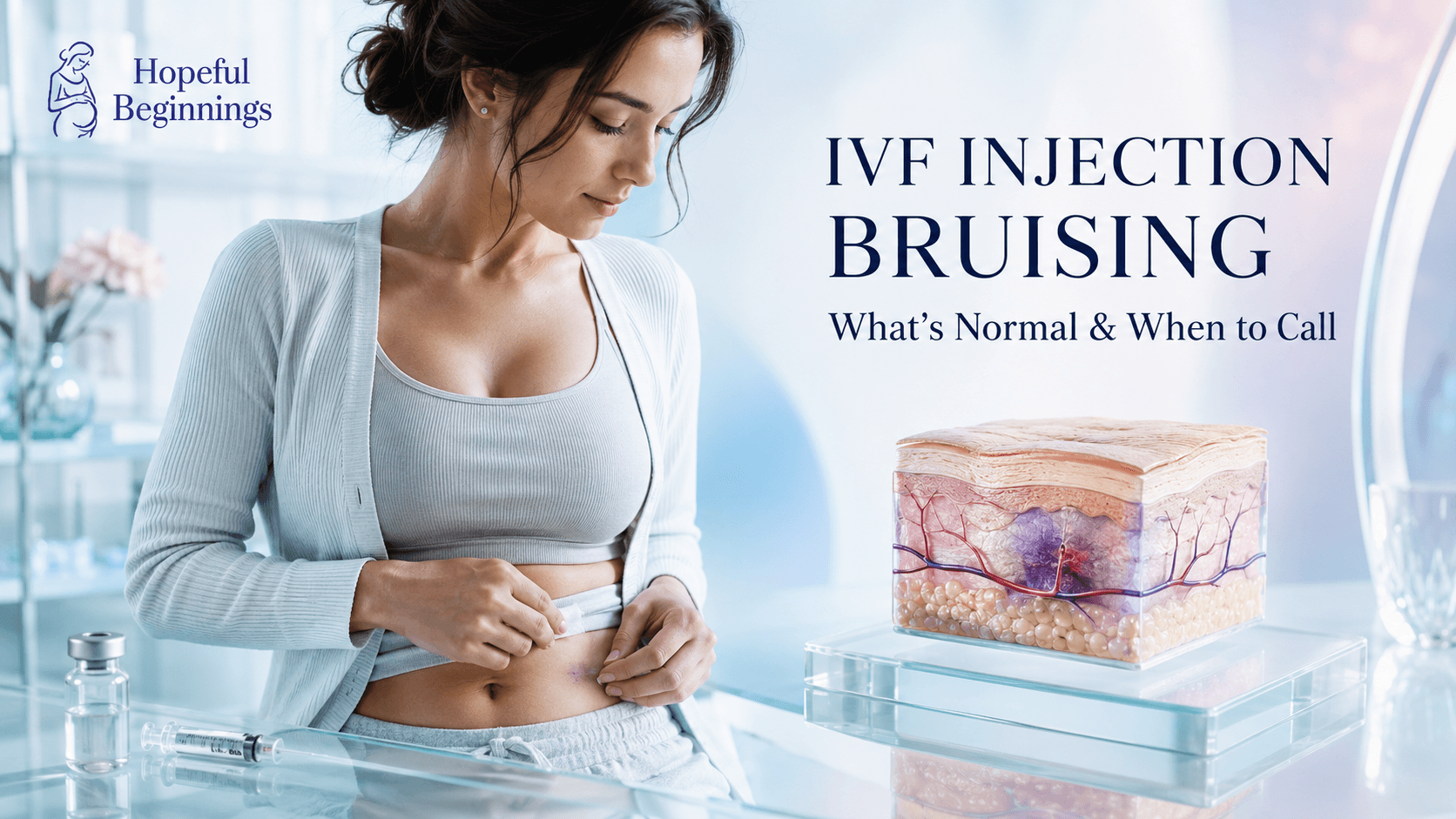

Quick answer: A small, localized bruise after an IVF injection is often an expected injection-site reaction. It usually happens when the needle damages a tiny blood vessel beneath the skin. The area should stay limited and gradually improve rather than become larger, hotter, harder, or more painful.
Contact your fertility clinic if a bruise is rapidly expanding, bleeding will not stop, pain or swelling is getting worse, the area becomes hot or drains fluid, or you develop hives, facial swelling, trouble breathing, severe abdominal symptoms, or any reaction your clinic told you to report. Do not skip, repeat, or change an IVF medication because of bruising unless your prescribing clinic directs you to do so.
Noticing a dark purple mark on your abdomen or hip during fertility treatment can be alarming—especially when every injection feels connected to the outcome of your cycle. Bruising from IVF injections is common enough to be listed in the official prescribing information for several fertility medications. It can happen after a subcutaneous stimulation shot, a trigger injection, or a deeper intramuscular medication.
Still, not every injection-site change should be treated the same way. A flat, coin-sized bruise that becomes lighter is different from redness that spreads, a painful lump that keeps growing, or bleeding that continues despite pressure. The safest approach is to know what ordinary bruising tends to look like, what can make it more likely, and which changes deserve a prompt call to your fertility clinic.
This guide explains IVF injection bruising without replacing the medication-specific instructions from your reproductive endocrinologist, fertility clinic, or dispensing pharmacy. If their directions differ from general information online, follow your care team.
Is Bruising From IVF Injections Normal?
Yes. Mild bruising and soreness at the injection site are recognized side effects of injectable fertility medicines. The American Society for Reproductive Medicine’s patient education resource lists mild injection-site bruising and soreness among possible effects of gonadotropin medications and notes that varying injection sites may help.
Individual drug labels provide additional context. In an assisted reproductive technology study included in the current GONAL-f RFF Redi-ject prescribing information, injection-site bruising was reported among the application-site reactions. Ovidrel’s official labeling also reports injection-site bruising, pain, inflammation, and other local reactions. MENOPUR labeling identifies injection-site pain, reaction, and inflammation among reported adverse effects.
Those labels confirm that a bruise can occur even when a patient is following a clinic-directed protocol. A bruise alone does not prove that the dose was incorrect, that the medication failed, or that the IVF cycle is in danger.
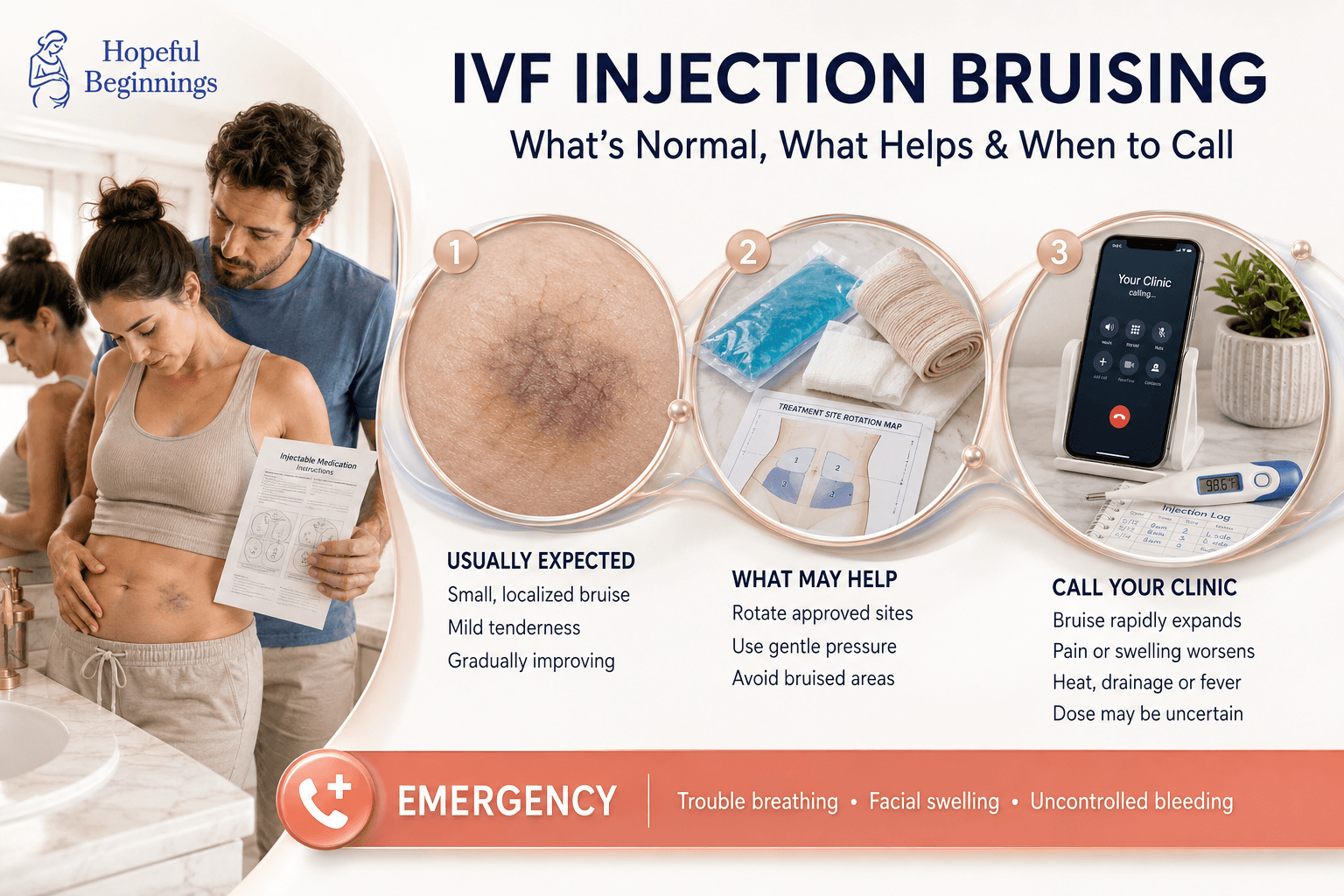
A typical mild injection bruise is usually:
- Limited to the area around the needle entry point
- Flat or only mildly tender
- Not actively bleeding
- Not rapidly increasing in size
- Not hot, draining, or surrounded by spreading redness
- Gradually becoming less tender and changing color as it heals
There is no single IVF-specific healing deadline. What matters most is the direction of change: a simple bruise should trend toward improvement. If it is worsening, persistent, unexplained, or accompanied by other symptoms, contact your clinic.
Why Do IVF Shots Cause Bruising?
A bruise forms when a small amount of blood escapes from a damaged blood vessel and collects beneath the skin. With fertility injections, that can happen when the needle passes through a tiny capillary. The mark may appear immediately or become more visible several hours later.
The abdomen contains many small vessels that cannot always be seen from the surface. Even a short, fine subcutaneous needle may occasionally contact one. A deeper intramuscular injection travels through more tissue, so its soreness or bruising may feel different. Neither experience automatically means the injection was performed incorrectly.
Repeated injections can make the area more sensitive
Ovarian stimulation often requires daily injections, sometimes more than one per day. Using a small area repeatedly can leave less time for the skin and underlying tissue to recover. Tenderness from yesterday’s shot may also make it harder to relax or choose a comfortable site today.
Medication instructions commonly tell patients to vary or rotate sites. MENOPUR’s patient instructions, for example, direct patients to alternate lower-abdominal locations to reduce soreness and skin problems. GONAL-f instructions similarly advise choosing a different injection site each time to reduce irritation and other skin problems. Site rotation should still remain within the areas approved by your fertility clinic for that particular medication.
Pressure after the needle is removed matters
A tiny amount of bleeding may continue briefly after the needle leaves the skin. Gentle, steady pressure with clean gauze can help it stop. Official instructions for MENOPUR advise pressure when bleeding occurs and specifically say not to rub the site. Ovidrel instructions also advise gentle pressure if the injection site bleeds.
Rubbing is not the same as pressure. Vigorous rubbing may irritate the tissue and can spread blood beneath the skin. Medication-specific aftercare varies—especially between subcutaneous medicines and progesterone in oil—so use the method your clinic has approved.
Injection route and medication formulation can change the reaction
Subcutaneous injections deliver medication into fatty tissue beneath the skin. Intramuscular injections go deeper into muscle. A short stimulation needle in the abdomen and a progesterone-in-oil injection in the gluteal muscle are not interchangeable procedures. They can use different needles, angles, sites, preparation steps, and aftercare.
If your clinic prescribed progesterone in oil, use the dedicated Hopeful Beginnings guide to progesterone in oil shots after embryo transfer. For general preparation for smaller abdominal injections, review the clinic-directed information on subcutaneous injections in IVF.
Some medicines and health factors can increase bleeding or bruising
Tell your fertility clinic about every prescription medication, over-the-counter medicine, vitamin, and supplement you take. Aspirin, anticoagulants, antiplatelet drugs, certain supplements, bleeding disorders, low platelet counts, and other health factors may affect bruising. Do not stop a prescribed medication or supplement on your own; the clinician who understands your full treatment plan should make that decision.
Unexplained bruises away from injection sites, frequent nosebleeds, gum bleeding, unusually heavy bleeding, or bruising that seems disproportionate to the injection should also be reported. These patterns may have causes unrelated to injection technique.
IVF Bruise, Injection-Site Reaction, Allergy, or Infection?
Patients often use “bruise” to describe any mark after a shot, but several different reactions can occur. Looking at the color, temperature, size, symptoms, and direction of change can help you describe the problem accurately when you call your clinic. It cannot diagnose the cause at home.
| What you notice | What it may represent | Best next step |
|---|---|---|
| Small blue, purple, green, or yellow mark; mild tenderness; not enlarging | A localized bruise from a small injured blood vessel | Monitor it, avoid reinjecting into the tender area, and follow clinic-approved aftercare |
| Brief redness, itching, stinging, or a small raised area near the site | A local injection-site reaction; some fertility drug labels report these effects | Tell your clinic if it is intense, repeated, worsening, or not resolving |
| Spreading redness, warmth, increasing tenderness, drainage, red streaks, or fever | Possible skin infection or another inflammatory problem | Contact a medical professional promptly; do not inject through the affected area |
| Hives, widespread itching, facial or tongue swelling, wheezing, faintness, or trouble breathing | Possible serious allergic reaction | Seek emergency care for breathing trouble, facial/tongue swelling, or other severe symptoms |
| Rapidly enlarging, firm, very painful swelling or bleeding that will not stop | Possible hematoma or ongoing bleeding | Apply gentle pressure and contact your clinic promptly; seek urgent care if severe |
A small amount of temporary redness can occur after an injection. Infection becomes more concerning when redness expands, the skin feels hot, pain and swelling worsen, or fluid drains from the site. The National Library of Medicine describes increasing redness, warmth, tenderness, swelling, drainage, and fever among features that can occur with cellulitis.
An allergy may also begin at the skin, but it can extend beyond one injection spot. Ganirelix labeling, for example, notes rare postmarketing hypersensitivity reactions, including anaphylaxis, angioedema, and hives. If you develop trouble breathing, swelling of the face, lips, or tongue, faintness, or a rapidly developing widespread reaction, seek emergency care.
What to Do When an IVF Injection Bruises
First, pause and look at the whole situation. Confirm that the injection is complete, place the used needle directly into an appropriate sharps container, and check whether the site is actively bleeding. Do not panic and do not automatically repeat a dose.
1. Use gentle pressure for active bleeding
Place clean gauze over the site and hold gentle, steady pressure. Avoid repeatedly lifting the gauze to check every few seconds because that can disturb early clotting. Do not rub the area. If bleeding does not stop within a few minutes, continues to soak through gauze, or is more than a small surface spot, contact your clinic for instructions.
2. Protect the bruised area from another injection
Do not place the next injection into a visible bruise, a sore knot, broken skin, a rash, or an area of spreading redness unless your prescribing team specifically directs you to use that location. Ask which alternative sites are approved for the exact medication and route. A site that is acceptable for one drug may not be appropriate for another.
3. Follow only medication-approved comfort measures
Patients often ask whether to use ice, heat, massage, or topical products. There is no universal answer for every fertility injection. MENOPUR’s patient instructions include a specific intermittent-ice approach for a sore or red site, while oil-based intramuscular medications may have different clinic-directed aftercare. Follow the package instructions and your fertility clinic’s guidance for the medication you actually received.
Do not place ice directly on bare skin. Do not apply strong heat, deep massage, numbing cream, arnica, essential oils, or other products unless your clinic says they are appropriate. Topical products can irritate skin or make it harder to see whether a reaction is progressing.
4. Photograph and measure a concerning mark
If a bruise or red area seems to be changing, take a clear photo in consistent lighting and note the date and time. Placing a ruler nearby can help show scale. Record whether the area is flat or raised, warm or normal temperature, itchy or painful, and stable or enlarging. This information can help your clinic assess what changed between calls or visits.
5. Keep taking medication exactly as directed unless the clinic changes the plan
A bruise can look dramatic while still being local to the skin. Do not reduce a dose, move a dose to a different time, skip the next injection, change the route, or substitute another needle because of appearance alone. IVF protocols are time-sensitive. Your prescribing fertility clinic should decide whether any treatment change is necessary.
If you are unsure whether the full dose went in: Contact your fertility clinic and describe exactly what happened. Tell them the medication name, dose, scheduled time, actual time, whether the syringe or pen showed any remaining medication, and whether fluid leaked or spilled. A bruise does not tell you how much medication was delivered. Never repeat an uncertain dose unless the clinic instructs you to do so.
How to Reduce Bruising During IVF Injections
No technique can guarantee that you will never bruise. Tiny vessels are not always visible, and some patients bruise more easily than others. The goal is to reduce avoidable tissue irritation while administering every medication exactly as prescribed.
Use the correct medication, route, supplies, and site
Before each injection, compare the medication label with the current written plan. Confirm the prescribed dose, time, route, needle, syringe, and injection site. Some fertility medicines arrive in prefilled syringes or pens; others require reconstitution. Do not assume that yesterday’s supplies or technique apply to a newly added medication.
If the instructions are unclear, contact the fertility clinic or dispensing pharmacy before the dose is due. Professional in-home fertility injection support can also help patients carry out the clinic’s written orders when mixing, positioning, or technique feels overwhelming.
Rotate within the clinic-approved injection area
Use a simple rotation plan so you are not relying on memory. Some patients alternate left and right sides; others divide the approved area into sections and move systematically. Record the date, medication, side, and reaction in a treatment log.
Rotation does not mean choosing any convenient body part. Stay within the site options your clinic provided for that drug. Avoid the navel itself, existing bruises, scars, irritated skin, and tender areas unless your medication instructions say otherwise.
Let the cleansing solution dry
After cleaning the site as directed, allow it to air-dry. Touching or blowing on the cleaned skin can reintroduce contamination. Injecting while the alcohol is still wet may also increase stinging. Do not clean the site and then touch it again while searching for supplies; organize everything first.
Relax the tissue and use one controlled motion
Tensing, twisting, or changing direction while the needle is in the skin may increase tissue irritation. Position yourself securely, breathe normally, and use the angle and insertion technique taught for that device and route. Pen devices, prefilled syringes, reconstituted medications, subcutaneous injections, and intramuscular injections have different instructions.
Do not copy a needle angle from a general video when your clinic or the manufacturer gave you different directions. If your hand shakes, your partner is uncertain, or you cannot comfortably reach the prescribed site, ask for hands-on training or administration support.
Use a new sterile needle and dispose of it immediately
Never reuse a single-use needle. A used needle can become dull, contaminated, and more likely to damage tissue. Place it directly into a sharps container after use. The FDA advises putting used needles and other sharps into a sharps-disposal container immediately and keeping the container away from children and pets.
Apply gentle pressure, not vigorous rubbing
If a small drop of blood appears, use clean gauze and gentle pressure. Keep the motion still. Ask your clinic whether any massage is permitted after the specific medication; this is particularly important because aftercare for a subcutaneous stimulation injection may differ from aftercare for an oil-based intramuscular injection.
Medication-Specific Bruising: What the Labels Show
Fertility medication labels use terms such as bruising, pain, inflammation, edema, redness, or “injection-site reaction.” These categories overlap but are not identical. The presence or absence of bruising in one label does not predict how any individual patient will respond.
| Medication example | Route described in the label | Reported local effects relevant to this guide |
|---|---|---|
| GONAL-f RFF Redi-ject | Subcutaneous | Bruising, pain, inflammation, reaction, and edema at the application site were reported in ART study data |
| MENOPUR | Subcutaneous in the current label | Injection-site pain, reaction, and inflammation are reported; the instructions emphasize site changes and gentle pressure rather than rubbing if bleeding occurs |
| Ganirelix acetate | Subcutaneous | Injection-site reactions are reported; labeling also warns about rare hypersensitivity reactions |
| Ovidrel prefilled syringe | Subcutaneous | Injection-site pain, bruising, inflammation, and reaction appear in clinical-trial adverse-event tables |
This table is not a dosing or administration guide. Brand, generic, and compounded formulations may differ, and manufacturers can update labeling. Check the instructions supplied with your exact product and follow your fertility clinic and pharmacy.
When to Call Your Fertility Clinic About a Bruise
Call your fertility clinic promptly when the reaction is worsening rather than improving, when you cannot confidently classify it as a simple bruise, or when it occurs with other symptoms. A photo and treatment log can be useful, but they should not delay urgent care.
Contact the clinic for any of the following:
- A bruise that rapidly expands or becomes very firm
- Bleeding that does not stop after several minutes of gentle pressure
- Pain, tenderness, or swelling that increases over time
- Redness that spreads beyond the immediate injection spot
- Skin that feels hot, develops red streaks, blisters, or drains fluid
- Fever, chills, or feeling systemically unwell with a local reaction
- Numbness, tingling, weakness, or pain traveling down a limb
- Hives, widespread itching, or swelling beyond the injection site
- Unexplained bruises elsewhere, recurrent bleeding, or many large bruises
- Any concern that the dose, medication, route, timing, needle, or injection site was wrong
Seek emergency care for trouble breathing, swelling of the face or tongue, fainting, chest pain, severe weakness, uncontrolled bleeding, or other emergency symptoms. If you are unsure whether a symptom is an emergency, use the emergency instructions provided by your clinic or call emergency services.
Bruising Is Not the Same as Ovarian Hyperstimulation Syndrome
OHSS is a response inside the body to ovarian stimulation; it is not a skin bruise. A patient can have an ordinary injection-site bruise and still need to watch separately for systemic symptoms during or after stimulation.
ASRM describes worsening OHSS symptoms that require medical attention, including significant abdominal swelling or pain, continued vomiting or inability to tolerate fluids, decreased urination, shortness of breath, and rapid weight gain. Follow the thresholds and call instructions given by your fertility clinic because they know your ovarian response, hormone levels, trigger medication, and retrieval plan.
Do not let a visible bruise distract from more important symptoms elsewhere in the body. Conversely, do not assume abdominal tenderness is only from the ovaries when the skin itself is hot, spreading red, or draining. Report the complete symptom picture.
What Information to Give Your Clinic
A clear report helps your fertility team decide whether the reaction can be monitored, whether technique or supplies should be reviewed, or whether you need an examination. Have the following details ready:
- Medication name and formulation
- Prescribed dose and route
- Scheduled injection time and actual injection time
- Needle and syringe or pen used
- Body location and side
- When the bruise or reaction first appeared
- Approximate size and whether it is changing
- Whether it is flat, raised, warm, itchy, painful, firm, or draining
- Whether bleeding stopped with pressure
- Any medication leakage, spillage, or dose uncertainty
- Other symptoms, including rash, breathing changes, fever, abdominal swelling, vomiting, or decreased urination
- Medicines or supplements that may affect bleeding, if your clinic does not already have the current list
If the concern involves a trigger injection, time matters. Use the clinic’s after-hours number and review Hopeful Beginnings IVF’s guide to IVF trigger shot timing. Do not wait for a bruise to change before reporting a late, early, missed, or uncertain trigger dose.
How Professional In-Home Injection Support Can Help
Professional injection support cannot guarantee that bruising will never happen. It can, however, reduce preventable uncertainty by helping patients follow the fertility clinic’s written instructions for medication verification, preparation, site selection, injection technique, timing, and documentation.
Support may be particularly useful when:
- You bruise repeatedly because the same small area is being used
- You are unsure how to rotate approved injection sites
- A medication must be mixed before administration
- Your treatment adds a new syringe, pen, needle, route, or injection location
- You or your partner becomes shaky or tense during injections
- An intramuscular site is difficult to reach safely
- You need assistance at the exact time prescribed by your clinic
- You want a trained professional to document the reaction and help you communicate it accurately to the prescribing team
Hopeful Beginnings IVF provides clinic-directed fertility injection services in Raleigh, Cary, Apex, Durham, Wake Forest, Knightdale, Wendell, Wake County, Franklin County, Johnston County, and surrounding North Carolina communities. The service supports administration of prescribed injections; the reproductive endocrinologist and fertility clinic remain responsible for medication selection, dosing, monitoring, and medical decisions.
IVF Injections Should Not Feel Like a Solo Test
A small bruise can be part of an otherwise correctly administered injection, but repeated bruising, uncertain technique, and new reactions deserve clear guidance. If you want professional help carrying out your clinic’s injection plan at home, contact Hopeful Beginnings IVF to ask about availability in your area.
Frequently Asked Questions About IVF Injection Bruising
Is it normal to bruise after IVF injections?
Yes. Mild, localized bruising can occur after subcutaneous or intramuscular fertility injections when the needle contacts a small blood vessel. Several fertility medication labels list bruising or other injection-site reactions. A simple bruise should remain limited and gradually improve. Call your clinic if it rapidly expands, becomes increasingly painful or hot, drains fluid, or occurs with other concerning symptoms.
Does bruising mean the IVF medication did not go in?
No. A bruise shows that a small amount of blood entered the tissue; it does not show how much medication was delivered. If the syringe or pen did not empty, medication leaked or spilled, or you are unsure about the dose, contact your fertility clinic. Do not repeat the injection unless the clinic specifically instructs you to.
How long should an IVF injection bruise last?
There is no single IVF-specific healing time. A small bruise commonly changes color and becomes less tender as the body reabsorbs the blood. The trend matters more than an exact day count. Contact your clinic if the bruise is enlarging, not improving, unusually painful, unexplained, or accompanied by ongoing bleeding, warmth, spreading redness, drainage, or fever.
Can I inject into an existing bruise?
Usually, patients are advised to rotate away from bruised, tender, irritated, or broken skin, but approved sites differ by medication and route. Ask your clinic where the next dose should be given. Do not move an injection to a different body area based only on general online advice.
Should I use ice or heat on IVF injection bruising?
Use only the comfort measure approved for your specific medication. Some subcutaneous medication instructions allow a brief cold application for soreness or redness, while oil-based intramuscular injections may have different aftercare. Never place ice directly on skin, and do not use strong heat, deep massage, or topical products without clinic approval.
Why am I suddenly bruising more during IVF?
Repeated injections, using a tender area again, tissue movement, insufficient pressure after bleeding, or individual tendency can contribute. Medicines and supplements that affect bleeding may also matter. Report a sudden increase, large bruises, bruises away from injection sites, or other bleeding to your clinic. Do not stop prescribed medicines on your own.
What does an infected IVF injection site look like?
Possible warning signs include redness that expands, increasing warmth, worsening pain or swelling, drainage, red streaks, or fever. These findings need prompt medical assessment. Do not inject through the affected area, and do not try to diagnose or treat a suspected infection using home remedies.
When is an IVF injection reaction an emergency?
Seek emergency help for trouble breathing, swelling of the face or tongue, fainting, chest pain, uncontrolled bleeding, or other severe symptoms. Also follow your clinic’s emergency plan for severe abdominal pain or swelling, continued vomiting, inability to drink, decreased urination, shortness of breath, or other possible signs of worsening OHSS.
Sources
- American Society for Reproductive Medicine: IVF—What Are the Risks?
- American Society for Reproductive Medicine: Ovarian Hyperstimulation Syndrome
- DailyMed: GONAL-f RFF Redi-ject Prescribing Information
- DailyMed: MENOPUR Prescribing Information
- DailyMed: Ganirelix Acetate Prescribing Information
- DailyMed: Ovidrel Prescribing Information
- National Library of Medicine: Bleeding Into the Skin
- National Library of Medicine: Cellulitis
- U.S. Food and Drug Administration: Proper Sharps Disposal