


Progesterone in Oil Shots After Embryo Transfer: Pain Relief, Timing, and When to Get Help
Progesterone in oil shots can feel like one of the most physically and emotionally demanding parts of an IVF cycle. By the time many patients start progesterone support, they have already completed ovarian stimulation, monitoring appointments, a trigger shot, egg retrieval, fertilization updates, and embryo transfer planning. Then, just when the finish line feels closer, the daily or frequent intramuscular injection routine begins.
For some patients, progesterone in oil injections are manageable with the right technique. For others, they can be uncomfortable, stressful, or difficult to administer correctly at home. The medication is thick, the needle is longer than most subcutaneous IVF needles, and the injection is usually placed deep into the gluteal muscle.
Hopeful Beginnings IVF provides professional in-home fertility injections for patients who want support with IVF medications, including progesterone in oil intramuscular injections, throughout Raleigh, Cary, Apex, Durham, Wake Forest, Knightdale, Wendell, Wake County, Franklin County, Johnston County, and surrounding North Carolina communities.
This guide explains why progesterone may be prescribed during IVF, what progesterone in oil shots do after embryo transfer, how patients can reduce discomfort, what timing issues to watch for, and when to contact your fertility clinic.
Quick Answer: What Should You Know About Progesterone in Oil Shots After Embryo Transfer?
Progesterone in oil, often called PIO, is an intramuscular progesterone injection commonly used in IVF and frozen embryo transfer protocols to support the uterine lining and early pregnancy environment. ReproductiveFacts, the patient education site of the American Society for Reproductive Medicine, explains that IVF medications and procedures may affect the ovaries’ ability to make progesterone, so a doctor may prescribe progesterone supplementation during treatment.
If you are taking progesterone in oil after embryo transfer, follow your fertility clinic’s instructions exactly. Do not skip doses, change timing, switch injection sites, stop progesterone, or adjust your dose unless your clinic tells you to.
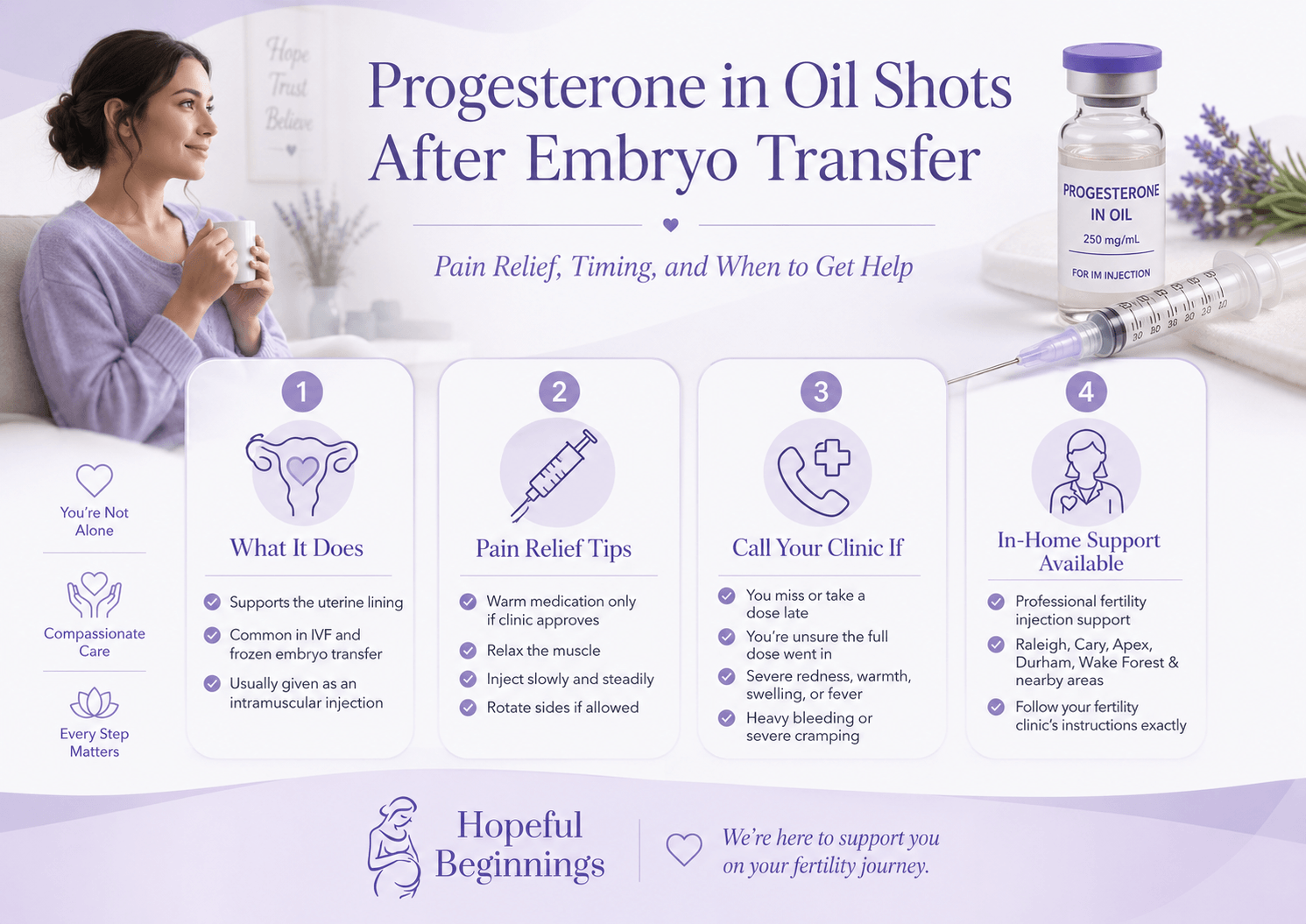
Call your fertility clinic if:
- You miss a dose
- You take a dose late
- You are not sure the full dose went in
- You inject in the wrong location
- You develop a painful lump, severe redness, warmth, swelling, drainage, or fever
- You have an allergic-type reaction
- You have heavy bleeding, severe cramping, or concerning symptoms after transfer
- You are unsure whether to continue progesterone after a pregnancy test
Professional fertility injection service support can help patients feel more confident with the timing, preparation, and technique of progesterone in oil injections at home.
What Is Progesterone in Oil?
Progesterone in oil is an injectable form of progesterone suspended in an oil-based solution. It is usually prescribed as an intramuscular injection, which means the medication is injected into a muscle rather than just under the skin.
DailyMed, a National Library of Medicine resource for drug labeling, describes progesterone injection as a sterile solution of progesterone in a suitable vegetable oil for intramuscular use.
Patients may hear it called:
- Progesterone in oil
- PIO
- Progesterone IM injection
- Intramuscular progesterone
- Progesterone oil shot
- Luteal phase support injection
- Progesterone after embryo transfer
The oil base helps carry the progesterone, but it also makes the medication thicker than many other fertility injections. That thickness can make the shot feel intimidating, especially for patients who are used to smaller subcutaneous needles during ovarian stimulation.
Progesterone in oil is commonly injected into the upper outer area of the gluteal muscle when directed by a fertility clinic. Because the injection is intramuscular, proper site selection and technique matter. Injecting too low, too far inward, too shallow, or into the wrong area can increase discomfort and may raise the risk of irritation or other problems.
Why Is Progesterone Important After Embryo Transfer?
Progesterone helps prepare and support the uterine lining. In a natural menstrual cycle, progesterone rises after ovulation and helps the endometrium become more receptive to an embryo. In IVF, the process is medically controlled, and the body may need supplemental progesterone depending on the protocol.
ReproductiveFacts explains that progesterone supports the uterine lining and helps an embryo implant and grow inside the uterus.
In IVF and frozen embryo transfer cycles, progesterone may be prescribed because:
- Ovarian stimulation medications can change normal hormone patterns
- Egg retrieval can affect the cells that would usually produce progesterone
- Frozen embryo transfer cycles may not involve ovulation
- Medicated transfer protocols may rely on external hormone support
- The clinic wants to support the luteal phase and early implantation window
- Progesterone may be continued into early pregnancy if instructed by the clinic
The exact protocol depends on your fertility clinic, embryo transfer type, medication plan, hormone levels, and medical history.
Progesterone in Oil After Fresh vs. Frozen Embryo Transfer
Progesterone support may be used after both fresh and frozen embryo transfers, but the reason and timing can vary.
Fresh Embryo Transfer
In a fresh IVF cycle, progesterone support usually begins after egg retrieval or around the time instructed by the clinic. The ovaries have been stimulated, eggs have been retrieved, and the clinic may prescribe progesterone to support the uterine lining after the retrieval and transfer process.
Frozen Embryo Transfer
In a frozen embryo transfer cycle, the ovaries may not be producing progesterone naturally, especially in a fully medicated cycle. In that situation, progesterone may be started before embryo transfer so the uterine lining is exposed to progesterone for the correct number of days before the embryo is placed.
This is one reason timing matters. In frozen embryo transfer cycles, progesterone timing may be closely coordinated with embryo age, transfer date, and clinic protocol.
Never change the start date, dose, or timing of progesterone in oil without your fertility clinic’s approval.
Progesterone Support Options Used in IVF
Progesterone can be prescribed in different forms during IVF and embryo transfer cycles. Your fertility clinic will decide which form, dose, and timing schedule fits your treatment plan.
| Progesterone Type | Common Route | What Patients Should Know |
|---|---|---|
| Progesterone in oil | Intramuscular injection | Often used in IVF and frozen embryo transfer protocols. The medication is thick and may cause soreness, bruising, or knots with repeated injections. |
| Vaginal progesterone | Vaginal insert, gel, capsule, or suppository | May cause discharge, irritation, or local discomfort. Timing and dose vary by clinic. |
| Combination support | Injection plus vaginal progesterone or another route | Some fertility clinics use more than one progesterone route depending on protocol, monitoring, and patient history. |
Do not switch from progesterone in oil to another form of progesterone unless your fertility clinic specifically approves the change. Even if another form seems easier or less painful, your clinic’s protocol is based on your treatment plan.
Why Some Clinics Use Progesterone in Oil Instead of Vaginal Progesterone
Some patients use vaginal progesterone, injectable progesterone, oral medications, or a combination depending on the clinic’s protocol.
Progesterone in oil may be chosen because:
- It delivers progesterone by intramuscular injection
- It may be preferred in certain clinic protocols
- It may be used in medicated frozen embryo transfer cycles
- It avoids some vaginal discharge associated with vaginal progesterone
- It may be combined with another progesterone route in selected cases
- The fertility clinic may prefer it based on experience, lab values, or patient history
A review in Nature Reviews Endocrinology explains that luteal phase support during assisted reproductive technology may support implantation and early pregnancy by increasing progesterone levels through hormone supplementation or related approaches.
There is no single progesterone plan that applies to every IVF patient. Your clinic’s instructions should always be treated as the source of truth.
How Long Do Patients Take Progesterone in Oil After Embryo Transfer?
The duration of progesterone in oil injections varies by fertility clinic, protocol, transfer type, pregnancy test result, and early pregnancy monitoring.
Some patients take progesterone until the pregnancy test. Others continue for several weeks if the test is positive. Hopeful Beginnings IVF’s in-home fertility injection information notes that progesterone in oil injections may be used to help prepare the uterus for pregnancy and help maintain it during early pregnancy, with duration determined by the doctor.
Your clinic may tell you to continue progesterone until:
- A negative pregnancy test
- A positive beta hCG with further instructions
- A certain week of pregnancy
- The clinic confirms the placenta is producing enough hormones
- A medication taper is complete
- Another protocol-specific milestone is reached
Do not stop progesterone because of symptoms, bleeding, cramping, side effects, or a home pregnancy test unless your fertility clinic gives you direct instructions.
Why Progesterone in Oil Shots Can Hurt
Progesterone in oil shots can be uncomfortable for several reasons.
The medication is thick. The injection is intramuscular. The gluteal area may become tender with repeated injections. Some patients develop soreness, knots, bruising, or tightness at the injection site.
Common reasons PIO shots may hurt include:
- The oil is cold or thick at the time of injection
- The medication is injected too quickly
- The muscle is tense
- The injection site is too low or in the wrong area
- The same side is used repeatedly
- The needle does not reach the correct muscle depth
- The patient is anxious and clenches the muscle
- The area is already sore from previous injections
- The medication pools in the tissue
- The person giving the shot is nervous or rushed
A painful shot does not always mean something is wrong. However, severe pain, spreading redness, warmth, swelling, drainage, fever, numbness, or pain that worsens should be reported to the fertility clinic.
Where Is Progesterone in Oil Usually Injected?
Progesterone in oil is typically injected into the gluteal muscle when prescribed as an intramuscular injection. Your fertility clinic should tell you exactly where to inject and what needle to use.
Many clinics direct patients to use the upper outer quadrant of the buttock or a nearby gluteal area that avoids major nerves and blood vessels. The exact site can vary by instruction, body type, and clinic preference.
The injection should not be placed randomly into the buttock. Proper site selection helps reduce pain and may lower the risk of complications.
If you are not sure where to inject, ask your fertility clinic or schedule professional expert guidance before your next dose.
Progesterone in Oil Injection Timing: Why Consistency Matters
Progesterone timing after embryo transfer is important because the medication is part of a hormone support plan. Your clinic may tell you to take the shot once daily, twice daily, every other day, or on another schedule.
The timing may be especially important in frozen embryo transfer cycles because the number of progesterone exposure days can be coordinated with embryo development. Your fertility clinic may schedule progesterone based on whether the embryo is a day-3 embryo, day-5 blastocyst, or another stage.
Patients should confirm:
- The date progesterone starts
- The exact time of day to take it
- Whether the time must stay consistent
- Whether doses can vary by a small window
- What to do if a dose is late
- What to do if a dose is missed
- Whether progesterone should continue after transfer
- Whether progesterone should continue after a positive pregnancy test
Never assume progesterone timing is flexible unless your fertility clinic tells you it is.
What Happens If You Miss a Progesterone in Oil Shot?
If you miss a progesterone in oil shot, call your fertility clinic for instructions.
Do not double up unless the clinic tells you to. Do not stop the medication because one dose was missed. Do not assume the transfer failed. The clinic needs to know when the dose was due, when you realized it was missed, and what your current protocol is.
When you call, be ready to share:
- The time the dose was scheduled
- The current time
- The dose amount
- Whether you are before or after embryo transfer
- Your embryo transfer date
- Whether you are pregnant or waiting for beta hCG results
- Whether any other progesterone form is part of your protocol
The clinic will decide what to do based on timing and your treatment plan.
What If You Take Progesterone in Oil Late?
If your progesterone shot is late, follow the instructions your clinic gave you. If you were not given late-dose guidance, contact your clinic.
A slightly late dose and a missed dose may be handled differently. Your clinic may want to know how late it was and whether late dosing has happened before.
Do not make your own schedule changes to “catch up.” Consistency matters, and your clinic needs accurate information.
For patients who struggle to take the injection at the same time each day, flexible scheduling and in-home injection support may help keep the medication routine on track.
What If You Are Not Sure the Full Progesterone Dose Went In?
Call your fertility clinic if you are unsure whether the full dose was administered.
This may happen if:
- Medication leaked out
- The syringe still appears to contain oil
- The needle came out early
- The plunger was not fully depressed
- The needle disconnected from the syringe
- The medication was difficult to inject
- The person giving the shot became nervous
- The injection site bled more than expected
- The dose was prepared incorrectly
Do not automatically repeat the dose. Progesterone dosing decisions should come from your fertility clinic.
A small amount of oil on the skin does not always mean the dose failed, but uncertainty should be reported.
Pain Relief Tips for Progesterone in Oil Shots
Many patients can reduce discomfort with better preparation and technique. Always follow your clinic’s instructions first.
Warm the Medication as Directed
Progesterone in oil is thick. Some patients are instructed to warm the vial or syringe gently before injection so the oil flows more easily. This should only be done in a safe, clinic-approved way.
Do not microwave medication. Do not place medication in boiling water. Do not overheat it.
Ask your clinic or pharmacy how to safely bring the medication closer to body temperature if they allow it.
Relax the Muscle
A tense muscle can make the injection more painful. Before the shot:
- Shift weight off the injection-side leg
- Lie down if instructed or comfortable
- Take slow breaths
- Avoid clenching the gluteal muscle
- Keep the body supported
- Let the person giving the injection know if you need a pause
Patients who self-inject may find it harder to relax the muscle. Professional support can make the process easier because the patient can focus on breathing and positioning instead of handling the needle.
Use the Correct Site
The right site matters. Repeated injections in the wrong area can cause more pain. If you have bruising, knots, or soreness, ask your clinic whether you should rotate sides or adjust the approved site.
Do not inject into areas with:
- Severe bruising
- Redness
- Heat
- Infection signs
- Hard painful lumps
- Broken skin
- Rash
- Numbness
- Unusual swelling
Inject Slowly and Steadily
Because progesterone in oil is thick, a slow and steady injection may feel more comfortable than pushing the medication quickly. The person giving the shot should avoid rushing, especially if the oil is difficult to push through the needle.
Apply Gentle Movement Afterward
Some patients are instructed to walk, gently move, or apply light massage after the injection to help the oil disperse. Others may be told to avoid deep pressure. Follow your clinic’s guidance.
Use Heat or Ice Only If Approved
Some patients use warmth before or after the injection, while others use ice briefly before the shot. Clinics vary in what they recommend. Ask your fertility team what is appropriate for your medication and situation.
Rotate Sides If Your Clinic Allows It
Alternating sides may help reduce repeated irritation in one area. However, follow your clinic’s site instructions and do not inject into unapproved areas.
Progesterone in Oil Knots: What Are They?
A “knot” after a PIO shot is usually a firm, sore area under the skin or in the muscle. It may happen when oil collects in the tissue, the muscle becomes irritated, or repeated injections cause localized inflammation.
Common knot-related symptoms include:
- Firmness at the injection site
- Tenderness
- Mild bruising
- Soreness when sitting
- A small lump that improves over time
- Tightness in the gluteal area
A mild knot can be common with repeated intramuscular injections, but some symptoms need medical attention.
Call your fertility clinic if a lump is:
- Getting larger
- Very painful
- Warm to the touch
- Red or spreading
- Draining fluid or pus
- Associated with fever
- Associated with numbness, tingling, or shooting pain
- Not improving
- Making it difficult to walk or sit
Bruising After Progesterone in Oil Shots
Mild bruising can happen after intramuscular injections. A small blood vessel may be irritated by the needle. Bruising may look concerning, but it is not always dangerous.
To reduce bruising risk:
- Use the correct site
- Avoid injecting into bruised areas
- Keep the muscle relaxed
- Use steady technique
- Apply gentle pressure with gauze afterward if instructed
- Avoid rubbing aggressively unless your clinic tells you to massage
Call your clinic if bruising is severe, expanding, unusually painful, or accompanied by swelling, warmth, or other concerning symptoms.
When Progesterone in Oil Pain Is Not Normal
Some soreness is expected for many patients, especially with daily injections. Severe or worsening symptoms should not be ignored.
Contact your fertility clinic if you notice:
- Severe pain during or after the injection
- Pain that shoots down the leg
- Numbness or tingling
- Trouble walking
- Large swelling
- Skin that feels hot
- Redness that spreads
- Drainage from the injection site
- Fever
- Hives or rash
- Shortness of breath
- Chest tightness
- Dizziness or fainting
- Heavy bleeding
- Symptoms your clinic warned you about
For severe allergic symptoms, trouble breathing, chest pain, fainting, or any medical emergency, seek emergency medical care.
Progesterone in Oil vs. Subcutaneous IVF Injections
Many patients are surprised by how different progesterone in oil feels compared with stimulation medications.
Subcutaneous IVF injections are placed into the fatty tissue under the skin. They often use smaller needles and are commonly given in the abdomen.
Progesterone in oil injections are typically intramuscular. They usually involve a longer needle and thicker medication. The injection site is usually in the gluteal muscle when directed by the clinic.
Patients who have already completed stimulation injections may still feel nervous when progesterone starts. That is normal. The experience is different.
Hopeful Beginnings IVF’s guide to subcutaneous vs. intramuscular IVF injections explains the differences between these injection types in more detail.
Can You Self-Inject Progesterone in Oil?
Some patients self-inject progesterone in oil, but many prefer help because the injection site can be difficult to reach and the medication is thick.
Self-injection may be harder if:
- You are nervous around needles
- You have limited mobility
- You cannot comfortably reach the injection area
- You are unsure of the correct site
- You have daily injections
- You are already bruised or sore
- You feel faint with injections
- The syringe is difficult to push
- Your partner or support person is unavailable
If self-injection feels stressful, professional in-home injection support can help you follow your clinic’s instructions while reducing the emotional load of doing it alone.
Can a Partner Give Progesterone in Oil Shots?
A partner can often help if the fertility clinic allows home administration and the partner understands the instructions.
A partner should be comfortable with:
- Confirming medication name and dose
- Preparing the syringe
- Identifying the correct injection site
- Using the correct needle
- Keeping the muscle relaxed
- Injecting slowly and steadily
- Disposing of the needle safely
- Watching for concerning symptoms
- Calling the clinic if something goes wrong
Some partners do very well with training. Others feel anxious about giving a deep injection. A nervous partner may unintentionally rush, hesitate, inject in the wrong location, or cause the patient to tense up.
Professional support can reduce stress for both people.
How In-Home Progesterone Injection Support Helps
Hopeful Beginnings IVF helps patients follow their clinic’s injection instructions in the comfort of home.
In-home support can help with:
- Medication organization
- Dose confirmation based on written instructions
- Correct intramuscular technique
- Proper site selection according to clinic guidance
- Timing consistency
- Reducing injection anxiety
- Supporting patients who feel faint
- Helping with hard-to-reach injection areas
- Offering calm reassurance during the process
- Reducing stress for partners or family members
Hopeful Beginnings IVF does not replace your fertility clinic. Your clinic remains responsible for your medication orders, protocol, monitoring, pregnancy testing, and treatment decisions. Hopeful Beginnings IVF supports the injection process based on your clinic’s written instructions.
What to Have Ready for a Progesterone in Oil Injection Appointment
Before your appointment, prepare:
- Progesterone in oil vial
- Syringe
- Correct needle or needles
- Alcohol pads
- Gauze
- Bandage if needed
- Sharps container
- Written fertility clinic instructions
- Pharmacy instructions
- Clinic contact number
- Clean surface
- Good lighting
- Comfortable place to sit, stand, or lie down
- Any timing instructions from the clinic
Keep medication packaging available. Do not discard the box, label, or instructions until the injection is complete.
If your clinic changes your dose or timing, notify your injection support provider promptly.
Questions to Ask Your Fertility Clinic About Progesterone in Oil
Before starting progesterone in oil, ask your clinic:
- What date should I start progesterone?
- What time should I take each dose?
- How strict is the timing?
- What dose should I use?
- What needle size should I use?
- Where exactly should the injection go?
- Should I rotate sides?
- Should I warm the medication?
- Should I use heat or ice?
- What should I do if I miss a dose?
- What should I do if a dose is late?
- What should I do if medication leaks out?
- When should I stop progesterone?
- Should I continue after a positive pregnancy test?
- What symptoms should I report immediately?
- Who do I call after hours?
These questions can prevent confusion later, especially during the two-week wait when emotions are already high.
The Emotional Side of Progesterone Shots After Transfer
Progesterone in oil shots often happen during one of the most emotionally intense parts of IVF: the waiting period after embryo transfer.
Patients may feel hopeful, anxious, protective, exhausted, or afraid to make a mistake. Every injection can feel connected to the outcome, even though IVF success depends on many factors beyond a patient’s control.
It is common to feel:
- Nervous before each shot
- Frustrated by soreness
- Tired of daily injections
- Worried about symptoms
- Unsure whether cramping or spotting is meaningful
- Afraid to move normally after transfer
- Hyperaware of every body sensation
- Emotionally drained during the wait for beta hCG testing
Support matters during this stage. Professional injection help does not remove all of the uncertainty, but it can make the daily medication routine feel less overwhelming.
Can Progesterone Cause Pregnancy-Like Symptoms?
Yes. Progesterone can cause symptoms that overlap with early pregnancy symptoms.
Possible progesterone-related symptoms may include:
- Breast tenderness
- Bloating
- Fatigue
- Mood changes
- Cramping
- Nausea
- Constipation
- Headaches
- Sleepiness
- Pelvic heaviness
These symptoms do not confirm pregnancy. They also do not rule pregnancy out. During IVF, medications can make symptom tracking confusing.
Follow your clinic’s testing schedule. Do not stop medications based on symptoms or home pregnancy tests unless your clinic instructs you.
Can You Bleed While Taking Progesterone?
Some patients experience spotting or bleeding during progesterone support. This can be frightening after embryo transfer.
Bleeding can happen for different reasons, and only your fertility clinic can interpret it based on your treatment timeline. Do not stop progesterone unless your clinic tells you to. Call your clinic if you have spotting, bleeding, cramping, or any symptom they instructed you to report.
Seek urgent care for heavy bleeding, severe pain, fainting, or emergency symptoms.
Progesterone in Oil and Allergies: What to Watch For
Progesterone in oil may be compounded or manufactured with different oil bases, depending on the prescription and pharmacy. Some formulations may use sesame oil or another oil vehicle. DailyMed labeling for some progesterone injection products identifies progesterone as being prepared in sesame oil and intended for intramuscular use.
Tell your fertility clinic and pharmacy about any allergies before starting medication, especially allergies to sesame, peanut, cottonseed, ethyl oleate, preservatives, or prior injectable medications.
Call your clinic if you develop:
- Rash
- Hives
- Itching
- Swelling
- Worsening redness
- Trouble breathing
- Chest tightness
- Dizziness
- Severe injection site reaction
For trouble breathing, throat swelling, chest tightness, or severe allergic symptoms, seek emergency care.
Should You Continue Progesterone After a Positive Pregnancy Test?
Follow your fertility clinic’s instructions.
Many IVF patients continue progesterone after a positive beta hCG test, but the duration varies. Your clinic may continue progesterone until a specific gestational week, until ultrasound confirmation, or until another milestone. Other patients may be given different instructions.
Do not stop progesterone because the test is positive unless your clinic says to stop.
Also, do not continue or change medication on your own beyond the clinic’s protocol. Fertility medication decisions should be directed by your medical team.
What If Progesterone in Oil Is Too Painful to Continue?
If progesterone in oil becomes too painful, call your fertility clinic. Do not stop on your own.
Your clinic may evaluate:
- Injection technique
- Site placement
- Needle length
- Medication temperature
- Rotation pattern
- Possible reaction to the oil
- Whether another progesterone route is appropriate
- Whether professional injection support may help
- Whether symptoms suggest infection or another concern
Some patients tolerate progesterone in oil much better after technique changes. Others may need medical guidance about alternatives. Only your fertility clinic can decide what is appropriate.
Related IVF Injection Resources
Progesterone in oil shots are one part of a broader IVF medication plan. Patients who want additional guidance may also find these Hopeful Beginnings IVF resources helpful:
- IVF trigger shot timing
- Trigger shot at home in Raleigh
- IVF injections at home in Raleigh
- In-home IVF injection service
- Subcutaneous vs. intramuscular IVF injections
Local Support for Progesterone in Oil Shots in Raleigh, Cary, and the Triangle
Hopeful Beginnings IVF provides compassionate, professional injection support for fertility patients who want help with progesterone in oil shots and other IVF medications.
Patients often request help because:
- Progesterone shots are painful
- The injection site is hard to reach
- The needle feels intimidating
- Their partner is nervous
- They need consistent timing
- They have knots or soreness
- They are traveling during treatment
- They are overwhelmed after embryo transfer
- They want a trained professional to administer the injection
- They want the routine to feel calmer
Hopeful Beginnings IVF serves patients throughout Raleigh, Cary, Apex, Durham, Wake Forest, Knightdale, Wendell, Wake County, Franklin County, Johnston County, and nearby communities.
Patients can learn more through In-Home Fertility Injections, IVF Injections, Oil Intramuscular Injections, and Fertility Injection Service.
Progesterone in Oil Injection Checklist
Use this checklist to prepare for each injection.
Before the First Dose
- Confirm the progesterone start date.
- Confirm the exact dose.
- Confirm the injection time.
- Confirm the injection site.
- Confirm needle and syringe size.
- Ask whether the medication should be warmed.
- Ask whether you should rotate sides.
- Ask what to do if a dose is missed or late.
- Save your clinic’s after-hours contact number.
- Schedule professional support if needed.
Before Each Injection
- Wash your hands.
- Check the medication label.
- Confirm the dose.
- Gather supplies.
- Choose the clinic-approved injection site.
- Avoid areas with severe bruising, redness, or swelling.
- Relax the muscle.
- Inject slowly and steadily.
- Dispose of the needle safely.
- Record the time if your clinic wants tracking.
After Each Injection
- Follow your clinic’s aftercare instructions.
- Watch for unusual pain, redness, warmth, or swelling.
- Rotate sides if allowed.
- Keep taking medication until your clinic tells you to stop.
- Call the clinic with concerns.
The Bottom Line on Progesterone in Oil Shots After Embryo Transfer
Progesterone in oil shots are an important part of many IVF and embryo transfer protocols. They help support the hormone environment needed during the luteal phase and early pregnancy window, but they can also be physically uncomfortable and emotionally stressful.
If your progesterone shot is painful, late, missed, uncertain, or difficult to administer, contact your fertility clinic for medical instructions. Do not stop, skip, double, or change doses unless your clinic tells you to.
If progesterone in oil shots feel painful, stressful, or difficult to manage consistently, Hopeful Beginnings IVF can help. Professional in-home fertility injection support gives patients calm, experienced assistance with clinic-directed progesterone injections throughout Raleigh, Cary, Apex, Durham, Wake Forest, Knightdale, Wendell, and surrounding North Carolina communities.
When fertility injections feel overwhelming, you do not have to do them alone.
Frequently Asked Questions About Progesterone in Oil Shots After Embryo Transfer
What is progesterone in oil?
Progesterone in oil is an injectable form of progesterone suspended in an oil-based solution. It is usually given as an intramuscular injection, meaning the medication is injected into the muscle. In IVF and embryo transfer cycles, progesterone in oil may be prescribed to support the uterine lining and help create the hormone environment needed during the implantation and early pregnancy window.
Why do IVF patients take progesterone after embryo transfer?
IVF patients may take progesterone after embryo transfer because ovarian stimulation medications, egg retrieval, and certain transfer protocols can affect the body’s natural progesterone production. Progesterone helps support the uterine lining and is commonly used for luteal phase support during IVF. The exact form, dose, start date, and stop date should always come from the fertility clinic.
Are progesterone in oil shots always required after embryo transfer?
No. Not every patient uses progesterone in oil. Some clinics prescribe vaginal progesterone, injectable progesterone, oral medication, or a combination. The best protocol depends on the clinic’s approach, the type of transfer, hormone monitoring, patient history, and treatment plan. Patients should not switch forms or stop progesterone unless their fertility clinic gives specific instructions.
How long do you take progesterone in oil after embryo transfer?
The duration varies by clinic and treatment protocol. Some patients take progesterone until the pregnancy test, while others continue for several weeks after a positive beta hCG result. The fertility clinic may stop, continue, or taper progesterone based on test results, ultrasound findings, pregnancy timing, and individual medical factors. Patients should continue exactly as instructed until their clinic says otherwise.
Why do progesterone in oil shots hurt?
Progesterone in oil shots can hurt because the medication is thick, oil-based, and injected into the muscle. Repeated injections can also cause soreness, bruising, knots, or tenderness. Pain may be worse if the muscle is tense, the medication is cold, the injection is given too quickly, or the site is not correct. Severe pain, spreading redness, warmth, drainage, fever, numbness, or pain down the leg should be reported to the fertility clinic.
How can I make progesterone in oil shots less painful?
Patients may be able to reduce discomfort by relaxing the muscle, using the clinic-approved injection site, injecting slowly, rotating sides if allowed, and following clinic-approved instructions about warming the medication or using heat. Do not microwave or overheat medication. Ask your fertility clinic before changing technique, using heat or ice, or adjusting the injection routine.
What should I do if I miss a progesterone in oil shot?
Call your fertility clinic for instructions. Do not double the next dose unless your clinic specifically tells you to. Tell the clinic when the dose was due, when you realized it was missed, whether you are before or after embryo transfer, and whether you are waiting for or already have pregnancy test results. The clinic will decide the next step based on your protocol.
What if I take my progesterone shot late?
If your progesterone shot is late, follow any late-dose instructions from your fertility clinic. If you do not have instructions, contact the clinic. Tell them how late the dose was and whether this has happened before. Do not change your schedule or take extra progesterone unless the clinic tells you to.
What if I am not sure the full progesterone dose went in?
Contact your fertility clinic if you are not sure the full dose was administered. Do not automatically repeat the injection. The clinic may ask whether medication leaked, whether the syringe looked empty, whether the needle came out early, or whether the medication was difficult to push. Small droplets do not always mean the dose failed, but uncertainty should be reported.
Are knots after progesterone in oil shots normal?
Small sore knots can happen with repeated progesterone in oil injections, especially when the medication is thick or the same area becomes irritated. However, a lump that is getting larger, very painful, hot, red, draining, associated with fever, or causing numbness or trouble walking should be reported to the fertility clinic.
Can progesterone in oil cause pregnancy symptoms?
Progesterone can cause symptoms that overlap with early pregnancy symptoms, including bloating, breast tenderness, fatigue, mood changes, constipation, cramping, and nausea. Symptoms alone cannot confirm whether an embryo transfer worked. Patients should follow their clinic’s pregnancy testing schedule and continue medications exactly as directed.
Can I stop progesterone if my pregnancy test is positive?
Do not stop progesterone after a positive pregnancy test unless your fertility clinic tells you to. Many IVF patients continue progesterone for a period of time after a positive beta hCG result, but the duration varies by protocol. Your clinic will tell you when to continue, stop, or taper.
Can I stop progesterone if my pregnancy test is negative?
Do not stop progesterone until your fertility clinic gives you instructions. Some clinics want bloodwork confirmation before stopping medication. Others may give specific instructions after a negative beta hCG. Follow your clinic’s process rather than relying only on a home pregnancy test.
Can a nurse or trained professional give progesterone in oil shots at home?
Yes. Hopeful Beginnings IVF provides in-home fertility injection support for patients who want professional help with progesterone in oil shots. This can be helpful when the injection site is hard to reach, the patient is nervous, the partner is uncomfortable giving injections, or consistent timing is difficult. Professional injection support follows the fertility clinic’s written medication instructions.
When should I call my fertility clinic about progesterone in oil side effects?
Call your clinic if you have severe pain, spreading redness, warmth, swelling, drainage, fever, rash, hives, numbness, tingling, pain down the leg, heavy bleeding, severe cramping, or symptoms your clinic warned you about. For trouble breathing, chest tightness, fainting, or other emergency symptoms, seek emergency medical care.
Sources
- ReproductiveFacts: Progesterone Supplementation During IVF
- ReproductiveFacts: In Vitro Fertilization Treatment Journey
- DailyMed: Progesterone Injection, Solution
- DailyMed: Drug Labeling Database
- Nature Reviews Endocrinology: Luteal Phase Support in Assisted Reproductive Technology
- American Society for Reproductive Medicine: Practice Guidance