



IVF treatment can feel hopeful, emotional, and overwhelming all at once. For many patients, the most stressful part is not the appointments, ultrasounds, or lab updates. It is the moment they bring fertility medications home and realize they now have to mix, time, and administer injections correctly.
For patients in Raleigh, Cary, Apex, Durham, Wake Forest, Knightdale, Wendell, Wake County, Franklin County, and Johnston County, professional in-home IVF injection support can make this part of fertility treatment feel more manageable. Hopeful Beginnings provides concierge IVF injection services designed to help patients receive fertility injections safely, comfortably, and on schedule in the privacy of their home. The practice lists in-home injections, expert guidance, and flexible scheduling as core service areas, with injection plans that include stimulation-cycle subcutaneous injections, progesterone in oil intramuscular injections, trigger injections, and instructional teaching.
IVF injections are not just routine shots. They are time-sensitive medications that support ovarian stimulation, egg maturation, ovulation timing, embryo transfer preparation, and early pregnancy support. During an IVF cycle, fertility clinics monitor patients with bloodwork and ultrasound imaging so medication doses and timing can be adjusted based on follicle growth and hormone response. Hopeful Beginnings’ IVF injection guide explains that the injection phase often begins early in the menstrual cycle and may involve once- or twice-daily injections for approximately 8 to 14 days, depending on ovarian response.
This guide explains what IVF injections do, why timing matters, which injections are most common, when professional help may be worth considering, and how Raleigh-area patients can prepare for a smoother treatment experience.
What Are IVF Injections?
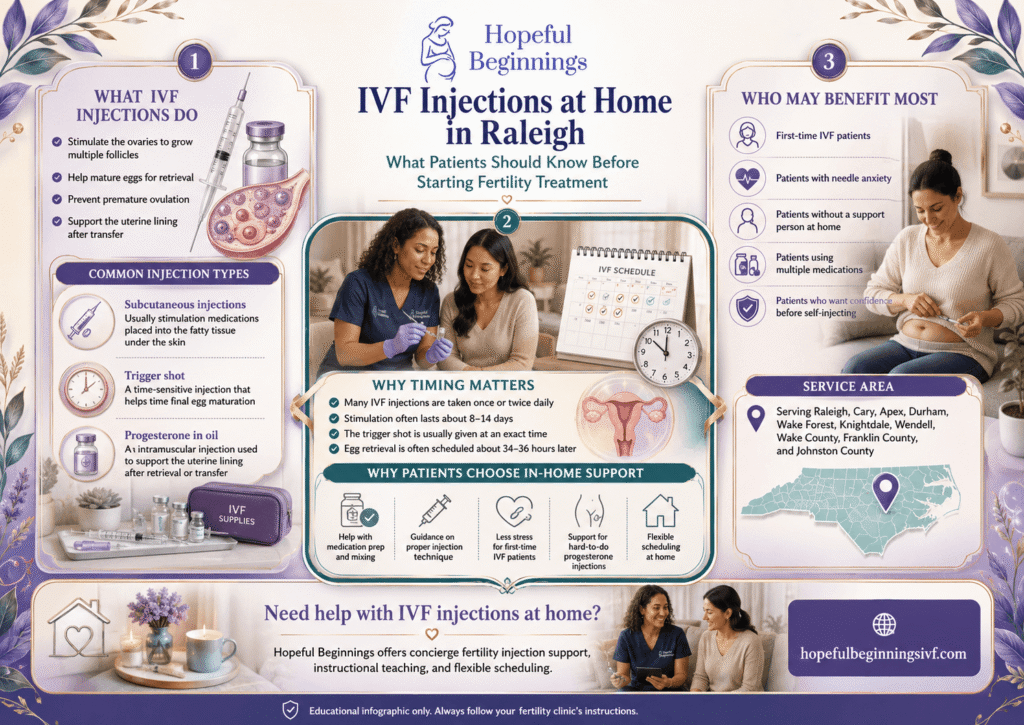
IVF injections are injectable fertility medications used during in vitro fertilization to help regulate hormones, stimulate the ovaries, mature eggs, prevent premature ovulation, trigger final egg maturation, and support the uterine lining after embryo transfer.
In a natural menstrual cycle, the body usually develops and releases one egg. During IVF, fertility medications encourage the ovaries to develop multiple follicles so the fertility team may retrieve more than one mature egg for fertilization. Hopeful Beginnings explains that IVF medications help stimulate the ovaries, regulate hormone levels, and allow fertility specialists to carefully control egg development during a treatment cycle.
Most IVF patients will encounter several types of injections during treatment. These may include stimulation medications, medications that prevent premature ovulation, the trigger shot, and progesterone support after retrieval or embryo transfer. The exact protocol depends on the fertility clinic, ovarian reserve, age, diagnosis, medication response, prior cycle history, and physician recommendations.
For patients searching for IVF injections, the key point is this: these medications are powerful because they are precise. The right medication has to be administered at the right dose, by the right route, at the right time.
Why IVF Injection Timing Matters
IVF injection timing matters because fertility medications are used to coordinate ovarian stimulation, follicle growth, ovulation prevention, final egg maturation, egg retrieval timing, and luteal-phase support. Even small timing errors can create stress and may require guidance from the fertility clinic.
During stimulation, medications are often administered daily. Monitoring appointments allow the fertility physician to track follicle growth, measure hormone levels, adjust medication dosing, and determine when the trigger shot should be given. Hopeful Beginnings’ IVF injection timeline notes that egg retrieval is typically scheduled approximately 34 to 36 hours after the trigger injection.
That narrow window is one reason the trigger shot is often one of the most anxiety-producing injections in the IVF process. Patients may be told to administer it at an exact time, sometimes late at night. If the trigger shot is given too early, too late, incorrectly mixed, or administered through the wrong route, the patient should contact the fertility clinic immediately for instructions.
This does not mean patients should panic. It means they should prepare. Many people successfully self-administer IVF injections after proper instruction. Others feel more confident using a professional fertility injection service, especially for the first few days, trigger shot, or progesterone in oil injections.
The Main Types of IVF Injections Patients May Use
Most IVF injection protocols include several categories of medication. Names and instructions vary by clinic, so patients should always follow the protocol provided by their reproductive endocrinologist or fertility nurse.
Ovarian Stimulation Injections
Ovarian stimulation injections are usually given during the first major injection phase of IVF. These medications help multiple follicles develop at the same time.
Common stimulation medications may include:
| Medication Type | Common Examples | General Purpose |
|---|---|---|
| FSH medications | Gonal-F, Follistim | Support follicle development |
| FSH/LH combination medications | Menopur | Support ovarian stimulation |
| GnRH antagonist medications | Ganirelix, Cetrotide | Help prevent premature ovulation |
| Trigger medications | hCG, Ovidrel, Lupron trigger, dual trigger protocols | Support final egg maturation before retrieval |
| Progesterone support | Progesterone in oil, vaginal progesterone, other physician-directed forms | Support the uterine lining after retrieval or transfer |
Hopeful Beginnings notes that fertility injections can include FSH and LH to help eggs develop, hCG trigger shots to prompt ovulation timing, and progesterone to stabilize and nourish the uterine lining after transfer.
Subcutaneous IVF Injections
Subcutaneous IVF injections are injections placed into the fatty tissue just under the skin. MedlinePlus defines a subcutaneous injection as one given in the fatty tissue under the skin, and Hopeful Beginnings explains that many stimulation medications are delivered this way because the route allows hormones to be absorbed predictably.
Common subcutaneous injection sites may include the lower abdomen or upper thigh. Patients are typically instructed to rotate injection sites, clean the area, prepare medication carefully, and dispose of needles safely. For many patients, subcutaneous injections become easier after the first few doses, but the first night can still feel intimidating.
Patients who are nervous about mixing medications, choosing the injection site, using the correct needle, or administering the shot at the correct angle may benefit from subcutaneous IVF injection support, especially early in the stimulation cycle.
The IVF Trigger Shot
The trigger shot is one of the most time-sensitive injections in an IVF cycle. It is given when the fertility clinic determines that follicles have reached the appropriate stage for final egg maturation.
The trigger injection may include hCG, a GnRH agonist such as Lupron, or a dual-trigger protocol, depending on the physician’s plan. Hopeful Beginnings explains that the trigger injection signals final egg maturation and helps time ovulation so eggs can be retrieved at the optimal moment.
Because the trigger shot is directly tied to retrieval timing, patients should review instructions before trigger night. That includes confirming the medication name, dose, route, syringe, needle, mixing instructions, storage requirements, and exact administration time.
Progesterone in Oil Injections
Progesterone in oil, often called PIO, is an intramuscular injection commonly used after egg retrieval or embryo transfer to support the uterine lining. ASRM’s patient education material explains that progesterone supplementation is often prescribed during IVF because medications used to prevent premature ovulation can affect the ovary’s ability to make progesterone; progesterone supports the uterine lining and helps an embryo implant and grow.
Hopeful Beginnings describes progesterone in oil as a medication that helps the uterine lining stay receptive and strong while the body prepares for or supports early pregnancy after embryo transfer. The practice also notes that these injections are administered in the gluteal/buttock muscle and may continue for 10 to 12 weeks or as determined by the patient’s physician.
PIO injections can be harder for patients to self-administer because they are intramuscular, often use a longer needle, and may involve thicker oil-based medication. This is one of the most common reasons patients seek progesterone in oil intramuscular injection support.
Why Patients Choose In-Home IVF Injection Support
Patients choose in-home IVF injection support for safety, comfort, timing, confidence, and emotional relief. IVF already involves medical decisions, financial planning, frequent appointments, and waiting periods. Removing the stress of medication preparation and injection technique can make the process feel more controlled.
Hopeful Beginnings states that professional in-home fertility injections allow patients to avoid extra clinic visits while receiving support in the comfort of their home. The service page also emphasizes expert handling of medications, proper injection techniques, and on-the-spot guidance for last-minute concerns.
1. Medication Preparation Can Be Confusing
Some IVF medications arrive in prefilled pens. Others require mixing, drawing medication into a syringe, changing needles, checking doses, or combining vials. Medications may also have specific storage requirements.
Hopeful Beginnings notes that IVF medications such as Menopur, Cetrotide, and Pregnyl may require precise preparation, including reconstituting powders or storing medications at specific temperatures.
A professional injection provider can help reduce confusion by confirming the medication, preparing it according to the fertility clinic’s instructions, and administering it through the correct route.
2. Injection Route Matters
Some IVF injections are subcutaneous. Others are intramuscular. Some medications may come with multiple needle sizes, where one needle is used to draw medication and another is used to inject it.
The injection route affects where the medication is delivered and how it is absorbed. Using the wrong route may require immediate guidance from the fertility clinic. Patients should never guess when instructions are unclear.
3. Timing Can Be Stressful
Timing is one of the biggest challenges in IVF. Hopeful Beginnings’ flexible scheduling page explains that medications such as Gonal-F and Ovidrel need to be administered at precise intervals to synchronize the body’s hormonal response with the IVF cycle.
This matters for busy professionals, parents, shift workers, patients traveling between Raleigh and fertility clinic appointments, and couples managing injections around work, childcare, or evening monitoring updates.
4. Progesterone in Oil Can Be Physically Difficult
PIO injections are often administered in the upper outer gluteal area. Many patients rely on a partner, spouse, friend, or nurse because the injection site can be difficult to reach comfortably and accurately alone.
Professional support may be especially valuable when a patient has needle anxiety, bruising, soreness, prior injection discomfort, limited mobility, or uncertainty about site placement.
5. Emotional Support Matters
IVF injections are not only technical. They can be emotional. Patients may feel pressure because each dose feels connected to the outcome of the cycle.
Hopeful Beginnings’ expert guidance page emphasizes reassurance, emotional support, medication education, and helping patients feel informed and empowered throughout the process.
That reassurance can be clinically practical and emotionally grounding.
In-Home IVF Injections vs. Self-Injections
Many patients can safely self-administer fertility injections after training from their fertility clinic. Others prefer professional injection support for some or all of the cycle.
| Option | Best For | Potential Advantages | Potential Drawbacks |
|---|---|---|---|
| Self-injections | Confident patients with clear instructions and manageable schedules | Flexible, no added service appointment, often less costly | Can be stressful; medication mixing or timing mistakes may feel overwhelming |
| Partner-administered injections | Patients with a reliable support person | Helpful for hard-to-reach injections like PIO | Partner may feel nervous or unsure |
| Professional in-home injections | Patients who want clinical support, precision, and reassurance | Professional technique, timing support, reduced anxiety, home convenience | Requires scheduling and service cost |
| Instructional teaching | First-time IVF patients or patients transitioning to self-injection | Builds confidence and independence | May still require practice and follow-up |
The right choice depends on the patient’s comfort level, protocol complexity, schedule, medication route, and support system.
For many Raleigh-area patients, the best solution is hybrid support: professional help for the first night of stimulation, the trigger shot, and progesterone in oil, while self-administering simpler injections once they feel confident.
Who May Benefit Most From Professional IVF Injection Support?
Professional IVF injection support may be especially helpful for:
- First-time IVF patients
- Patients with needle anxiety
- Patients using multiple injectable medications per day
- Patients taking medications that require mixing
- Patients with a precise trigger shot time
- Patients using progesterone in oil
- Patients without a partner or support person at home
- Patients with work schedules that make clinic visits difficult
- Patients who previously had bruising, pain, or uncertainty with injections
- Patients who want one-on-one education before self-administering
Hopeful Beginnings offers instructional teaching as an option and describes it as a first-session recommendation to help patients become comfortable preparing medications and injections one-on-one.
This type of support can be particularly valuable for patients who do not want to rely solely on online videos or printed instructions.
Local IVF Injection Support in Raleigh, Cary, Apex, Durham, and the Triangle
Local access matters during IVF because medication timing often happens outside traditional office hours. Patients may receive same-day instructions after monitoring appointments. A dose may be scheduled early in the morning, during the evening, or late at night. The trigger shot may fall at an inconvenient time.
Hopeful Beginnings states that it proudly serves Raleigh, Cary, Apex, Durham, Wake Forest, Knightdale, Wendell, Wake County, Franklin County, and Johnston County.
For patients searching “IVF injections near me,” “fertility injection nurse Raleigh,” “PIO injection help Cary,” or “trigger shot help Triangle NC,” local availability can be the difference between feeling rushed and feeling supported.
Patients should confirm service availability, appointment windows, after-hours options, and travel coverage before the cycle begins. IVF schedules can change quickly, so it is best to contact an injection service before stimulation starts rather than waiting until trigger night or transfer week.
How IVF Injection Support Fits Into the Bigger Fertility Treatment Process
IVF injection support does not replace a reproductive endocrinologist, fertility clinic, or physician-directed treatment plan. Instead, it supports the patient in carrying out the injection portion of the protocol accurately and comfortably.
The fertility clinic remains responsible for:
- Diagnosis and treatment recommendations
- Medication protocol design
- Dose changes
- Ultrasound monitoring
- Bloodwork interpretation
- Egg retrieval
- Fertilization and embryo development
- Embryo transfer
- Pregnancy testing and follow-up
The injection support provider helps with:
- Medication preparation according to clinic instructions
- Injection administration
- Route and technique support
- Timing accountability
- Patient reassurance
- Instructional teaching
- Comfort-focused care at home
CDC’s ART resources explain that IVF outcomes depend on patient and treatment characteristics, including age, diagnosis, number of embryos transferred, ART procedure type, ICSI use, and reproductive history. Patients considering ART should discuss treatment options with a physician.
That distinction is important. A professional injection service can make the process easier, safer, and less stressful, but it cannot guarantee IVF success. It supports protocol adherence, comfort, and confidence during one of the most hands-on parts of treatment.
How to Prepare Before Your First IVF Injection Appointment
Preparation can reduce stress and help the appointment go smoothly.
Confirm Your Medication Instructions
Before the appointment, review the fertility clinic’s written medication calendar. Confirm:
- Medication name
- Dose
- Route: subcutaneous or intramuscular
- Timing window
- Storage requirements
- Whether medication must be mixed
- Needle and syringe selection
- Whether the dose is daily, twice daily, or one-time
- What to do if a dose is late or missed
Never rely on memory alone. IVF instructions can change after monitoring appointments.
Organize Your Medication Area
Choose a clean, well-lit area with enough space for medication supplies. Have everything available before the appointment begins, including:
- Medication vials, pens, or syringes
- Alcohol swabs
- Gauze or cotton pads
- Bandages
- Sharps container
- Fertility clinic instructions
- Phone access in case the clinic must be contacted
CDC injection safety guidance emphasizes that unsafe injection practices, including needle or syringe reuse and medication vial misuse, can cause harm, making safe handling and single-use supplies essential.
Ask Questions Early
Patients should ask their fertility clinic or injection provider about anything unclear before the scheduled injection time. Examples include:
- “Which needle is for drawing up medication and which is for injecting?”
- “Should this medication be refrigerated?”
- “Do I need to let this medication come to room temperature?”
- “Where exactly should this injection be placed?”
- “What should I do if medication leaks from the site?”
- “What side effects should prompt a call to the clinic?”
A strong IVF plan is not just about medications. It is about communication.
What to Expect During an In-Home IVF Injection Visit
During an in-home IVF injection visit, the provider typically reviews the physician’s instructions, confirms the medication and dose, prepares the injection, administers it using the appropriate technique, and answers practical questions within the scope of the service.
Patients can expect the visit to focus on:
- Confirming the medication schedule
- Reviewing the fertility clinic’s protocol
- Preparing or mixing medication if required
- Choosing the appropriate injection site
- Administering the injection
- Providing comfort measures when appropriate
- Reviewing basic aftercare
- Helping the patient feel more confident for future injections
Hopeful Beginnings describes its in-home concierge IVF injection service as professional support that comes directly to the patient, with trained professionals focused on safe, precise, and comfortable administration of essential IVF medications.
For instructional appointments, patients may also learn how to prepare supplies, handle syringes, identify injection sites, and understand the difference between subcutaneous and intramuscular techniques.
Common IVF Injection Mistakes Patients Worry About
Patients often worry about making a mistake. That anxiety is understandable. IVF protocols can be detailed, and many patients are handling injectable medications for the first time.
Common concerns include:
“What if I miss the exact injection time?”
Call the fertility clinic if a medication is late or missed. Do not double a dose unless instructed. Some medications have flexible windows, while others, especially trigger shots, may require exact timing.
“What if I inject in the wrong spot?”
Contact the fertility clinic or injection provider for guidance. The impact depends on the medication, route, and amount administered.
“What if I see a drop of medication after the injection?”
A small drop may not always be concerning, but patients should ask their fertility clinic what to do if they are worried a dose was incomplete.
“What if I have bruising or soreness?”
Mild bruising or soreness can happen with injections. However, worsening redness, heat, swelling, severe pain, fever, or signs of infection should be reported to a medical professional.
“What if I cannot do progesterone in oil myself?”
Many patients need help with PIO injections. This is one of the clearest reasons to use professional support, especially if a partner is unavailable or uncomfortable administering intramuscular injections.
Safety Considerations for IVF Injections at Home
IVF injections should always be administered according to the fertility clinic’s instructions. Patients should never change doses, switch routes, combine medications, or adjust timing unless directed by their physician or fertility nurse.
Important safety practices include:
- Wash hands before handling supplies
- Use clean surfaces
- Check medication labels carefully
- Verify dose and route before injection
- Use a new sterile needle and syringe every time
- Do not reuse needles or syringes
- Dispose of sharps properly
- Store medications as directed
- Rotate injection sites when appropriate
- Contact the clinic if instructions are unclear
Subcutaneous injections go under the skin into fatty tissue, while intramuscular injections go deeper into the muscle. Because these routes are different, patients should confirm the correct method for every medication.
This is where professional guidance can be especially valuable. The goal is not only to administer the shot. The goal is to administer the right medication correctly, calmly, and on schedule.
Cost Considerations: Is In-Home IVF Injection Support Worth It?
The value of in-home IVF injection support depends on the patient’s comfort level, medication complexity, schedule, and emotional needs.
Professional injection support may be worth considering when:
- The patient is anxious about needles
- The medication requires mixing
- The injection is intramuscular
- The trigger shot timing is exact
- The patient has no reliable support person
- A prior injection was painful or stressful
- Work or family obligations make clinic-based help difficult
- The patient wants hands-on teaching before self-injecting
Hopeful Beginnings’ injection plans include stimulation cycle subcutaneous injections, progesterone in oil intramuscular injections, trigger injections, instructional teaching, after-10 p.m. appointments, and holiday availability, with patients instructed to call for pricing.
Patients should ask about pricing before the cycle begins, including whether additional charges apply for extended stimulation cycles, late-night visits, holidays, travel, or multiple injections in one appointment.
When to Contact Hopeful Beginnings
Patients should consider contacting Hopeful Beginnings before their IVF medication start date if they want help with injection planning, medication preparation, trigger shot timing, progesterone in oil injections, or hands-on teaching.
It is best to reach out before the cycle begins because IVF calendars can change quickly after monitoring appointments. Early scheduling gives the patient more flexibility and helps the provider understand the likely timing, location, and type of support needed.
Hopeful Beginnings provides in-home fertility injections, expert guidance, flexible scheduling, subcutaneous IVF injection support, progesterone in oil injection support, and fertility injection services for patients navigating fertility treatment in the Triangle.
Medical Disclaimer
This article is for educational purposes only and does not replace medical advice from a reproductive endocrinologist, fertility nurse, OB-GYN, or other licensed healthcare professional. Always follow the medication calendar and instructions provided by your fertility clinic. If you miss a dose, administer a medication incorrectly, experience concerning symptoms, or have questions about your IVF protocol, contact your fertility clinic immediately.
FAQs About IVF Injections at Home in Raleigh
Are IVF injections hard to do at home?
IVF injections can feel intimidating at first, especially for patients who have never handled syringes, mixed medication, or followed a time-sensitive fertility calendar. Many subcutaneous injections become easier with practice because they use smaller needles and are placed into fatty tissue under the skin. However, medications that require mixing, exact trigger shot timing, or intramuscular progesterone in oil injections may feel more difficult. Patients who are nervous should ask their fertility clinic for teaching and may benefit from professional in-home injection support for the first few doses or more complex injections.
What is the difference between subcutaneous and intramuscular IVF injections?
Subcutaneous injections are placed into the fatty tissue just under the skin, often in the lower abdomen or thigh. Many ovarian stimulation medications are administered this way. Intramuscular injections are placed deeper into the muscle and may use a longer needle. Progesterone in oil is commonly administered intramuscularly in the gluteal area. Because these routes are different, patients should confirm the route for every medication and never assume that all fertility injections are given the same way.
Why do IVF patients take progesterone in oil?
Progesterone helps support the uterine lining after ovulation, egg retrieval, or embryo transfer. During IVF, certain medications can affect the body’s natural progesterone production, so physicians often prescribe progesterone supplementation. Progesterone in oil is one option. It is typically injected into the muscle and may continue into early pregnancy if the physician recommends it. Patients should follow their fertility clinic’s exact instructions for timing, dose, injection site, and duration.
When is the IVF trigger shot given?
The trigger shot is given when the fertility clinic determines that the follicles are ready for final egg maturation. This decision is usually based on ultrasound monitoring and hormone testing. The injection is often scheduled at an exact time because egg retrieval is typically planned approximately 34 to 36 hours afterward. Patients should review trigger instructions before trigger night, including medication name, route, dose, mixing steps, and timing. If a trigger shot is late or administered incorrectly, the patient should contact the fertility clinic immediately.
Can a nurse come to my home for IVF injections in Raleigh or Cary?
Yes, in-home IVF injection support is available for patients in Raleigh, Cary, and other Triangle-area communities through providers such as Hopeful Beginnings. The service is designed to help patients receive fertility medications in the comfort of their home with professional support for preparation, technique, timing, and reassurance. Patients should schedule early because IVF medication calendars can change quickly and some injections may occur in the evening, late at night, on weekends, or around holidays.
Is professional IVF injection support only for people who are afraid of needles?
No. Needle anxiety is one reason patients seek support, but it is not the only reason. Many patients use professional IVF injection support because they want help with medication mixing, trigger shot timing, intramuscular progesterone injections, site selection, or first-cycle teaching. Others are comfortable with needles but do not have a partner available to help with hard-to-reach injections. Professional support can also be useful for patients balancing work, childcare, travel, and frequent fertility clinic appointments.
What should I do if I miss an IVF injection?
If you miss an IVF injection or take it later than instructed, contact your fertility clinic as soon as possible. Do not double the dose unless your clinic specifically tells you to. Some medications may have a small timing window, while others are more time-sensitive. Trigger shots and medications used to prevent premature ovulation require especially careful timing. Keep your clinic’s after-hours contact information available throughout your cycle.
How long do IVF injections usually last?
The stimulation phase often lasts about 8 to 14 days, depending on how the ovaries respond to medication. Some patients may need shorter or longer stimulation based on monitoring results. Progesterone support may continue after egg retrieval or embryo transfer and, if pregnancy occurs, may continue into the first trimester depending on the physician’s plan. Because every IVF protocol is individualized, patients should follow their own fertility clinic’s timeline rather than relying on a general schedule.
Can professional injection support improve IVF success rates?
Professional injection support cannot guarantee IVF success. IVF outcomes depend on many factors, including age, egg quality, sperm factors, diagnosis, embryo development, uterine health, clinic protocol, and treatment history. However, professional injection support may help patients follow their medication protocol more confidently by supporting accurate preparation, correct technique, and on-time administration. For many patients, reducing stress and uncertainty during the injection phase is valuable even though it does not replace medical treatment from the fertility clinic.
When should I schedule in-home IVF injection help?
Patients should schedule in-home IVF injection support before their medication start date whenever possible. Early planning is especially important for first-time IVF patients, patients using progesterone in oil, patients who expect a trigger shot outside normal business hours, or anyone who wants instructional teaching before self-administering. Because IVF cycles can change after monitoring appointments, patients should choose a provider that offers flexible scheduling and understands the timing demands of fertility treatment.
Sources
- Hopeful Beginnings — Home
- Hopeful Beginnings — In-Home Fertility Injections
- Hopeful Beginnings — Expert Guidance
- Hopeful Beginnings — Flexible Scheduling
- Hopeful Beginnings — IVF Injections
- Hopeful Beginnings — Subcutaneous Injections in IVF
- Hopeful Beginnings — Progesterone in Oil Intramuscular Injections
- Hopeful Beginnings — Fertility Injection Service
- Hopeful Beginnings — Injection Plans
- CDC — ART Success Rates
- CDC — IVF Success Estimator
- CDC — Safe Injection Practices and Your Health
- MedlinePlus — Subcutaneous Injections
- ReproductiveFacts.org — Progesterone Supplementation During IVF