


The trigger shot is one of the most pivotal—and nerve‑wracking—moments in any IVF cycle. After weeks of daily hormone injections, endless monitoring appointments, and careful preparation, everything culminates in a single injection that must be administered at an exact, prescribed moment. Miss that window by even a few minutes, and an entire cycle can be jeopardized.
For patients navigating IVF in Raleigh, the question often becomes: should I self‑administer this critical shot, or bring in professional support? This comprehensive guide explains why trigger shot timing is so unforgiving, what’s at stake, and when Raleigh‑area patients choose to book expert in‑home nursing care for peace of mind.
If you are planning a trigger shot at home in Raleigh, understanding the unforgiving 34‑36 hour window is the first step to a successful egg retrieval.
What Is a Trigger Shot? A Complete Breakdown
A trigger shot is an injection of medication that mimics the body’s natural luteinizing hormone (LH) surge, triggering the final maturation of eggs and precisely timing ovulation. In a natural cycle, the brain releases a surge of LH, which tells the ovaries to release a mature egg. In IVF, where hormones are tightly controlled by stimulation medications, that natural surge is suppressed. The trigger shot replaces it.
Two Main Types of Trigger Shots
| Type | Medication Examples | Route | Onset | Best For |
|---|---|---|---|---|
| hCG trigger | Pregnyl, Novarel, Ovidrel | IM or SubQ | ~36 hrs | Standard IVF cycles; high oocyte yield |
| GnRH agonist trigger | Lupron | SubQ | ~34‑36 hrs | Patients at risk of OHSS; freeze‑all cycles |
Some clinics also use a dual trigger (both hCG and Lupron) to maximize egg maturity and reduce OHSS risk.
Why the Trigger Shot Is Different from Daily Stim Shots
- Stimulation injections (Follistim, Gonal‑F, Menopur) are given daily for 8–14 days to encourage multiple follicles to grow. They have a reasonable time window (e.g., within 1–2 hours).
- The trigger shot is a one‑time injection. Its timing is absolute because the egg retrieval must occur exactly 34–36 hours later, before the eggs are released naturally.
Administering the trigger shot even 15 minutes outside the prescribed time can compromise egg maturity or cause premature ovulation. Many fertility specialists describe it as “the most important injection of your entire IVF cycle.”
Why Precise Timing Is Non‑Negotiable: The 34‑36 Hour Window
Fertility clinics schedule egg retrieval precisely 34 to 36 hours after the trigger shot is given. This narrow window is the result of decades of clinical experience: ovulation predictably occurs about 36 hours after the trigger, and retrieval must happen just before the eggs are naturally released.
What Happens in Each Hour?
| Hours Post‑Trigger | Biological Event |
|---|---|
| 0 | Injection given |
| 8‑12 | Final meiotic resumption begins in eggs |
| 18‑24 | Cumulus cells expand; eggs loosen from follicle wall |
| 32‑34 | Eggs are mature and ready but still inside follicles |
| 34‑36 | Optimal retrieval window |
| 36‑40 | Ovulation begins; eggs are released into peritoneal cavity |
Real‑World Consequences of Mistimed Trigger
- Early trigger (28‑32 hrs post‑injection): Low maturation rate; poor fertilization; possible cycle cancellation.
- Late trigger (38+ hrs): Complete follicle rupture; no eggs retrieved; cancelled cycle.
- Wrong dose/missed injection: No LH surge; eggs never mature; cycle failure.
A 2022 retrospective study found that among cancelled IVF cycles, approximately 12% were due to trigger shot errors—either timing, technique, or medication mishandling.
What Can Go Wrong With Self‑Administration?
Many IVF patients successfully self‑administer their daily stimulation shots. But the trigger shot presents unique challenges that even confident patients find daunting.
Intramuscular (IM) Injection Complexity
While some trigger shots (e.g., Ovidrel) are subcutaneous, many—especially hCG triggers like Pregnyl or Novarel—require intramuscular injection into the gluteal muscle. IM injections require:
- Locating the upper outer quadrant of the buttock (to avoid the sciatic nerve)
- Using a longer needle (1–1.5 inches)
- Aspirating to check for blood return
- Injecting at a 90‑degree angle
Reaching this area on your own is difficult. Twisting to self‑inject often leads to incorrect site selection, bent needles, or partial medication delivery.
Trigger shot medications often come as powder that must be mixed with diluent. Errors include: using the wrong diluent, not mixing thoroughly, injecting air instead of liquid, or drawing up the wrong dose.
Psychological Stress
Knowing that a single injection carries the weight of the entire cycle adds significant stress. One patient recounted:
Why Patients Choose a Professional Trigger Shot at Home in Raleigh
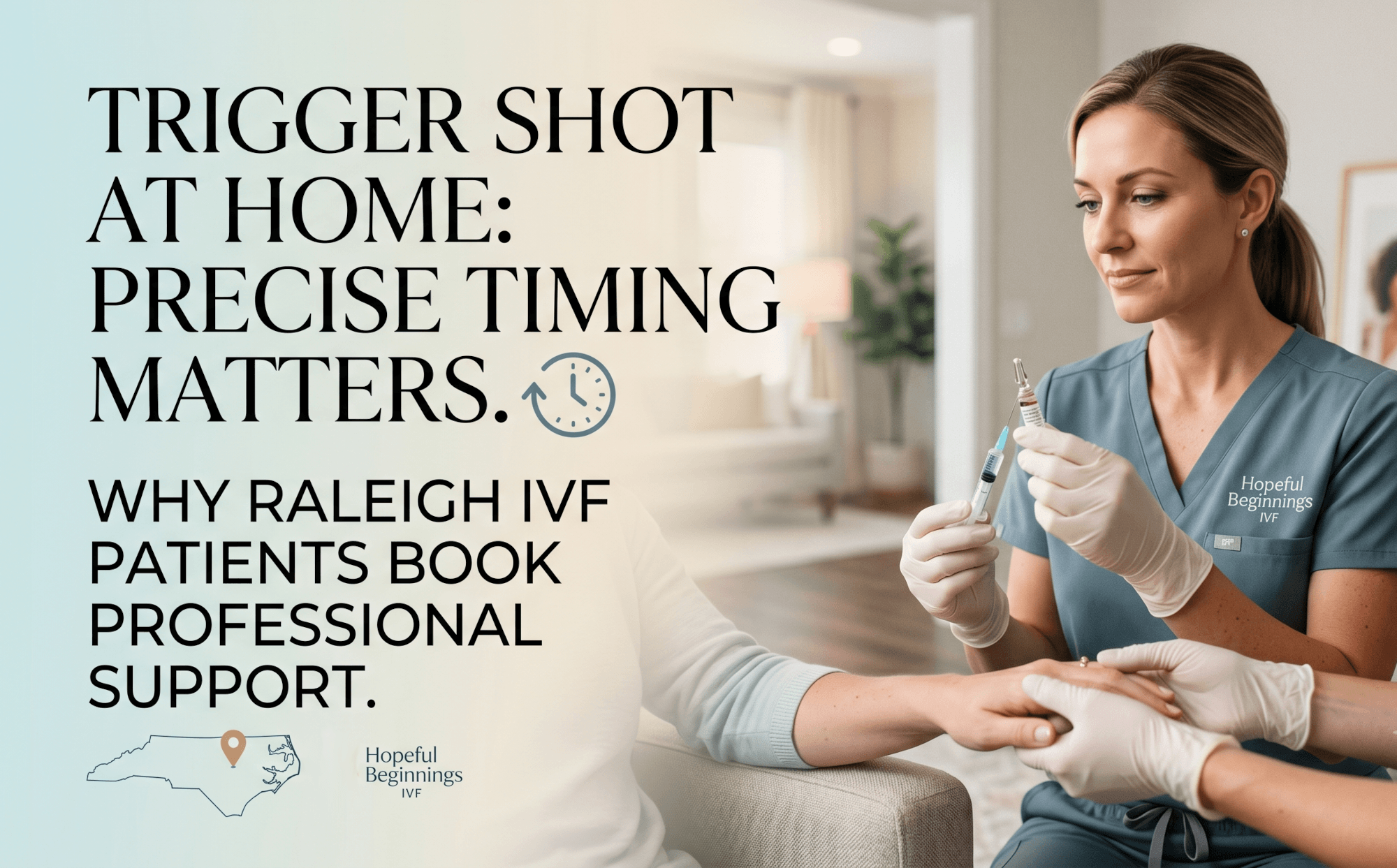
Given the stakes, many Raleigh patients choose to bring in a trained professional for their trigger shot. Professional in‑home trigger shot administration offers several distinct advantages.
- Flawless timing. A nurse arrives early to prepare, ensuring the injection is given at the exact minute.
- Correct technique. For IM trigger shots, a professional knows exactly how to locate the gluteal site, mix medications, and administer without error.
- Stress reduction. One patient described how professional support “took the stress and pressure away from having to handle the whole thing myself, and gave me great peace of mind.”
- Late‑night and holiday availability. Hopeful Beginnings accommodates evening, weekend, and holiday time slots.
- Instructional support. Many services offer one‑on‑one teaching sessions for patients and partners.
- Backup and emergency support. If a problem arises, the nurse can contact your clinic’s after‑hours line.
How Professional Trigger Shot Services Work in Raleigh
Hopeful Beginnings, PLLC offers concierge IVF injection services throughout the Raleigh area. Here’s a step‑by‑step walkthrough.
- Receive your trigger time from your fertility clinic (date, time, medication, dosage).
- Schedule your nurse by calling 910‑200‑2337 as soon as you know the time.
- Prepare your medications – have the trigger shot, syringes, needles, alcohol wipes, and instructions ready.
- Nurse arrives 15‑20 minutes early to set up and confirm details.
- Administration at the exact prescribed minute, using proper IM or SubQ technique.
- Post‑injection guidance – what to expect, signs of OHSS, next steps for retrieval.
- Documentation – you receive a record of administration for your clinic.
Pricing and Value: Is Professional Support Worth It?
| Service | Estimated Cost (Raleigh) |
|---|---|
| Stand‑alone trigger shot (regular hours) | $150 – $200 |
| Evening (after 7 PM) or weekend surcharge | +$50 – $75 |
| Holiday surcharge | +$100 |
| Full stimulation cycle (10 days + trigger) | $1,200 – $1,800 |
Call Hopeful Beginnings at 910‑200‑2337 for current pricing.
For patients who have already invested $12,000‑$25,000 in an IVF cycle, the incremental cost of professional trigger support is less than 2% of total cycle cost—a small price for cycle‑saving reliability.
Expanded Patient Testimonials from Raleigh
Detailed Checklist for Trigger Shot Day
If You Choose to Self‑Administer:
- ☐ Confirm trigger time in writing from your clinic
- ☐ Set at least three alarms
- ☐ Prepare medication and supplies 1 hour before
- ☐ Practice IM site marking if needed
- ☐ Have a partner or friend present to assist
- ☐ Keep clinic’s after‑hours number handy
- ☐ Do not eat a heavy meal within 2 hours
- ☐ Use a warm compress on the injection site beforehand
- ☐ After injection, lie down for 10 minutes to reduce dizziness
If You Book Professional Support:
- ☐ Call Hopeful Beginnings immediately after receiving trigger time
- ☐ Confirm the nurse’s arrival window
- ☐ Have medications and supplies in one accessible spot
- ☐ Clear a small table or counter for the nurse
- ☐ Decide if you want your partner present
- ☐ Ask the nurse to show you the drawn‑up dose before injection
- ☐ Request post‑injection OHSS education
- ☐ Get a printed record of administration for your file
Common Trigger Shot Errors and How to Avoid Them
| Error | Consequence | Prevention |
|---|---|---|
| Injecting at wrong time | Cycle cancellation | Multiple alarms; book a nurse |
| Wrong medication | No egg maturation | Double‑check vial label with clinic |
| Incorrect dose | Poor response or OHSS | Have nurse verify |
| Air bubble injection | Reduced dose | Tap syringe and push air out |
| Needle not deep enough (IM given SubQ) | Partial absorption | Have nurse administer |
| Forgetting to mix powder | Water only injected | Follow mixing steps slowly; nurse demonstration |
What to Expect After the Trigger Shot (Hours 1‑36)
- 0‑6 hours: Mild pinch at injection site.
- 6‑12 hours: Slight pelvic fullness or bloating – normal.
- 12‑24 hours: Breast tenderness or mild nausea possible. Avoid heavy exercise.
- 24‑34 hours: Bloating may increase. Stay hydrated. Call clinic if severe pain or difficulty breathing (possible OHSS).
- 34‑36 hours: Arrive for egg retrieval.
Signs of OHSS to watch for: rapid weight gain (3+ lbs in 24 hours), severe abdominal pain, nausea/vomiting, shortness of breath, decreased urination. If any occur, contact your clinic immediately.
Insurance and HSA/FSA Considerations
Most insurance plans do not cover concierge injection services, but many patients use Health Savings Account (HSA) or Flexible Spending Account (FSA) funds. Because trigger shot administration is a qualified medical expense (prescribed by a physician), you can typically reimburse yourself. Save your receipt from Hopeful Beginnings and the prescription documentation.
Make Your Trigger Shot the Easiest Part of IVF
Your IVF journey involves enough uncertainty. Professional trigger shot administration ensures that the most important injection of your cycle is handled with precision, care, and compassion.
If you’re in the Raleigh area and approaching trigger day, don’t leave timing to chance. For a safe, precisely timed trigger shot at home in Raleigh, call Hopeful Beginnings today.
📞 Call: 910‑200‑2337
🌐 Visit: www.hopefulbeginningsivf.com
Hopeful Beginnings, PLLC provides concierge in‑home IVF injection services throughout Raleigh, North Carolina, including trigger shot administration, progesterone in oil injections, and full‑cycle stimulation support. Serving Wake County and surrounding areas.
FAQ
What is a trigger shot in IVF and why does timing matter so precisely?
A trigger shot is an injection of hCG or a GnRH agonist that initiates the final maturation of a woman’s eggs and triggers ovulation at a controlled time. Timing is critically precise because egg retrieval must be performed 34–36 hours after the injection—before the eggs are naturally released from the ovaries. If the trigger is given too early, eggs may remain immature and fail to fertilize. If given too late, ovulation can occur prematurely, resulting in no eggs being retrieved and a cancelled cycle.
What happens if I administer the trigger shot at the wrong time?
Administering the trigger shot even 15–30 minutes outside the prescribed window can compromise the entire IVF cycle. Too early (before 34 hours post‑injection) leads to a low egg maturation rate, often under 50%, causing poor or no fertilization. Too late (after 36 hours) allows the eggs to be released naturally into the abdominal cavity, where they cannot be recovered during retrieval. In either scenario, the cycle is typically cancelled, and you lose the thousands of dollars already invested in medications and monitoring.
Can I get a nurse to come to my home to give me the trigger shot in Raleigh?
Yes. Hopeful Beginnings, PLLC provides licensed registered nurses who travel to your home anywhere in the Raleigh area, including Cary, Durham, and Wake Forest. The nurse arrives 15–20 minutes before your scheduled trigger time, prepares the medication, and administers the injection at the exact minute prescribed by your fertility clinic. Evening, weekend, and even holiday appointments are available to accommodate late‑night trigger times (often 9 PM or later).
Is the IVF trigger shot injected into a muscle or under the skin?
It depends on the specific medication. Many hCG triggers (Pregnyl, Novarel) are intramuscular (IM) injections that require a 1‑to‑1.5‑inch needle into the upper outer quadrant of the buttock. Others, like Ovidrel (a recombinant hCG), are subcutaneous (SubQ) and use a much smaller needle injected into the abdomen or thigh. Your fertility clinic will specify the route and provide a written instruction sheet. Professional nurses are trained to perform both types correctly and safely.
What is the typical timeframe between the trigger shot and egg retrieval?
The standard window is 34 to 36 hours. For example, if your trigger shot is given at 9:00 PM on a Tuesday, your egg retrieval will be scheduled between 7:00 AM and 9:00 AM on Thursday. This precise interval allows the eggs to complete final meiotic maturation while still being contained within the ovarian follicles. Your clinic will give you an exact arrival time, and you should not deviate from it.
Can the trigger shot be taken at home instead of at the clinic?
Yes, the vast majority of IVF patients administer the trigger shot at home. Most fertility clinics do not offer in‑office trigger shots due to late‑night scheduling and staffing limits. However, because the consequences of a mistake are so high, many Raleigh patients choose to have a professional nurse come to their home to ensure flawless timing and technique rather than self‑injecting.
How late at night can a trigger shot be given, and can Hopeful Beginnings accommodate that?
Trigger shots are commonly prescribed between 9:00 PM and 11:30 PM to align the egg retrieval for the following morning. Hopeful Beginnings routinely accommodates these late‑night appointments, as well as early morning, weekend, and holiday time slots. There is an additional surcharge for after‑hours visits (typically 50–50–75), but the service ensures you never have to worry about missing your window.
Does Hopeful Beginnings offer trigger shot services for IUI as well as IVF?
Absolutely. The trigger shot is also used in intrauterine insemination (IUI) cycles to precisely time ovulation and the insemination procedure. The same precise timing rules apply, though the window for IUI is often 36–40 hours post‑trigger. Hopeful Beginnings provides the same professional at‑home injection service for IUI patients in the Raleigh area.
Do I need to have my fertility clinic coordinate directly with Hopeful Beginnings?
No, you do not need clinic‑to‑clinic coordination. You simply provide Hopeful Beginnings with the written instructions from your fertility doctor—including the exact trigger time, medication name, dosage, and injection route. The nurse follows those instructions exactly. Many patients call to book the same day they receive their trigger time from their clinic.
What are the signs that my trigger shot worked correctly?
Most patients feel little to nothing immediately after a properly administered trigger shot. Some experience mild bloating, pelvic fullness, or breast tenderness within 12–24 hours—these are normal signs that the medication is working. The true confirmation comes during egg retrieval when the doctor visualizes mature eggs and is able to collect them successfully. If you feel severe pain, shortness of breath, or rapid abdominal swelling, contact your clinic immediately as these could be signs of Ovarian Hyperstimulation Syndrome (OHSS).
How do I schedule a trigger shot appointment with Hopeful Beginnings in Raleigh?
Call 910‑200‑2337 directly. It’s best to call as soon as your fertility clinic gives you a confirmed trigger time (typically 24–48 hours in advance). If you have an urgent or same‑day need, ask about availability—they will do their best to accommodate. You will need to provide your name, address, trigger time, and medication details. You can also request a callback or send a message through the Hopeful Beginnings website.
Can my partner or family member be present during the trigger shot visit?
Yes. Hopeful Beginnings encourages partners or support persons to be present. The nurse can also provide a brief teaching session if you or your partner wants to learn how to self‑administer future injections (e.g., progesterone in oil for the luteal phase). The atmosphere is private, respectful, and tailored to your comfort level.
How far in advance should I book my trigger shot appointment?
Book as soon as your fertility clinic gives you a confirmed trigger time, which is usually 24 to 48 hours before the injection. While Hopeful Beginnings can sometimes accommodate same‑day requests, advance booking guarantees that a nurse is available for your exact minute, especially for popular late‑night or weekend slots. Do not wait until the day of your trigger if you can avoid it.
Does Hopeful Beginnings offer full IVF injection cycle support?
Yes. In addition to trigger shots, Hopeful Beginnings provides complete stimulation cycle support, including daily subcutaneous injections (Follistim, Gonal‑F, Menopur, Cetrotide, Ganirelix) and intramuscular progesterone shots after retrieval. Many Raleigh patients use the full package to reduce stress throughout the entire IVF process, not just for the trigger shot.
Can I use my HSA or FSA to pay for professional trigger shot administration?
Generally, yes. Because the trigger shot is a prescribed medical treatment, the cost of having a licensed nurse administer it at home is considered a qualified medical expense under IRS rules. Most Health Savings Account (HSA) and Flexible Spending Account (FSA) cards are accepted directly, or you can pay out‑of‑pocket and submit for reimbursement. Always keep your itemized receipt from Hopeful Beginnings along with your clinic’s prescription documentation.
Sources and References
1. Hopeful Beginnings, PLLC
2. Fertility Centers of New England – What Is a Trigger Shot?
3. PMC / NIH – Case Report on Wrong Trigger Injection
4. Rescripted – What If I Make a Mistake With My hCG Trigger Shot?
5. CNY Fertility – IVF Trigger Shot Guide
6. Fertility News – Why an Ovulation Trigger Shot Sometimes Fails
7. Asian Infertility – Trigger Shot Timing & Egg Retrieval
8. Midwest Fertility Center – Trigger Shots: Purpose and Timing
9. MDR MedCoach – Pregnyl Intramuscular Injection Instructions
10. Berry Fertility – Intramuscular Injections for Fertility Treatments
11. Healthline – Trigger Shot Overview
12. ReUnite Rx – The Science of the Trigger Shot
13. Fertility NJ – Trigger Shots in IVF
14. SART – ART Step‑by‑Step
15. Carolina Conceptions Fertility (Raleigh Area Clinic)
16. Preferred Fertility Concierge – Injection Training
17. Wikipedia – Final Maturation Induction (Trigger Shot)
18. Remembryo – 2024 Meta‑Analysis of IVF Trigger Shots