


The IVF trigger shot is one of the most time-sensitive injections in a fertility cycle. After days of stimulation medications, monitoring appointments, bloodwork, ultrasounds, and changing instructions, everything can come down to one precisely timed injection.
For many patients, this is also one of the most stressful moments of IVF.
You may be looking at the clock, reading your fertility clinic’s instructions again, checking the medication box, and wondering:
What if I take the trigger shot too late? What if I accidentally take it early? What if I am not sure the full dose went in?
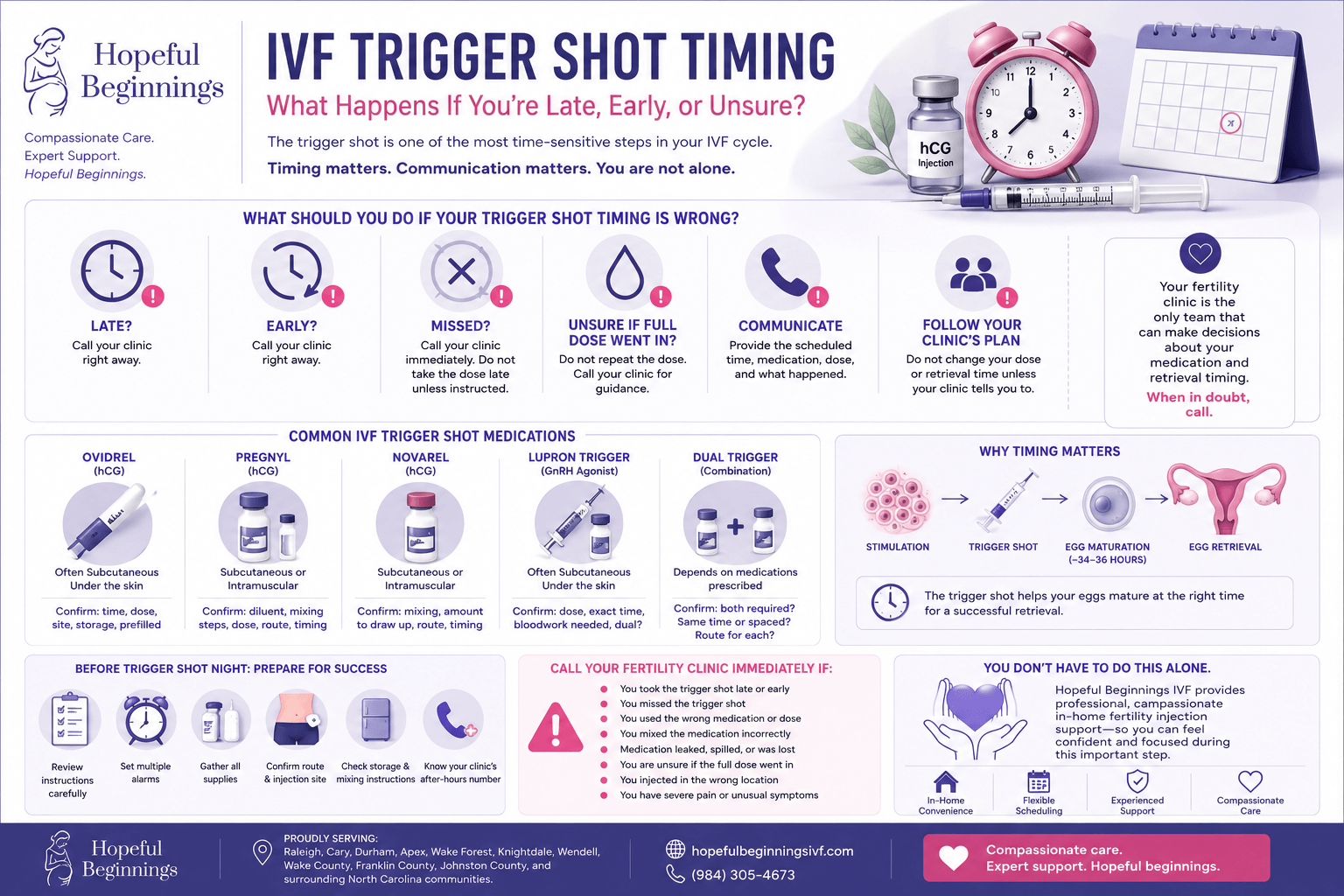
If you are worried about your IVF trigger shot timing, the safest answer is simple: contact your fertility clinic immediately if the injection is late, early, missed, mixed incorrectly, or uncertain. Do not repeat the dose, change your egg retrieval timing, or make medication decisions unless your fertility clinic specifically tells you to.
Hopeful Beginnings IVF provides professional in-home fertility injections for patients in Raleigh, Cary, Durham, Apex, Wake Forest, Knightdale, Wendell, Wake County, Franklin County, Johnston County, and surrounding North Carolina communities. When timing matters, having experienced injection support at home can help make the process feel calmer, safer, and more manageable.
Quick Answer: What Should You Do If Your IVF Trigger Shot Timing Is Wrong?
If you took your IVF trigger shot late, early, missed it, used the wrong medication, mixed it incorrectly, injected in the wrong location, or are unsure whether the full dose went in, call your fertility clinic right away.
Do not guess. Do not take an extra dose unless your clinic tells you to. Do not assume your egg retrieval time should change unless your fertility team gives you updated instructions.
When you call, be ready to share:
- The exact trigger shot time your clinic prescribed
- The exact time you took the injection, if you took it
- The medication name
- The dose
- Whether the medication required mixing
- Whether the full dose appeared to go in
- Whether any medication leaked, spilled, or remained in the syringe
- Whether your protocol included a dual trigger
- Any symptoms or concerns you are experiencing
Your fertility clinic is the only team that can tell you what to do next based on your protocol, monitoring results, medication instructions, and scheduled retrieval time.
What Is the IVF Trigger Shot?
The IVF trigger shot is a fertility injection given near the end of the ovarian stimulation phase. Its purpose is to help the eggs complete their final stage of maturation before egg retrieval or ovulation.
During an IVF cycle, fertility medications are used to stimulate the ovaries so multiple follicles can develop. Each follicle may contain an egg. Your fertility clinic monitors follicle growth and hormone levels to decide when the follicles are ready for the final maturation step.
Once your clinic determines the timing is right, they give you an exact date and time for the trigger shot.
The trigger shot may include human chorionic gonadotropin, commonly called hCG, a GnRH agonist such as Lupron, or a combination of medications as part of a dual trigger. ReproductiveFacts, a patient education resource from the American Society for Reproductive Medicine, explains that hCG or a similar medication may be used to trigger the final stage of egg maturation before egg retrieval.
Your clinic may refer to the injection as:
- Trigger shot
- hCG trigger
- Ovidrel trigger
- Pregnyl trigger
- Novarel trigger
- Lupron trigger
- GnRH agonist trigger
- Dual trigger
- Final maturation injection
The exact medication, route, dose, and timing depend on your IVF protocol. Some trigger shots are subcutaneous, meaning they are injected under the skin. Others may be intramuscular, meaning they are injected into the muscle. Some patients may need more than one medication.
Always follow your fertility clinic’s written instructions exactly.
Why Trigger Shot Timing Matters
Trigger shot timing matters because it helps coordinate egg maturation with the planned egg retrieval or ovulation window.
In IVF, the goal is usually to retrieve eggs after they have had enough time to mature, but before ovulation occurs. Egg retrieval is commonly scheduled about 34 to 36 hours after the trigger shot, although timing can vary by clinic, medication protocol, and individual treatment plan.
That timing is why your instructions may say something like:
Take your trigger shot at 9:30 p.m. on Tuesday.
That does not mean “sometime Tuesday night.” It means your fertility clinic has selected that time to align your injection with your retrieval or treatment schedule.
Even if the time feels unusually specific, it is intentional. Some patients are told to take the trigger at 8:45 p.m., 10:15 p.m., or another exact time. The clinic may be coordinating your injection with procedure scheduling, anesthesia timing, lab availability, physician scheduling, and your monitoring results.
This is why Hopeful Beginnings IVF offers flexible scheduling for patients who need professional help at the time their fertility clinic prescribes.
What Happens If You Take the Trigger Shot Late?
If you take the trigger shot late, call your fertility clinic immediately.
A late trigger shot may affect the timing between the injection and egg retrieval or ovulation. The impact depends on how late the injection was, which medication you used, your protocol, your scheduled retrieval time, and your clinic’s judgment.
A short delay may be handled differently than a major delay. A late single trigger may be handled differently than a late dual trigger. A timing concern before IVF egg retrieval may be handled differently than a trigger used for IUI or timed intercourse.
When you call your clinic, give them clear information. Say:
- “My trigger shot was scheduled for [time].”
- “I actually took it at [time].”
- “The medication was [name].”
- “The dose was [dose].”
- “I believe the full dose did/did not go in.”
- “My retrieval is scheduled for [date/time], if applicable.”
Do not take another trigger shot unless your clinic specifically instructs you to. Taking extra medication without approval can create additional concerns.
If you have not taken the injection yet and realize you are late, call the clinic before taking it unless your clinic already gave you specific missed-dose instructions.
What Happens If You Take the Trigger Shot Early?
If you take the trigger shot earlier than instructed, contact your fertility clinic right away.
Taking the injection early may shift the timing between the trigger and your egg retrieval or ovulation plan. Because retrieval is intended to occur before ovulation, your clinic needs to know as soon as possible.
Do not wait until the next morning if your clinic provided an after-hours number. Fertility clinics often have after-hours instructions for urgent medication timing issues.
Tell your clinic:
- The time you were supposed to take the trigger
- The time you actually took it
- The medication and dose
- Whether you took one injection or multiple injections
- Whether the full dose was administered
- Whether your retrieval or procedure time has already been scheduled
The most important step is fast communication. Your fertility clinic can determine whether anything needs to be adjusted.
What If You Miss the Trigger Shot Completely?
If you miss the trigger shot completely, call your fertility clinic immediately.
Do not take the injection late unless your clinic tells you to. A missed trigger is a time-sensitive situation because the injection is connected to egg maturation, retrieval timing, and the next steps in your fertility plan.
When you call, explain that the trigger was missed and provide:
- The scheduled trigger time
- The current time
- The medication name
- Whether the medication is still available
- Whether the medication has been stored correctly
- Whether you are alone or have someone to help
- Whether your retrieval is scheduled
Your clinic may ask additional questions and provide instructions based on your situation.
What If You Are Not Sure the Full Dose Went In?
Many patients worry that the full trigger shot dose did not go in.
This can happen when:
- Medication leaks from the injection site
- A droplet appears on the skin
- The needle is removed too quickly
- The syringe still appears to contain fluid
- The plunger was not fully pushed down
- Medication spilled during mixing
- The needle disconnected from the syringe
- The injection felt unusual
- You are unsure whether the dose was administered correctly
If you are uncertain, call your fertility clinic.
Do not automatically repeat the dose. A small droplet on the skin does not always mean the dose failed, but you should not guess. Your clinic may ask you how much medication was lost, whether the syringe looked empty, whether the needle was inserted properly, and whether you have photos of the syringe or supplies.
This is one of the reasons patients choose professional fertility injection service support. A trained professional can help confirm the medication, prepare the dose, administer the injection using the correct technique, and reduce the uncertainty that can happen when a patient is trying to manage a high-pressure injection alone.
Common IVF Trigger Shot Medications and What Patients Should Confirm
Your fertility clinic will choose the trigger medication based on your cycle, response to stimulation, risk factors, and treatment plan. The medication may be prefilled, may require mixing, may be subcutaneous, may be intramuscular, or may be part of a dual-trigger protocol.
Use this table as a general guide, not as a substitute for your clinic’s instructions.
| Trigger Medication Type | Common Use in Fertility Care | Common Route | What Patients Should Confirm |
|---|---|---|---|
| Ovidrel | Recombinant hCG used to support final follicular maturation and early luteinization | Often subcutaneous | Exact time, dose, injection site, storage, whether it is prefilled |
| Pregnyl | hCG trigger medication that may require mixing | May be subcutaneous or intramuscular depending on instructions | Diluent, mixing steps, dose, needle size, injection route, timing |
| Novarel | hCG trigger medication that may require mixing | May be subcutaneous or intramuscular depending on instructions | Mixing instructions, amount to draw up, route, timing, full-dose administration |
| Lupron Trigger | GnRH agonist trigger used in some protocols | Often subcutaneous | Dose, exact timing, whether bloodwork is needed afterward, whether it is part of a dual trigger |
| Dual Trigger | Combination trigger approach that may include more than one medication | Depends on medications prescribed | Whether both injections are required, whether they are taken at the same time or spaced apart, route for each medication |
The FDA labeling for Ovidrel identifies the prefilled syringe as a sterile liquid intended for subcutaneous injection. Other medications may have different preparation and administration requirements, so patients should always follow their fertility clinic and pharmacy instructions.
Is the Trigger Shot Subcutaneous or Intramuscular?
The trigger shot can be subcutaneous or intramuscular depending on the medication and your fertility clinic’s instructions.
A subcutaneous injection is placed into the fatty tissue beneath the skin. Many fertility stimulation medications are subcutaneous, and certain trigger medications may also be given this way.
An intramuscular injection is placed deeper into the muscle. Some fertility medications require a longer needle and a specific injection site, often in the upper outer gluteal area or another location directed by the clinic.
The route matters. Do not assume one fertility injection is given the same way as another.
Before trigger night, confirm:
- Medication name
- Exact dose
- Injection route
- Needle size
- Syringe size
- Mixing instructions
- Injection site
- Exact trigger time
- Whether there is one injection or more than one
- Storage instructions
- Clinic after-hours phone number
Patients who want more background can review Hopeful Beginnings IVF’s guides to IVF injections, subcutaneous injections in IVF, and oil intramuscular injections.
Why Patients Often Feel Nervous About the Trigger Shot
The trigger shot can feel different from earlier IVF injections because the timing is so exact. Even patients who have become comfortable with daily stimulation shots may feel nervous when the trigger shot arrives.
Common worries include:
- “What if I miss the time?”
- “What if I mix the medication wrong?”
- “What if I inject in the wrong place?”
- “What if I use the wrong needle?”
- “What if I forget one part of a dual trigger?”
- “What if some medication leaks out?”
- “What if I panic and cannot do it?”
- “What if my partner gets nervous?”
- “What if the shot is scheduled late at night?”
- “What if I am traveling?”
- “What if I cannot reach the clinic?”
These concerns are common. IVF asks patients to manage medical tasks at home during an emotionally loaded time. Feeling nervous does not mean you are not prepared. It means you understand that this step matters.
Hopeful Beginnings IVF offers expert guidance so patients do not have to navigate fertility injections alone.
How to Prepare Before Trigger Shot Night
Preparation can reduce stress and lower the chance of a timing or medication mistake.
Review Your Instructions as Soon as You Receive Them
Read your clinic’s instructions carefully before trigger night. Confirm:
- The trigger date
- The exact trigger time
- Medication name
- Dose
- Injection route
- Whether medication must be mixed
- Whether there are one or two injections
- Whether one injection is subcutaneous and another is intramuscular
- What supplies are needed
- What to do if there is a problem
If anything is unclear, contact your fertility clinic before the scheduled injection time.
Confirm Your Time Zone
This matters if you are traveling, working with an out-of-state fertility clinic, staying near a retrieval center, or coordinating care between locations.
Ask your clinic which time zone applies if there is any uncertainty.
Set Multiple Alarms
Set more than one alarm. Consider setting reminders for:
- 60 minutes before the trigger
- 30 minutes before the trigger
- 10 minutes before the trigger
- The exact trigger time
If a partner or family member is helping, ask them to set alarms too.
Lay Out Your Supplies Early
Before the scheduled injection time, gather:
- Medication
- Syringe
- Correct needle or needles
- Diluent, if needed
- Alcohol pads
- Gauze
- Bandage
- Sharps container
- Written clinic instructions
- Pharmacy instructions
- Fertility clinic after-hours number
- Phone charger
- A clean, well-lit workspace
Do not wait until the final few minutes to open the box or search for supplies.
Check Storage Instructions
Some fertility medications must be refrigerated. Others may be stored at room temperature. Some medications have specific rules after mixing.
If you are unsure whether the medication was stored correctly, contact your pharmacy or fertility clinic before using it.
Know the Injection Site
Confirm whether your trigger shot is subcutaneous or intramuscular. Confirm the exact location your clinic wants you to use.
Do not change the injection route because one location seems easier.
Schedule Help Before the Last Minute
If you already know you are uncomfortable giving yourself the trigger shot, schedule help before trigger night. Once final instructions arrive, update your injection support provider with the exact time.
Hopeful Beginnings IVF provides in-home injections for patients who want professional support at home.
What If Your Trigger Shot Is Scheduled Late at Night?
Late-night trigger shots are common. Patients may be instructed to take the trigger shot at 8 p.m., 9 p.m., 10 p.m., 11 p.m., or another specific time based on the clinic’s retrieval schedule.
This can feel stressful because you may be tired, your clinic may be closed, and pharmacies may not be open if you realize something is missing.
Before trigger night, confirm:
- Your clinic’s after-hours phone number
- Whether your medication needs refrigeration
- Whether you have the right syringes and needles
- Whether the medication must be mixed
- Whether your trigger includes one or more injections
- Whether you need someone to help
- Whether professional support is scheduled
If your trigger shot is late at night and you are concerned about doing it alone, Hopeful Beginnings IVF’s flexible scheduling may help you stay on track.
What If You Are Traveling During Your Trigger Shot Window?
Travel can make trigger shot timing more complicated. You may be traveling for work, staying near your fertility clinic, moving between monitoring appointments, or managing treatment while away from home.
Before traveling, ask your fertility clinic:
- How should the medication be stored?
- Can the medication travel safely?
- What time zone should be followed?
- Should the injection be taken at a hotel, home, or clinic-adjacent location?
- What supplies should be packed?
- What happens if travel is delayed?
- Who should you call after hours?
- Can professional injection support be arranged where you are staying?
If you are staying in Raleigh, Cary, Durham, Apex, Wake Forest, Knightdale, Wendell, or another nearby community, Hopeful Beginnings IVF may be able to provide local in-home support.
Can Your Partner Give the Trigger Shot?
In many cases, a partner can help administer the trigger shot if your fertility clinic has allowed home administration and your partner understands the instructions.
However, the partner should be comfortable with:
- Reading the medication instructions
- Identifying the correct syringe and needle
- Mixing medication if required
- Giving the injection by the correct route
- Administering the dose at the exact time
- Staying calm if you feel nervous
- Calling the clinic if something goes wrong
Some partners are comfortable with this role. Others are afraid of hurting the patient or making a mistake. That is understandable.
If your partner feels uncertain, professional injection support can remove pressure from both of you.
Can a Nurse or Trained Professional Help With a Trigger Shot at Home?
Yes. Many patients choose professional support for time-sensitive fertility injections, especially the trigger shot.
Professional support can help with:
- Medication organization
- Dose review based on clinic instructions
- Medication mixing, when required
- Correct injection route
- Proper injection technique
- Timing accountability
- Reducing anxiety
- Supporting patients who feel faint or overwhelmed
- Helping patients avoid avoidable mistakes
- Clear communication if a concern comes up
Hopeful Beginnings IVF does not replace your fertility clinic. Your clinic remains responsible for your treatment plan, medication orders, retrieval schedule, and medical decision-making. Hopeful Beginnings IVF helps carry out your clinic’s injection instructions with professional support in the home setting.
What to Have Ready for an In-Home Trigger Shot Appointment
If you schedule in-home trigger shot support, have everything ready before the appointment.
You should have:
- Written fertility clinic instructions
- Medication box, vial, or prefilled syringe
- Syringes and needles from the pharmacy
- Diluent, if required
- Alcohol pads
- Gauze
- Bandage
- Sharps container
- Clinic after-hours phone number
- A clean surface
- A well-lit space
- A place to sit or lie down
Keep all medication packaging available. Do not throw away boxes, labels, or instructions before the injection is complete.
If your clinic changes your trigger time after monitoring, notify your support provider as soon as possible.
Signs You Should Call Your Fertility Clinic Immediately
Call your fertility clinic immediately if:
- You took the trigger shot late
- You took the trigger shot early
- You missed the trigger shot
- You used the wrong medication
- You used the wrong dose
- You mixed the medication incorrectly
- You injected in the wrong location
- You are unsure whether the full dose went in
- You forgot one medication in a dual trigger
- Medication spilled, leaked, or was lost
- The syringe or needle broke
- You have severe pain
- You feel faint or unwell
- You develop symptoms your clinic warned you about
For severe symptoms, trouble breathing, severe abdominal pain, chest pain, fainting, or any medical emergency, seek emergency medical care.
Ovarian hyperstimulation syndrome, or OHSS, can occur as an excessive response to fertility medications used to stimulate egg development. ReproductiveFacts explains that OHSS can range in severity and that patients should follow their clinic’s instructions about symptoms that need attention.
Trigger Shot Side Effects: What May Be Normal and What Needs Attention
Side effects vary by medication and patient. Some patients have very few symptoms. Others notice discomfort after the injection or during the hours before egg retrieval.
Possible side effects may include:
- Mild injection site soreness
- Bruising
- Temporary redness
- Bloating
- Pelvic fullness
- Mild cramping
- Breast tenderness
- Mood changes
- Nausea
- Fatigue
These symptoms can overlap with the effects of ovarian stimulation medications and the body’s response to treatment. However, you should contact your fertility clinic if symptoms feel severe, unusual, or concerning.
Call your clinic urgently if you experience:
- Severe abdominal pain
- Rapid weight gain
- Shortness of breath
- Dizziness or fainting
- Heavy bleeding
- Severe nausea or vomiting
- Difficulty urinating
- Symptoms your clinic specifically warned you about
Your fertility clinic knows your cycle, your follicle count, your hormone levels, and your individual risk factors. Follow their guidance.
What the Trigger Shot Does Not Do
The trigger shot is important, but it is not a guarantee of IVF success.
The trigger shot does not:
- Guarantee that every follicle contains an egg
- Guarantee that every egg will be mature
- Guarantee fertilization
- Guarantee embryo development
- Guarantee implantation
- Confirm pregnancy
- Replace monitoring appointments
- Replace clinic instructions
- Mean you should make medication changes on your own
It is one carefully timed part of a larger fertility treatment plan. Its role is to support final maturation and timing. The rest of the process depends on many factors, including egg quality, sperm quality, fertilization, embryo development, transfer planning, uterine health, age, medical history, and the fertility clinic’s treatment protocol.
Can the Trigger Shot Cause a False Positive Pregnancy Test?
Yes, hCG trigger medications can remain detectable for a period of time after the injection and may affect pregnancy test results.
Because hCG is the hormone detected by many pregnancy tests, testing too soon after an hCG trigger can sometimes produce a misleading result. Your fertility clinic will tell you when to test and whether testing should be done at home or through bloodwork.
Do not use an early home pregnancy test to make medication decisions. Continue your medications exactly as directed unless your fertility clinic tells you otherwise.
Trigger Shot Timing for IVF vs. IUI
Trigger shots may be used in IVF, IUI, ovulation induction, or timed intercourse cycles, but timing goals can differ.
In IVF, the trigger is typically coordinated with egg retrieval. The clinic wants egg maturation to occur before retrieval while avoiding ovulation before the procedure.
In IUI or timed intercourse cycles, the trigger may be used to coordinate ovulation with insemination or intercourse timing.
Because the treatment goals are different, instructions may differ. Do not apply IVF trigger timing advice to IUI or timed intercourse unless your fertility clinic tells you to.
How Hopeful Beginnings IVF Supports Patients During Trigger Shot Timing
Hopeful Beginnings IVF helps fertility patients follow their clinic’s injection instructions at home with professional, compassionate support.
Patients may choose support because they:
- Are afraid of needles
- Are overwhelmed by medication instructions
- Need help with mixing medication
- Have an intramuscular injection
- Have a dual trigger
- Are worried about exact timing
- Need evening or weekend support
- Are traveling in the Triangle area
- Do not have a partner available
- Prefer professional injection administration
- Want reassurance during a stressful step
Hopeful Beginnings IVF proudly serves patients in Raleigh, Cary, Apex, Durham, Wake Forest, Knightdale, Wendell, Wake County, Franklin County, Johnston County, and surrounding North Carolina communities.
To learn more, visit In-Home Fertility Injections, IVF Injections, or Fertility Injection Service.
A Trigger Shot Checklist for IVF Patients
Use this checklist before your scheduled trigger time.
Before Trigger Day
- Confirm your medication name.
- Confirm your trigger date and exact time.
- Confirm whether the injection is subcutaneous or intramuscular.
- Confirm whether medication must be mixed.
- Confirm whether you have one injection or multiple injections.
- Confirm storage instructions.
- Confirm your fertility clinic’s after-hours number.
- Schedule professional injection support if needed.
On Trigger Day
- Read your clinic instructions again.
- Set multiple alarms.
- Gather medication and supplies.
- Wash your hands.
- Prepare a clean workspace.
- Confirm the medication and dose.
- Confirm the injection site.
- Take the injection at the exact prescribed time.
- Write down the actual administration time.
- Follow your clinic’s next instructions.
If Something Goes Wrong
- Call your fertility clinic immediately.
- Do not repeat the dose without instructions.
- Do not change your retrieval timing on your own.
- Save the medication packaging and syringe if your clinic asks questions.
- Explain exactly what happened.
The Bottom Line on IVF Trigger Shot Timing
The IVF trigger shot is one of the most important and time-sensitive injections in a fertility cycle. Its purpose is to help coordinate final egg maturation with the next step in your treatment plan.
If your trigger shot is late, early, missed, mixed incorrectly, administered incorrectly, or uncertain, call your fertility clinic immediately. Do not guess, repeat the dose, or change your schedule unless your clinic gives you specific instructions.
For patients who want help taking the trigger shot at home, Hopeful Beginnings IVF provides professional fertility injection support throughout Raleigh, Cary, Durham, Apex, Wake Forest, Knightdale, Wendell, Wake County, Franklin County, Johnston County, and surrounding North Carolina areas.
When the clock matters, you do not have to manage the moment alone.
Frequently Asked Questions About IVF Trigger Shot Timing
What is the IVF trigger shot?
The IVF trigger shot is an injection given near the end of the ovarian stimulation phase to help the eggs complete their final maturation before egg retrieval or ovulation. Depending on your protocol, the trigger may include hCG, a GnRH agonist such as Lupron, or a combination of medications known as a dual trigger. Your fertility clinic determines the medication, dose, injection route, and exact timing based on your monitoring results and treatment plan.
Why does the IVF trigger shot have to be taken at an exact time?
The trigger shot is timed to coordinate egg maturation with your scheduled egg retrieval or ovulation plan. In IVF, the clinic generally wants to retrieve eggs after they have matured but before ovulation occurs. This is why the trigger time may be given as an exact time rather than a broad window. If your clinic tells you to take the trigger shot at 9:30 p.m., follow that exact timing unless your clinic updates the instruction.
What happens if I take my trigger shot late?
If you take your trigger shot late, call your fertility clinic immediately. Tell them the scheduled trigger time, the actual injection time, the medication name, the dose, and whether the full dose went in. Do not take an extra dose unless your clinic specifically tells you to. Your clinic will decide whether the delay affects your retrieval timing or treatment plan.
What happens if I take my trigger shot too early?
If you take your trigger shot earlier than instructed, contact your fertility clinic right away. Taking the shot early may shift the timing between the injection and your scheduled egg retrieval or ovulation window. Your clinic needs accurate information so they can determine whether any changes are needed.
What should I do if I missed my trigger shot completely?
Call your fertility clinic immediately. Do not take the missed trigger late unless your clinic tells you to. A missed trigger shot is time-sensitive because it may affect egg maturation, ovulation timing, and the scheduled retrieval or procedure plan. Have your medication, instructions, and current time available when you call.
What if I am not sure the full trigger shot dose went in?
If you are unsure whether the full dose went in, contact your fertility clinic. Do not automatically repeat the injection. Tell your clinic what happened, whether any medication leaked or spilled, and whether the syringe appeared empty after the injection. Your clinic can help determine whether there is a true dosing concern.
Is the trigger shot subcutaneous or intramuscular?
The trigger shot may be subcutaneous or intramuscular depending on the medication and your fertility clinic’s instructions. Some medications are commonly given under the skin, while others may be injected into the muscle or prepared differently. Always confirm the medication name, route, needle size, dose, and injection site before taking the shot.
Can the IVF trigger shot be given at home?
Yes, many fertility patients take the trigger shot at home when directed by their fertility clinic. Some patients self-administer the injection, some have a partner help, and others schedule professional in-home injection support. The most important factors are correct medication preparation, correct injection technique, and exact timing.
Can a nurse or trained professional help with my trigger shot at home?
Yes. Hopeful Beginnings IVF provides in-home fertility injection support for patients who want professional help with time-sensitive injections, including trigger shots. This can be especially helpful for patients who are nervous, have a dual trigger, need an intramuscular injection, are unsure about mixing medication, or want support at the exact prescribed time.
What should I have ready before my trigger shot?
Before your trigger shot, have your medication, syringe, needle or needles, alcohol pads, gauze, sharps container, written clinic instructions, pharmacy instructions, and fertility clinic after-hours number ready. If the medication requires mixing, review the instructions early and ask your clinic questions before the scheduled time. Set multiple alarms so you are not relying on one reminder.
What if medication leaks out after my trigger shot?
A small droplet at the injection site does not always mean the dose failed, but you should call your fertility clinic if you are worried that medication leaked out or the full dose did not go in. Do not repeat the injection unless your clinic specifically tells you to. Your clinic may ask how much medication was lost and whether the syringe appeared empty.
Can I take a pregnancy test after an hCG trigger shot?
Follow your fertility clinic’s instructions about pregnancy testing. hCG trigger medications may remain detectable for a period of time and can sometimes affect home pregnancy test results if testing is done too early. Do not stop or change medications based on an early home test unless your fertility clinic tells you to.
Who should I call if something goes wrong with my trigger shot?
Call your fertility clinic for medical instructions, medication timing problems, missed doses, early or late injections, side effects, or uncertainty about whether the full dose went in. Hopeful Beginnings IVF can provide professional injection support based on your clinic’s written instructions, but your fertility clinic remains responsible for your treatment plan and medical decisions.
Sources
- ReproductiveFacts: Assisted Reproductive Technologies Patient Education Booklet
- ReproductiveFacts: In Vitro Fertilization Treatment Journey
- ReproductiveFacts: Ovarian Hyperstimulation Syndrome
- DailyMed: Ovidrel Choriogonadotropin Alfa Injection, Solution
- FDA: Ovidrel Prescribing Information
- F&S Reports: Optimal Timing for Triggering Oocyte Maturation During IVF