


IVF Medication Delivery Delayed? What to Do Next
Quick Answer: If you are facing an IVF medication delivery delay, check the tracking page, call the dispensing specialty pharmacy, and contact your prescribing fertility clinic promptly if the shipment may not arrive before your scheduled injection. Ask the clinic exactly what to do if the medication arrives late, is damaged, feels warm, is incomplete, or is labeled incorrectly. Do not guess, double up, substitute medication, change the injection time, or use questionable medication unless your clinic tells you to do so.
This guide is about the logistics of a late fertility medication shipment, not a missed-dose protocol. Your pharmacy handles shipping, replacement pathways, package problems, and medication labeling questions. Your prescribing fertility clinic decides whether your cycle timing or medication plan should change. Hopeful Beginnings IVF can support injection preparation, administration, and teaching once your clinic’s written instructions and the medication are clear, but Hopeful Beginnings does not prescribe, obtain, replace, or decide how delayed medication should be handled.
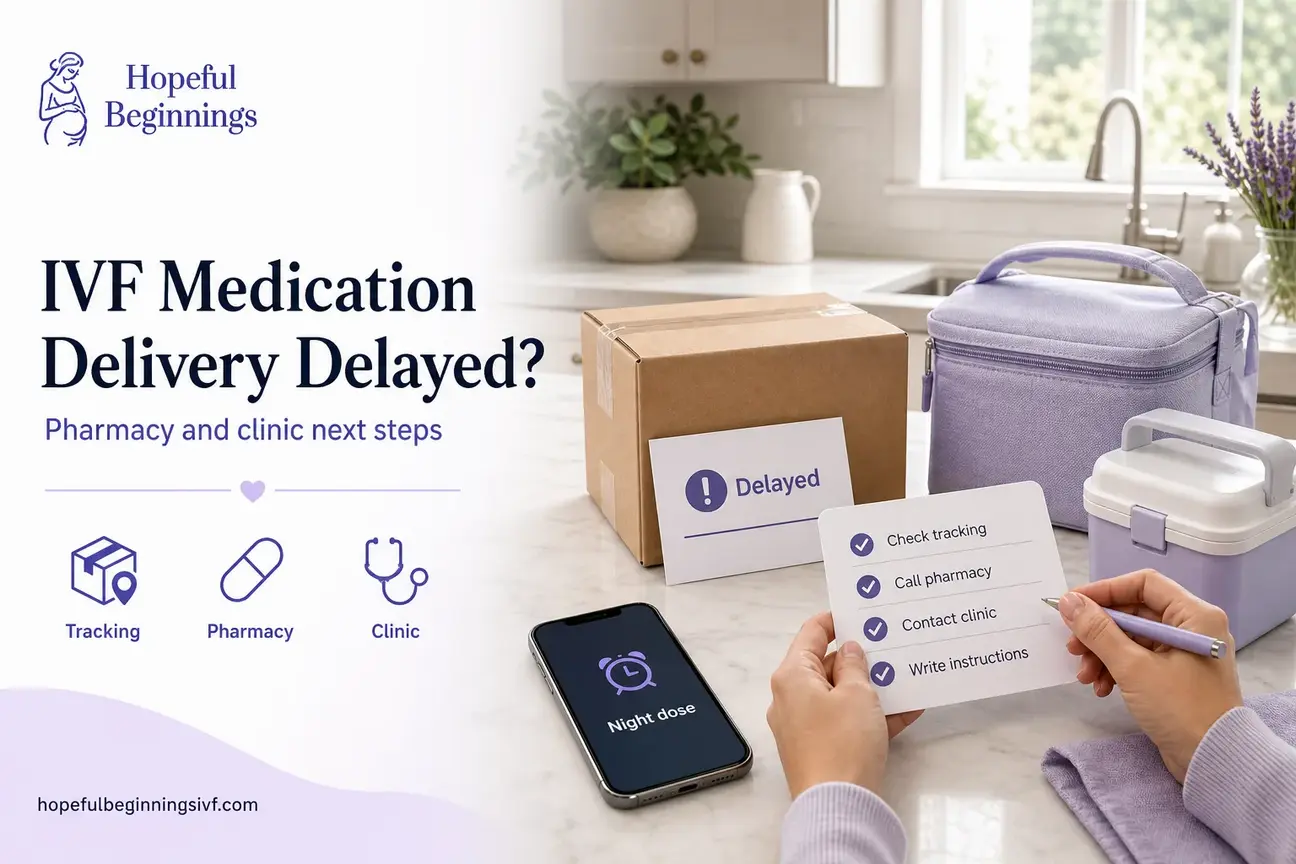
IVF medication delivery delay: 5 safe next moves
When a shipment is late, the goal is to bring the right people the right information quickly. IVF medication can be tied to clinic-directed timing, and some medications may have storage or handling requirements that vary by product. ReproductiveFacts explains IVF as a clinic-directed treatment process, so the prescribing clinic should be involved before a shipping problem becomes a medication-timing problem.
1. Check tracking now
Look for the current status, delivery estimate, carrier location, signature requirement, and whether the package is marked delayed, held, or delivered. Take a screenshot if the status changes, especially if the carrier lists an exception, failed delivery attempt, or delivery confirmation that does not match what you see at home.
2. Call the dispensing specialty pharmacy
Ask whether the package has shipped, where it is, whether the delivery estimate is reliable, and what the pharmacy can do if the medication will not arrive on time. The pharmacy is the right contact for shipment tracing, replacement pathways, dispensing questions, package condition, temperature handling, and whether the contents match the prescription.
3. Contact your prescribing fertility clinic promptly
Tell the clinic the medication name, scheduled injection time, tracking status, and the pharmacy’s current estimate. If the scheduled time is approaching, use the clinic pathway they gave you for time-sensitive medication questions, including the after-hours line when appropriate.
4. Ask for exact instructions
Ask what to do if the medication is late, unusable, incomplete, warm, leaking, or mislabeled. Do not substitute medication, change timing, skip, repeat, or double a dose unless your prescribing clinic specifically tells you to do so.
5. Document what you are told
Write down the time, the person’s name, and the instructions. Ask for portal or written confirmation when possible. If the injection time is approaching and you still do not have clear instructions, use your clinic’s after-hours line. Do not wait for a routine message response when the dose may be time-sensitive.
Why a fertility shipment late update needs fast pharmacy and clinic contact
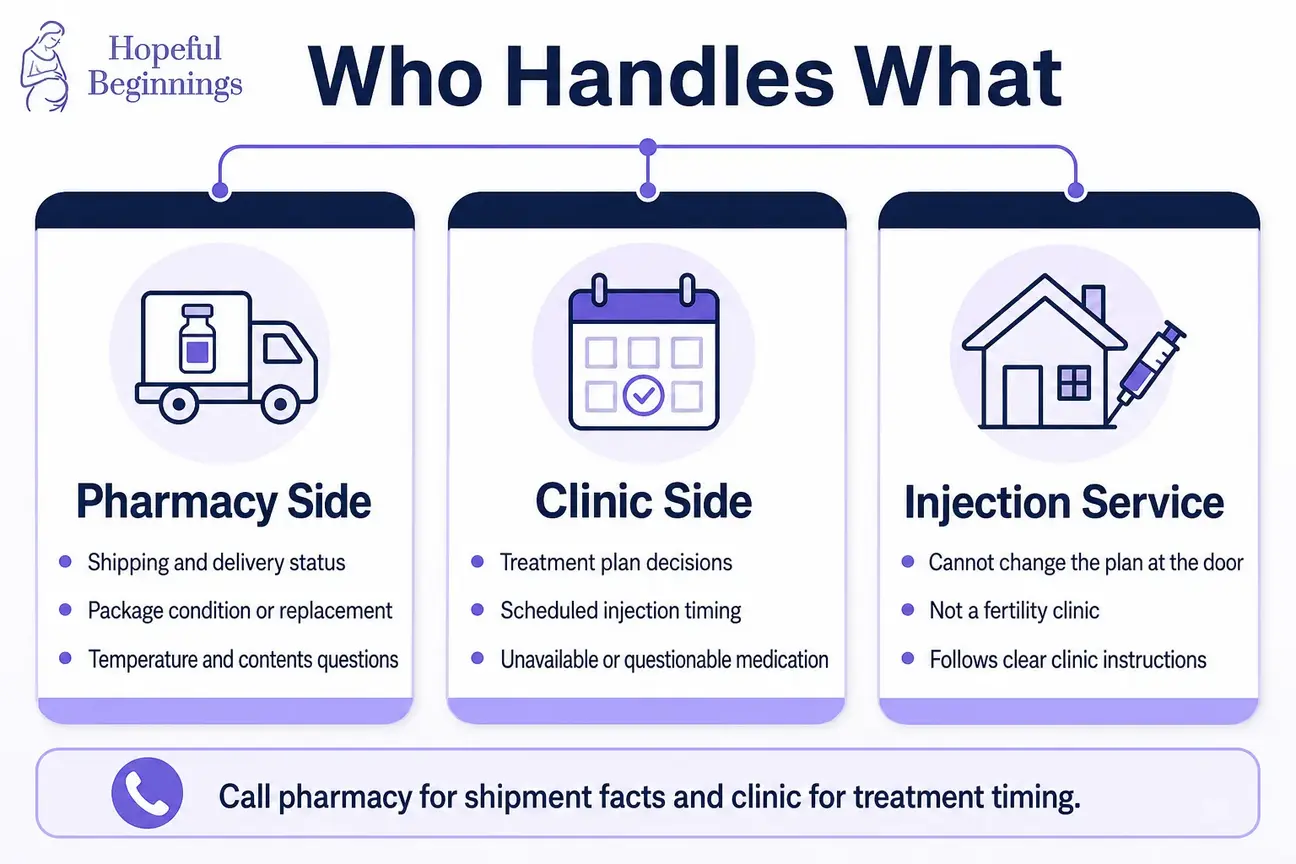
A fertility shipment late notice can feel like one problem, but it usually has two parts. The pharmacy side is about shipping, delivery, package condition, replacement, temperature handling, and whether the contents match what was dispensed. The clinic side is about your treatment plan, the scheduled injection time, and what to do if a medication is unavailable or questionable.
This distinction matters because a pharmacy delivery delay is not something an injection service can solve by changing the plan at the door. Hopeful Beginnings IVF is not a fertility clinic. Your prescribing fertility clinic diagnoses, prescribes, sets doses, monitors your cycle, and performs retrieval or transfer. Hopeful Beginnings prepares and gives injections the clinic prescribed, teaches patients and partners, and schedules around the clinic’s timing.
The timing concern can vary by medication class. Stimulation medications, antagonist medications, trigger injections, and progesterone-in-oil injections play different roles in fertility treatment. ReproductiveFacts describes medications used to induce ovulation, but it does not replace the individualized instructions from your own clinic. If a fertility shipment late update appears close to a scheduled dose, your clinic is the decision-maker for what happens next.
Try not to assume that a delivery estimate will resolve itself just because the carrier says “by end of day.” For a routine package, that may be enough. For a scheduled injection, it may not be. A fertility shipment late notice should prompt same-day contact with both the pharmacy and the clinic if the dose could be affected.
What should you check before you call?
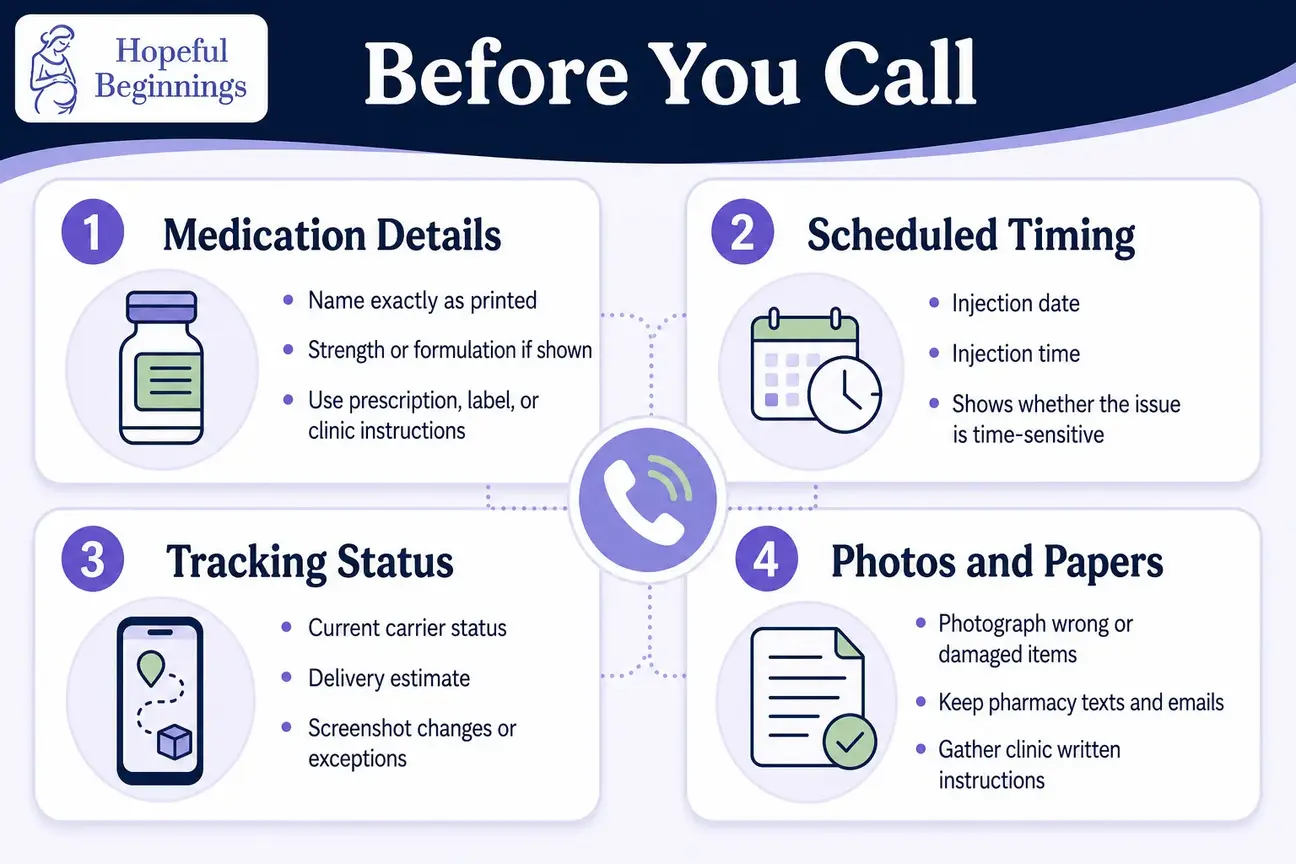
Before calling, gather the facts in one place. This keeps the conversation focused and reduces the chance that you forget a key detail while stressed. If you are dealing with missing IVF medication, an incomplete box, or a label that does not match your clinic’s instructions, photos can also help the pharmacy and clinic understand the problem.
| Information to have ready | Why it helps |
|---|---|
| Medication name exactly as printed on the prescription, label, or clinic instructions | Helps the pharmacy and clinic identify the specific drug and formulation |
| Strength or formulation, if shown | Helps distinguish similar-looking medications or package components |
| Scheduled injection date and time | Shows whether the delivery problem may affect the treatment schedule |
| Type of dose: stimulation, antagonist, trigger, or progesterone-in-oil | Helps the clinic triage the timing concern |
| Tracking number and current tracking status | Lets the pharmacy investigate the shipment and delivery estimate |
| Expected delivery date and time | Helps the clinic decide how urgent the medication question is |
| Signature requirement or delivery restriction | May explain why a package is held, delayed, or not delivered |
| Pharmacy name and phone number | Keeps the call sequence moving quickly |
| Clinic daytime and after-hours contact information | Helps you reach the right pathway if the scheduled time is close |
| Photos of the box, label, packing materials, vial, syringe, leak, damage, or temperature indicator | Supports pharmacy review of damage, labeling, or temperature concerns |
| Whether any medication, diluent, syringes, needles, or supplies are missing | Clarifies whether this is a replacement issue, a timing issue, or both |
Keep a call log. Write down the date, time, person you spoke with, and what they told you. If instructions are given verbally, ask whether they can be documented in the patient portal, pharmacy message, or another reliable written channel.
Who should you call when there is a pharmacy delivery delay?
A pharmacy delivery delay should usually trigger two calls: one to the pharmacy and one to the prescribing clinic. The order may depend on timing, but if the injection is due soon, contact both promptly. Do not wait for the carrier alone to solve a medication decision.
Call the specialty pharmacy first for shipment facts
The dispensing pharmacy is the source for shipment status, replacement options, package integrity, temperature questions, and whether the correct medication was dispensed. When you call, stay specific. Give the tracking number, medication name, scheduled injection time, and what the carrier page says.
Ask the pharmacy:
- Has the package left the pharmacy?
- Where is it now?
- Is the current delivery estimate still reliable?
- Is a signature required?
- Can the pharmacy investigate, replace, redirect, or otherwise address the shipment?
- Was the medication exposed to a temperature problem or shipping exception?
- What written information can the pharmacy provide about the shipment or replacement process?
If the package is marked delivered but you do not have it, check the delivery location, household members, front desk or package area if applicable, carrier photo, and any alternate delivery notes. Then call the pharmacy. If the dose may be affected, call your clinic too.
Call the prescribing clinic for medication-timing decisions
The prescribing fertility clinic decides what a late or unavailable medication means for your cycle. Tell the clinic the exact medication name, scheduled time, pharmacy estimate, and whether the problem involves a delayed fertility shipment, damaged package, warm package, leaking container, incorrect label, or missing IVF medication.
Ask direct questions without trying to solve the plan yourself:
- What should I do if the medication does not arrive before the scheduled injection time?
- What should I do if the package arrives late but appears intact?
- What should I do if the medication arrives warm, damaged, leaking, incomplete, or incorrectly labeled?
- Should I use the clinic’s after-hours line if the shipment is still unresolved closer to the scheduled time?
- Can you send written instructions through the portal or another written channel?
Do not ask an injection support service to make this decision for the clinic. Hopeful Beginnings can follow the clinic’s written medication instructions, but it cannot decide whether a late, damaged, questionable, or missing medication should be used.
How to report missing IVF medication without changing your plan
Missing IVF medication can mean several things: a medication vial is absent, a diluent is missing, a syringe or needle is missing, a temperature-sensitive item is not in the package, or the box contains medication but not the supplies your clinic expected. Compare the shipment with the dispensing paperwork and your clinic’s written medication list. If something is absent, call the pharmacy promptly.
When you report missing IVF medication, avoid saying only, “My box is wrong.” Instead, name what you expected and what arrived. For example, state the medication name, whether diluent or supplies are missing, and the scheduled injection time. If you are unsure whether something is missing, ask the pharmacy to walk through the dispensing record while you compare the box contents.
Then call the clinic if the missing item could affect the next dose. A pharmacy can address replacement or shipment logistics, but your prescribing fertility clinic decides what to do if the missing medication or supply affects the treatment schedule. Do not substitute another medication, use a different route, or improvise with supplies unless the clinic gives instructions.
If missing IVF medication turns into an actual missed or late dose, contact your clinic right away and do not guess or double up. Hopeful Beginnings has a separate guide on what to do after a missed IVF injection, but your clinic’s current instructions come first.
What if the package arrives warm, damaged, leaking, incomplete, or mislabeled?
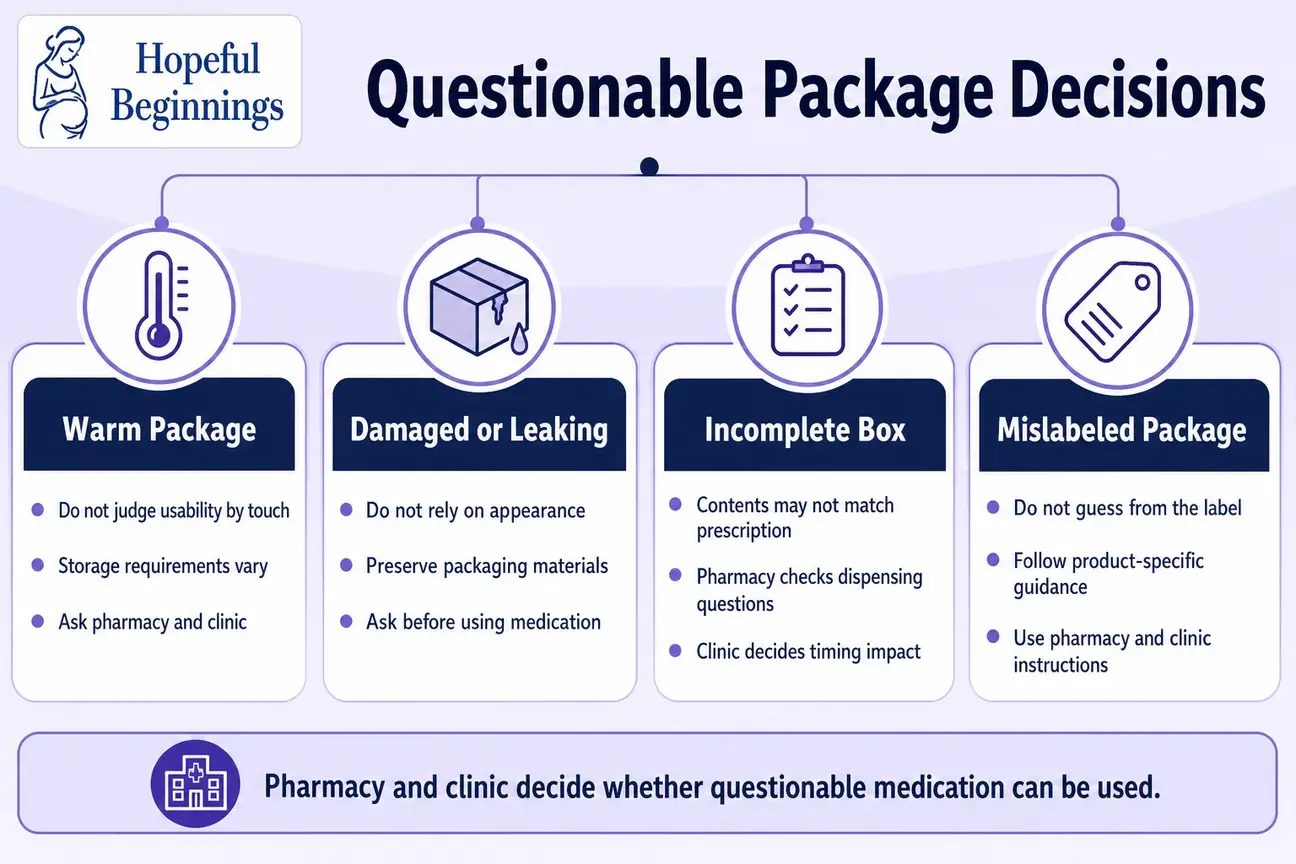
Do not decide that questionable medication is usable based on appearance, touch, or hope. Storage and transport requirements can vary by medication and formulation. DailyMed provides access to official medication labeling, but patients should follow the specific medication label, pharmacy instructions, and clinic instructions rather than relying on general storage assumptions. The practical decision in your cycle should come from the dispensing pharmacy and prescribing clinic using product-specific information.
| Problem | Immediate action | Who decides whether medication can be used? |
|---|---|---|
| Warm or inadequately cooled package | Do not independently decide it is usable. Preserve the packaging and temperature materials. Contact the pharmacy and clinic promptly. | The pharmacy and prescribing clinic, using product-specific storage and stability information |
| Leaking vial, cartridge, syringe, or container | Set it aside, avoid using it, photograph the damage, and contact the pharmacy and clinic. | The pharmacy and prescribing clinic |
| Broken, crushed, wet, or visibly damaged outer package | Photograph before discarding anything and contact the pharmacy. Tell the clinic if the scheduled dose may be affected. | The pharmacy, with clinic involvement if the medication timing may be affected |
| Missing medication, supplies, or diluent | Compare contents with the dispensing record and clinic instructions. Call the pharmacy immediately. | The pharmacy for replacement; the clinic for treatment timing |
| Incorrect medication or incorrect label | Do not use it. Compare the label with the clinic’s written instructions and contact both the pharmacy and clinic. | The pharmacy and prescribing clinic |
| Unclear label or missing instructions | Do not rely on memory or a similar-looking product. Contact the pharmacy and clinic. | The pharmacy and prescribing clinic |
| Package marked delivered but not received | Check the household, delivery location, carrier photo or notes, and any package area. Then call the pharmacy. | The pharmacy and carrier for shipment tracing; the clinic if the delay threatens the scheduled injection |
Temperature concerns deserve special caution. A delayed fertility shipment may still look normal when it arrives, but that does not prove the medication remained within its required conditions. Ask the pharmacy whether there was a temperature excursion, whether the shipment should be replaced, and what documentation they can provide. Tell the clinic if that medication may not be available for the scheduled injection.
Do not use a medication that is leaking, mislabeled, or not clearly matched to your clinic’s instructions unless the pharmacy and clinic tell you how to proceed. That is true even if the injection time is close.
What should you avoid while waiting for clinic instructions?
The most important safety step is to avoid turning a logistics problem into an unsupervised medication change. A fertility shipment late update can make anyone anxious, but guessing is not a safe substitute for clinic instructions.
- Do not change the dose.
- Do not change the injection time unless your clinic tells you to.
- Do not skip, repeat, or double a dose unless your clinic specifically instructs you.
- Do not substitute another medication or a medication from a prior cycle.
- Do not use a medication with an unclear label, questionable storage, visible damage, or leakage without pharmacy and clinic guidance.
- Do not rely on a home injection appointment to resolve a prescribing or pharmacy decision.
- Do not discard questionable medication, packaging, temperature materials, or labels unless the pharmacy or clinic instructs you, except where immediate safety requires appropriate handling.
MedlinePlus describes assisted reproductive technology as treatment involving medical steps and procedures, which is why medication questions belong with the prescribing care team rather than guesswork. If a dose is late, missed, spilled, or unavailable, call your clinic right away and do not double up or improvise.
How can you prepare while the delayed fertility shipment is unresolved?
Once you have made the calls, use the waiting time to organize what the pharmacy and clinic may need next. This is not busywork; it can make follow-up faster if the delivery status changes or the package arrives with a problem.
- Keep the tracking page open or take screenshots of major status changes.
- Save pharmacy texts, emails, and delivery notices.
- Photograph the package before opening if it appears crushed, wet, warm, or damaged.
- Keep labels, ice packs or cooling materials, inserts, receipts, and temperature indicators if included.
- Compare the contents with the pharmacy paperwork and your clinic’s medication list.
- Write down each call, including the time, person’s name, and instructions.
- Keep your clinic’s after-hours number accessible if the scheduled injection time is approaching.
If the package arrives while you are waiting for a call back, do not assume the issue is resolved. Check whether it is intact, complete, correctly labeled, and consistent with the pharmacy and clinic instructions. If the original concern involved heat exposure, delay, damage, leakage, or missing IVF medication, update the pharmacy and clinic before using it.
When is this more than a delivery problem?
Some concerns are medical symptoms, not shipment problems. Severe abdominal pain or swelling, shortness of breath, rapid weight gain, very little urine, chest pain, fainting, or signs of an allergic reaction should go to your prescribing clinic’s after-hours line or emergency services, including 911 when appropriate. Do not wait for a home visit for urgent symptoms.
Fertility medications can cause side effects, and ovarian hyperstimulation syndrome is a known risk in fertility treatment. ReproductiveFacts explains ovarian hyperstimulation syndrome as a condition that can occur after fertility medications stimulate the ovaries. If you have urgent symptoms, the priority is your clinic’s urgent instructions or emergency care, not scheduling injection support.
Also contact your clinic or a clinician for injection-site problems such as spreading redness, warmth, fever, or a hard painful lump. A delayed package and an injection reaction are different problems, and each needs the right contact pathway.
Future planning after a pharmacy delivery delay
A pharmacy delivery delay cannot always be prevented, but planning may help you spot problems earlier in a future cycle. Before the next shipment, ask your clinic or pharmacy how early medication should be ordered for that specific cycle. Confirm the shipping address, phone number, delivery instructions, signature requirements, and how tracking will be sent.
Ask the pharmacy what to do if tracking stops updating, the carrier misses the delivery window, or the package is marked delivered but cannot be found. Keep the pharmacy’s phone number and your clinic’s daytime and after-hours pathways in one place. If you will be away from home, review your clinic and pharmacy instructions before travel and read Hopeful Beginnings’ guide to storing and traveling with IVF medications for planning questions to discuss with your care team.
When the box arrives, check it promptly. Confirm that medication, diluent, syringes, needles, alcohol swabs, and other prescribed supplies match the dispensing record and your clinic’s written instructions. If there is a discrepancy, report missing IVF medication or missing supplies right away rather than waiting until the scheduled injection time.
If your cycle includes a trigger injection, weekend dose, holiday dose, or late-evening timing, discuss the timing plan early. Hopeful Beginnings offers flexible injection scheduling for evening, weekend, and holiday appointments, subject to scheduling and clinic instructions. This does not replace the pharmacy’s responsibility to deliver the medication or the clinic’s responsibility to decide the plan.
How can Hopeful Beginnings help after the shipment is resolved?
Hopeful Beginnings IVF is a concierge in-home fertility injection service based in Cary, serving patients in Raleigh and across the Triangle. Once your medication is available and your prescribing fertility clinic’s written instructions are clear, a licensed medical professional can come to your home to prepare and give prescribed injections or provide injection teaching for you or your partner.
Support may include medication preparation and reconstitution, comfort coaching, and following the clinic’s instructions for the injection being given. Hopeful Beginnings provides fertility injection service visits for prescribed medications and injection plans that include teaching and trigger-shot support. Patients who need home-visit support can also learn more about in-home fertility injections.
Hopeful Beginnings can support prescribed IVF injections, including stimulation-cycle medications, trigger injections, and progesterone-in-oil injections when ordered by your clinic. If your medication was delayed, damaged, incomplete, or mislabeled, resolve that issue with the pharmacy and clinic first. Hopeful Beginnings does not prescribe medication, obtain it from a pharmacy, replace missing medication, approve medication exposed to heat, change dosing or timing, or decide what to do after a delayed fertility shipment.
If you are in Cary, Raleigh, or elsewhere in the Triangle and your clinic’s written medication instructions are ready, you may request an appointment, call 910-200-2337, or email info@hopefulbeginningsivf.com. Call for pricing; after-10 p.m. and holiday visits are priced separately. Please have your clinic’s written instructions, medication name, scheduled time, and any pharmacy updates available when you reach out.
A calm recap before the scheduled injection time
An IVF medication delivery delay is stressful because it sits between shipping logistics and clinical timing. The safest next move is not to improvise. Check tracking, call the dispensing pharmacy, contact your prescribing fertility clinic, and ask exactly what to do if the medication is late or questionable.
If you receive a fertility shipment late update, a pharmacy delivery delay notice, missing IVF medication, or a delayed fertility shipment with damage or temperature concerns, keep the package materials and document your calls. Your pharmacy addresses shipment and replacement issues. Your clinic decides medication timing and whether a medication should be used. Hopeful Beginnings can help with in-home injection support after those decisions are clear.
Frequently Asked Questions
What should I do if my IVF medication shipment is delayed?
Check the tracking page, call the dispensing specialty pharmacy, and contact your prescribing fertility clinic promptly if the scheduled injection may be affected. Ask the clinic what to do if the medication will arrive late, and do not change the plan on your own.
Should I take IVF medication that arrives warm?
Do not decide based on appearance, touch, or how long you think the package was delayed. Contact the pharmacy and prescribing clinic, preserve the packaging and temperature materials, and follow medication-specific instructions.
What if the box is leaking, crushed, wet, or damaged?
Set the affected medication aside, photograph the package and label, and contact the pharmacy. If the scheduled injection may be affected, contact your prescribing clinic promptly for instructions before using anything from the shipment.
What if the pharmacy sent the wrong medication or label?
Do not use a medication that does not match your clinic’s written instructions or has an unclear label. Contact the pharmacy and your prescribing clinic immediately so they can determine the correct next step.
What information should I give my fertility clinic?
Give the medication name, scheduled injection date and time, tracking status, expected delivery time, pharmacy name, and the specific problem. Mention whether the package is late, missing, warm, damaged, leaking, incomplete, or mislabeled.
Can Hopeful Beginnings replace a missing IVF medication?
No. Hopeful Beginnings does not obtain, supply, or replace medication. The dispensing pharmacy handles shipment and replacement issues, and the prescribing fertility clinic decides how any medication delay affects your treatment plan.
Can Hopeful Beginnings decide whether I should take a late dose?
No. Your prescribing fertility clinic decides what to do with a late, missed, spilled, damaged, or questionable medication. Hopeful Beginnings can follow the clinic’s written instructions for prescribed injections but cannot change timing or dosing.
Can I still book an injection visit if my medication is delayed?
First resolve the medication and timing question with the pharmacy and prescribing clinic. Once the medication is available and the clinic’s written instructions are clear, Hopeful Beginnings may be able to schedule in-home support around the prescribed timing.
What if the delivery problem happens late at night, on a weekend, or on a holiday?
Use your prescribing clinic’s after-hours instructions for the medication decision. Hopeful Beginnings offers evening, weekend, and holiday appointment options subject to scheduling, but it is not an emergency or pharmacy replacement service.
How can I prepare for the next IVF medication shipment?
Ask when to order, confirm the delivery address and signature requirements, watch tracking, review storage instructions, check the package promptly, and keep pharmacy and clinic contact information accessible throughout the cycle.