




Starting in vitro fertilization can feel like receiving a calendar written in a new language. There may be cycle days, bloodwork, ultrasounds, medication changes, a precisely timed trigger shot, an egg retrieval, embryo updates, a transfer date, and then the wait for a pregnancy test.
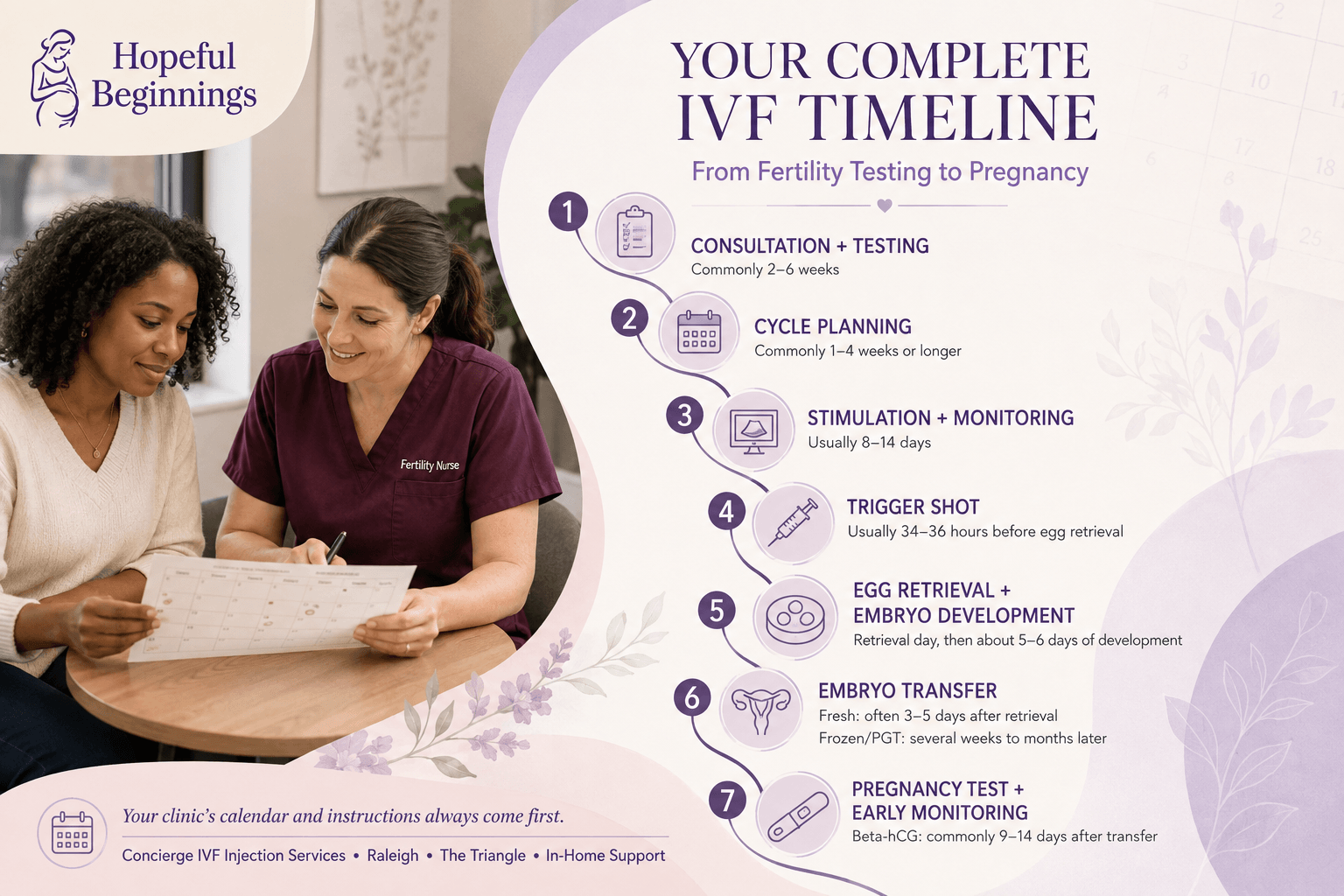
The first thing to know is that there is no single IVF timeline that fits every patient. A conventional IVF treatment cycle may take approximately three to six weeks once treatment medications begin, but the complete journey from initial fertility testing to a pregnancy test often takes two to four months. It can take longer when preimplantation genetic testing, embryo freezing, additional medical treatment, donor coordination, insurance authorization, or more than one cycle is involved.
The stages are consistent even when the dates are not. According to the American Society for Reproductive Medicine’s patient education resource, the basic IVF steps are ovarian stimulation, egg retrieval, fertilization, embryo culture, and embryo transfer. Before those steps, patients usually complete a fertility evaluation and treatment-planning process.
This guide explains the complete IVF process in order, what typically happens at each stage, why timelines change, and where professional injection support can make the schedule easier to manage.
Quick answer: From the first fertility consultation to a pregnancy test, an IVF timeline commonly lasts about two to four months. The active stimulation-to-retrieval phase is usually about two weeks. A fresh embryo transfer may occur several days after retrieval, while a frozen embryo transfer—especially after preimplantation genetic testing—usually adds another menstrual cycle or more. Your fertility clinic’s calendar always takes priority over a general timeline.
IVF Timeline at a Glance
| Stage | Common Timing | What Happens |
|---|---|---|
| Initial consultation and fertility evaluation | 2–6 weeks | Medical history, ovarian reserve testing, ultrasound, semen analysis, uterine or tubal evaluation, and individualized planning |
| Pre-cycle preparation | 1–4+ weeks | Insurance authorization, medication ordering, infectious-disease screening, genetic counseling when indicated, and possible cycle scheduling or suppression |
| Baseline appointment | Cycle day 2–3 in many protocols | Ultrasound and bloodwork confirm whether the ovaries and hormone levels are ready |
| Ovarian stimulation | Usually 8–14 days | Daily fertility injections encourage multiple follicles to grow; monitoring guides medication changes |
| Trigger shot | About 34–36 hours before retrieval | A precisely timed injection supports final egg maturation |
| Egg retrieval | One day | Eggs are collected during a brief outpatient procedure; sperm is collected or thawed |
| Fertilization and embryo culture | About 1–6 days | Eggs are fertilized through conventional IVF or ICSI and embryos develop in the laboratory |
| Fresh embryo transfer | Commonly 3–5 days after retrieval | An embryo is placed into the uterus during the same treatment cycle, when medically appropriate |
| Freeze-all or PGT pathway | Often several additional weeks | Suitable embryos are frozen; biopsied embryos may undergo genetic testing before a later transfer cycle |
| Frozen embryo transfer preparation | Commonly 2–4+ weeks | The uterine lining is prepared through a natural, modified-natural, or medicated protocol |
| Pregnancy blood test | Commonly 9–14 days after transfer | A beta-hCG blood test checks for pregnancy; the exact date depends on clinic protocol and embryo age |
| Early pregnancy monitoring | About 1–3 weeks after a positive beta | Repeat hCG tests and an early ultrasound may confirm location and development of the pregnancy |
These ranges are planning estimates, not promises. Your response to medication, laboratory results, clinic protocol, medical history, and embryo development determine the actual schedule.
Phase 1: Fertility Consultation and Testing
When it happens: commonly two to six weeks
The IVF process begins before the first injection. At the initial consultation, a reproductive endocrinologist reviews your medical, reproductive, surgical, and family history. The discussion may include prior pregnancies, menstrual patterns, previous fertility treatments, current medications, genetic history, sperm or egg source, family-building goals, and any known conditions that could affect treatment.
The purpose of testing is not simply to decide whether IVF is possible. It helps the fertility team identify contributing factors, choose an appropriate treatment, estimate how the ovaries may respond to medication, evaluate the uterine environment, and plan for sperm collection or use of donor gametes when applicable.
Common elements of a fertility evaluation may include:
- Anti-Müllerian hormone, or AMH, testing
- Follicle-stimulating hormone and estradiol testing, often early in the menstrual cycle
- Antral follicle count by transvaginal ultrasound
- Thyroid or other laboratory testing when clinically indicated
- Semen analysis
- Evaluation of ovulation history
- Uterine cavity assessment, such as saline infusion sonography or hysteroscopy when indicated
- Tubal evaluation, depending on medical history and treatment planning
- Infectious-disease screening
- Preconception carrier screening or genetic counseling when appropriate
The American Society for Reproductive Medicine recommends that infertility evaluation be systematic and that evaluation of both partners occur in parallel when applicable. Its guidance identifies ovulatory status, the reproductive tract, and semen evaluation among the central components of a standard infertility workup.
Not every patient needs every test. A person pursuing reciprocal IVF, donor sperm, donor eggs, fertility preservation, gestational carrier treatment, or preimplantation genetic testing may follow a different evaluation pathway.
Why this stage sometimes takes longer
Testing may need to be timed to a particular menstrual-cycle day. Results can also identify a condition that should be addressed before treatment, such as a uterine polyp, hydrosalpinx, uncontrolled thyroid condition, or a need for additional genetic counseling. Insurance authorization, outside medical records, sperm retrieval planning, and donor coordination can also extend the pre-treatment phase.
This is not necessarily lost time. A careful evaluation gives the fertility team information that can affect medication dosing, laboratory planning, transfer strategy, and safety.
Phase 2: IVF Planning and Pre-Cycle Preparation
When it happens: commonly one to four weeks or longer
After testing, the physician creates an individualized IVF protocol. You may receive a written calendar that includes the expected start of medications, monitoring visits, approximate retrieval window, and instructions for contacting the clinic when your period begins.
During this stage, patients often:
- Review consent forms and treatment decisions
- Confirm insurance authorization or financial arrangements
- Order fertility medications and supplies
- Learn how to store, mix, and administer medications
- Arrange time away from work for monitoring and egg retrieval
- Confirm transportation after a sedated procedure
- Review after-hours contact instructions
- Decide whether they want professional help with injections
Some protocols begin with birth control pills, estrogen, or another medication to coordinate follicle growth or schedule the cycle. Others begin directly with a baseline appointment early in the menstrual cycle. A longer suppression protocol can add several weeks, while an antagonist protocol may have a shorter lead-in.
If your plan includes preimplantation genetic testing, discuss the anticipated laboratory timeline and whether the clinic expects a freeze-all cycle. If a frozen embryo transfer is planned from the beginning, the retrieval cycle and transfer cycle should be viewed as separate stages.
Phase 3: Baseline Ultrasound and Bloodwork
When it happens: often on menstrual-cycle day two or three
The baseline appointment is the checkpoint before ovarian stimulation begins. The fertility clinic may use a transvaginal ultrasound to look at the ovaries, count small follicles, and check for ovarian cysts. Bloodwork may measure estradiol and other hormones.
If the results are appropriate, the clinic gives permission to start medication. If a cyst, unexpected hormone level, or another issue is present, the team may adjust the plan or delay the cycle. A delay can be frustrating, but the decision is intended to protect safety and support an appropriate response.
Before leaving the baseline appointment, confirm:
- The name and dose of each medication
- The date and time to begin
- Which injections are subcutaneous or intramuscular
- Whether any medication must be mixed
- Storage requirements
- The date of the next monitoring appointment
- Who to call after hours
For a more detailed overview, read Hopeful Beginnings IVF’s guide to IVF injections and fertility shots.
Phase 4: Ovarian Stimulation and Monitoring
When it happens: usually eight to fourteen days
During a natural menstrual cycle, one follicle commonly becomes dominant. During IVF, injectable medications encourage multiple follicles to grow at the same time so the clinic may retrieve more than one egg.
The American Society for Reproductive Medicine notes that ovarian stimulation generally lasts 8 to 14 days. The exact length cannot be predicted perfectly before the cycle because the ovaries do not respond according to a fixed calendar.
What the injections do
The medication plan may include:
- Gonadotropins: Medications containing FSH, LH activity, or both stimulate follicle growth.
- GnRH antagonist or agonist medication: These medications help prevent premature ovulation or serve another protocol-specific role.
- Trigger medication: hCG, a GnRH agonist, or a combination supports final egg maturation before retrieval.
Brand names, doses, injection routes, and timing vary. Never substitute a general medication list for your clinic’s written instructions.
Most stimulation medications are given subcutaneously, meaning into the fatty tissue beneath the skin. Other medications, including certain trigger shots or progesterone formulations, may be intramuscular. The route matters. Confirm the correct needle, injection site, dose, and technique for every medication.
What monitoring looks like
Monitoring appointments become more frequent as follicles grow. The clinic uses ultrasound measurements and hormone levels to assess response. Your medication dose may remain the same, increase, decrease, or change during the cycle.
Expect the retrieval date to remain approximate until the final monitoring visits. A calendar may show a retrieval window, but the clinic usually confirms the exact date only when follicle development and laboratory results indicate readiness.
Patients often notice bloating, pelvic fullness, fatigue, mood changes, breast tenderness, or injection-site soreness during stimulation. Contact your fertility clinic for severe or rapidly worsening symptoms, significant abdominal pain, rapid weight gain, shortness of breath, persistent vomiting, decreased urination, fainting, heavy bleeding, or any symptom your clinic instructed you to report.
Where in-home injection support fits
Daily medication management can be one of the most demanding parts of IVF. Some medications arrive as prefilled pens or syringes; others require careful reconstitution. Evening doses, changing instructions, needle anxiety, and a time-sensitive trigger shot can add pressure.
Hopeful Beginnings IVF provides professional in-home fertility injection support for patients in Raleigh, Cary, Apex, Durham, Wake Forest, Knightdale, Wendell, Wake County, Franklin County, Johnston County, and nearby North Carolina communities. The service supports administration of a fertility clinic’s prescribed plan; it does not replace the reproductive endocrinologist or change medication orders.
Phase 5: The IVF Trigger Shot
When it happens: usually about 34 to 36 hours before egg retrieval
The trigger shot is the transition from follicle growth to final egg maturation. Your clinic selects the medication and exact administration time based on your monitoring results and planned retrieval.
This is not an approximate appointment. If your instructions say 9:17 p.m., the intended time is 9:17 p.m. The retrieval is commonly scheduled approximately 34 to 36 hours later, before expected ovulation.
On trigger day:
- Review the clinic’s written instructions before the scheduled time.
- Confirm the medication, dose, route, injection site, and whether mixing is required.
- Check whether the protocol contains one injection or a dual trigger.
- Set multiple alarms.
- Prepare supplies early in a clean, well-lit space.
- Record the actual administration time.
If the trigger is early, late, missed, mixed incorrectly, given by the wrong route, or incomplete, call your fertility clinic immediately. Do not repeat the medication or change your retrieval schedule unless the clinic specifically instructs you to do so. Hopeful Beginnings IVF’s trigger-shot timing guide explains what information to have ready when you call.
Phase 6: Egg Retrieval
When it happens: one procedure day, approximately 34 to 36 hours after trigger
Egg retrieval is usually an outpatient procedure performed with sedation or pain medication. Using transvaginal ultrasound guidance, the physician passes a needle into the ovarian follicles and removes follicular fluid. The laboratory then looks for eggs in that fluid.
The ASRM patient guide states that retrieval of multiple eggs can usually be completed in less than 30 minutes, although the total appointment is longer because of preparation and recovery.
Plan for:
- Following the clinic’s fasting and medication instructions
- Having an adult drive you home if sedation is used
- Resting for the remainder of the day
- Mild cramping, spotting, bloating, or pelvic pressure
- Receiving the number of eggs retrieved, often the same day
The number of follicles seen on ultrasound, eggs retrieved, mature eggs, fertilized eggs, and blastocysts will not necessarily be the same. Attrition at each laboratory stage is expected biology, not evidence that a patient did something wrong.
Contact the clinic urgently for severe pain, heavy bleeding, fever, shortness of breath, fainting, rapidly increasing abdominal swelling, or other symptoms identified in your discharge instructions.
Phase 7: Fertilization and Embryo Development
When it happens: the day of retrieval through approximately day five or six
After retrieval, the laboratory assesses egg maturity. Mature eggs may be fertilized by conventional insemination, in which eggs and sperm are placed together, or by intracytoplasmic sperm injection, in which an embryologist injects one sperm into an egg.
The following day, the clinic may report how many eggs fertilized normally. Embryos are then cultured and observed as they divide.
A common laboratory update schedule is:
- Day 0: Egg retrieval and insemination or ICSI
- Day 1: Fertilization check
- Day 3: Cleavage-stage development assessment, depending on clinic practice
- Day 5–6: Blastocyst assessment, transfer, biopsy, freezing, or continued observation when appropriate
ASRM explains that a blastocyst commonly forms around day five and that embryos may be transferred between one and six days after retrieval. Clinics differ in how often they provide updates, so ask in advance when you should expect a call or portal message.
Not every retrieved egg is mature. Not every mature egg fertilizes. Not every fertilized egg becomes a blastocyst. Your embryology team can explain your results in the context of egg source, sperm factors, laboratory observations, and treatment history.
Phase 8A: Fresh Embryo Transfer
When it happens: commonly three to five days after retrieval
In a fresh transfer, an embryo is placed into the uterus during the same cycle as the egg retrieval. The exact day depends on embryo development and clinic strategy.
Embryo transfer is generally a brief procedure that does not require anesthesia. A physician passes a thin catheter through the cervix and places the embryo into the uterine cavity. Clinics may request a comfortably full bladder for ultrasound guidance.
A fresh transfer is not appropriate for every patient. Elevated progesterone, the risk of ovarian hyperstimulation syndrome, uterine-lining concerns, genetic testing, or another clinical factor may lead the fertility team to freeze all suitable embryos instead.
Phase 8B: Frozen Embryo Transfer and PGT
When it happens: several weeks to several months after retrieval
If embryos undergo preimplantation genetic testing, suitable blastocysts are usually biopsied and frozen while results are pending. The clinic then plans a later frozen embryo transfer, or FET, using an embryo selected in consultation with the patient.
Even without genetic testing, a clinic may recommend a freeze-all approach for medical or scheduling reasons. The Human Fertilisation and Embryology Authority describes a freeze-all cycle as creating embryos through IVF or ICSI, freezing them, and transferring an embryo in a later cycle.
FET preparation may use:
- A natural-cycle approach that tracks spontaneous ovulation
- A modified-natural approach with medication to help time ovulation
- A medicated approach using estrogen and progesterone to prepare the endometrium
Monitoring confirms when the uterine lining and hormone timing are appropriate. In a medicated cycle, the number of progesterone exposure days is coordinated carefully with the age of the embryo at freezing. Take every medication exactly as prescribed and contact the fertility clinic before making changes.
Phase 9: Luteal Support and the Wait After Transfer
When it happens: transfer day through the pregnancy test and, if pregnant, beyond
Progesterone supports the uterine lining after transfer. Depending on the protocol, it may be given as an intramuscular injection, vaginal medication, oral medication, or a combination. Estrogen may also continue in a medicated FET cycle.
Do not stop progesterone or estrogen because of spotting, symptoms, a home pregnancy test, or a missed dose without contacting the fertility clinic. The clinic determines whether and when these medications should be changed.
After transfer, most patients can return to ordinary light activity according to their clinic’s guidance. Strict bed rest is not routinely required, but follow the specific restrictions you receive. Sensations such as cramping, bloating, fatigue, breast tenderness, or no symptoms at all cannot reliably predict the result. Progesterone and other medications can produce symptoms that resemble early pregnancy.
Phase 10: IVF Pregnancy Test
When it happens: commonly nine to fourteen days after embryo transfer
The official IVF pregnancy test is usually a quantitative beta-hCG blood test. The exact test day depends on whether a day-three or day-five embryo was transferred and on clinic protocol.
Testing early at home can create confusion. An hCG trigger shot may cause a false-positive result if hormone remains in the body, while testing before hCG has risen enough may cause a false-negative result. The HFEA advises patients to use the date provided by their clinic and warns that testing early may produce a false result.
If beta-hCG is positive, the clinic commonly repeats the test to assess how the level is changing. One value alone does not establish the location or ongoing development of a pregnancy. Continue medications unless the clinic instructs otherwise.
If the test is negative, follow the clinic’s directions before stopping medication. Your team may schedule a follow-up appointment to review the cycle and discuss possible next steps. A negative result is a medical outcome, not a personal failure.
Phase 11: Early Pregnancy Monitoring
When it happens: usually during the weeks after a positive beta-hCG result
After appropriately rising hCG results, the fertility clinic may schedule an early transvaginal ultrasound, often around six to seven weeks of gestational age. IVF pregnancy dating may feel surprising because gestational age is calculated using standard obstetric conventions, not from the day of transfer.
Early ultrasound may evaluate:
- Whether the pregnancy is located in the uterus
- The gestational sac and yolk sac
- Fetal pole development
- Cardiac activity when development is far enough along
- The number of gestational sacs
One scan may be too early to answer every question. Your clinic will interpret findings based on the transfer date, embryo age, hCG pattern, and ultrasound measurements.
Seek prompt medical evaluation for significant one-sided pelvic pain, shoulder pain, fainting, heavy bleeding, severe abdominal pain, or other urgent symptoms. IVF does not eliminate the possibility of ectopic pregnancy or miscarriage.
When development is appropriate, many fertility practices transition care to an obstetric provider near the end of the first trimester. Timing varies by clinic and individual medical needs.
How Long Does IVF Take From Start to Pregnancy?
For many patients, the most realistic answer is:
- Consultation through completed testing: approximately two to six weeks
- Medication start through egg retrieval: approximately two weeks
- Retrieval through fresh transfer and pregnancy test: approximately two to three additional weeks
- Retrieval through frozen transfer and pregnancy test: commonly one to three additional months, sometimes longer
The HFEA estimates that one active IVF treatment cycle commonly takes about three to six weeks, depending on the protocol. That figure does not necessarily include preliminary testing, insurance steps, embryo genetic testing, a later frozen transfer, or delays between cycles.
What Can Make an IVF Timeline Longer?
Your timeline may extend because of:
- Menstrual-cycle timing
- Insurance authorization or medication delivery
- Additional imaging, surgery, or medical clearance
- Ovarian cysts or unexpected baseline hormone levels
- A longer or shorter response to stimulation
- Risk of ovarian hyperstimulation syndrome
- Cycle cancellation for safety or response concerns
- Preimplantation genetic testing
- Embryo biopsy and laboratory turnaround time
- A freeze-all recommendation
- Recovery between retrieval and transfer
- Donor egg, sperm, or embryo coordination
- Gestational carrier screening and legal steps
- Clinic laboratory closure dates or scheduling capacity
An extended schedule does not automatically mean anything is wrong. The calendar is adjusted to biology, laboratory information, and safety—not the other way around.
How to Prepare for the IVF Timeline
Build one reliable calendar
Use the clinic’s portal or written instructions as the source of truth. Record medication names, doses, administration times, monitoring visits, prescription refills, and after-hours phone numbers. When the clinic changes an instruction, update the calendar immediately.
Organize medications before the first dose
Separate refrigerated and room-temperature medications according to pharmacy instructions. Match syringes and needles to each medication. Check expiration dates and quantities early enough to correct a missing item.
Protect time around key dates
Monitoring appointments may be early and frequent. The trigger time is exact. Retrieval requires transportation and recovery time. Transfer and pregnancy-test dates may shift. Tell work or caregivers that some dates will remain tentative until the clinic confirms them.
Decide who will help with injections
Some patients self-administer every medication. Others rely on a partner, friend, or trained professional. Consider support early if you are uncomfortable with needles, mixing medication, intramuscular injections, late-night timing, or changing instructions.
Patients in the Triangle can review Hopeful Beginnings IVF’s fertility injection service and flexible scheduling options.
Know which team makes which decisions
Your reproductive endocrinologist and fertility clinic prescribe medications, interpret monitoring results, determine trigger and retrieval timing, manage embryo decisions, and provide emergency medical guidance. An in-home injection professional helps carry out those instructions accurately and compassionately but does not independently change the treatment plan.
Your IVF Timeline Is Personal, but You Do Not Have to Navigate It Alone
IVF moves through a recognizable sequence: evaluation, planning, ovarian stimulation, trigger, egg retrieval, fertilization, embryo development, transfer, pregnancy testing, and early monitoring. What changes is the time each patient needs at each stage.
The most useful plan is not a rigid countdown. It is a clear calendar, direct communication with your fertility clinic, careful medication handling, and support for the parts that feel hardest.
Hopeful Beginnings IVF provides concierge in-home fertility injection assistance for patients in Raleigh, Cary, Apex, Durham, Wake Forest, Knightdale, Wendell, Wake County, Franklin County, Johnston County, and surrounding North Carolina communities. If injections, medication mixing, a late-night trigger, or progesterone support feel overwhelming, contact Hopeful Beginnings IVF to discuss availability.
Medical disclaimer: This article is for general education only. It does not provide medical advice, diagnosis, treatment, medication dosing, or emergency guidance. IVF protocols vary. Follow the instructions of your reproductive endocrinologist, fertility clinic, and dispensing pharmacy. For urgent symptoms or a medication error, contact your clinic immediately; call emergency services for a medical emergency.
Frequently Asked Questions About the IVF Timeline
How long does the IVF process take from the first appointment to pregnancy?
The complete process commonly takes two to four months from the first consultation to a pregnancy test, but it may be shorter or substantially longer. Testing, insurance authorization, protocol type, embryo genetic testing, a fresh versus frozen transfer, medical procedures, and clinic scheduling can all change the timeline. Once ovarian stimulation begins, retrieval usually occurs about two weeks later.
How many days are IVF stimulation injections taken?
Ovarian stimulation usually lasts 8 to 14 days, according to ASRM patient guidance. Some patients respond sooner or need additional days. Ultrasound and bloodwork—not a preset calendar alone—determine when follicles are ready for the trigger shot.
When is egg retrieval after the trigger shot?
Egg retrieval is commonly scheduled approximately 34 to 36 hours after the trigger injection. The exact time is selected by the fertility clinic and should be followed precisely. If a trigger is early, late, missed, or uncertain, contact the clinic immediately and do not repeat the dose without instructions.
How soon after egg retrieval is embryo transfer?
A fresh embryo transfer commonly occurs three to five days after retrieval, depending on embryo development and clinic strategy. If embryos are frozen, biopsied for preimplantation genetic testing, or transferred in a later cycle for medical reasons, transfer may take place weeks or months later.
How long does preimplantation genetic testing add to the IVF timeline?
PGT usually requires embryos to reach the blastocyst stage, undergo biopsy, and be frozen while results are processed. Laboratory turnaround times vary, and a separate frozen embryo transfer cycle is then scheduled. In practice, this often adds several weeks or more. Ask your clinic and genetics laboratory for their current estimate.
What is the difference between a fresh and frozen embryo transfer timeline?
A fresh transfer occurs during the same treatment cycle as egg retrieval, usually a few days later. A frozen embryo transfer occurs in a later cycle after the embryo has been cryopreserved. FET preparation may track natural ovulation or use estrogen and progesterone to prepare the uterine lining.
When should I take a pregnancy test after IVF?
Fertility clinics commonly schedule a beta-hCG blood test about 9 to 14 days after embryo transfer, but the exact date varies. Use the date provided by your clinic. Testing too early may produce a false-negative result, and residual hCG from a trigger shot may cause a false-positive result.
When is the first ultrasound after a positive IVF pregnancy test?
After positive and appropriately changing beta-hCG results, many clinics schedule an early ultrasound around six to seven weeks of gestational age. Timing varies. The scan may confirm that the pregnancy is in the uterus and assess early development, but a very early scan may not yet show every expected structure.
Can an IVF timeline change after treatment begins?
Yes. Medication doses, monitoring appointments, trigger timing, and retrieval dates can change based on follicle growth and hormone levels. Transfer may also be postponed if the clinic recommends freezing embryos for safety, genetic testing, uterine-lining concerns, or another medical reason.
What happens if I miss an IVF injection?
Contact your fertility clinic immediately and provide the medication name, prescribed dose, scheduled time, actual time, and what occurred. Do not double a dose, change the schedule, or use a replacement medication unless the clinic instructs you to do so.
Can a professional administer IVF injections at home?
Yes, when home administration is permitted by the prescribing fertility clinic. A qualified professional can help prepare and administer medication according to the clinic’s written orders. Hopeful Beginnings IVF offers in-home fertility injection assistance in Raleigh and surrounding Triangle communities.
Does a longer IVF cycle mean the treatment is failing?
Not necessarily. Some ovaries need more stimulation days, some embryos require a later transfer plan, and some delays are made for safety or scheduling. Only the treating fertility team can interpret whether a change is routine or clinically significant for a specific cycle.
Sources
- American Society for Reproductive Medicine: Assisted Reproductive Technologies patient education booklet
- American Society for Reproductive Medicine: Fertility evaluation of infertile women
- Centers for Disease Control and Prevention: About Assisted Reproductive Technology
- Centers for Disease Control and Prevention: IVF Success Estimator
- Human Fertilisation and Embryology Authority: In vitro fertilisation
- Human Fertilisation and Embryology Authority: Elective freeze-all cycles
