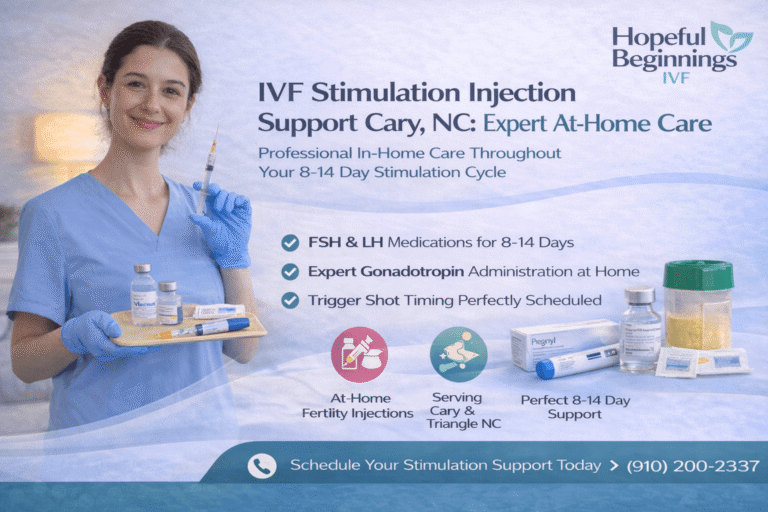


Why “Professional IVF Injections” Exists as a Service
Self-administering IVF injections is possible, but not always optimal. Complex intramuscular (IM) dosing, prior vasovagal episodes, oil-based medications, mobility limits, anticoagulation, and trauma histories can push a routine task into “do not DIY.” This is where professional IVF injections in a clinic or in-home reduce risk, protect adherence, and spare patients the decision fatigue of daily technical steps.
Hopeful Beginnings IVF offers structured Injection Plans and an In-Home Injections option overseen by licensed professionals, coordinated with your REI, and aligned with CDC/WHO injection-safety guidance.
“High-quality outcomes demand high-reliability processes. Getting the medication into the right tissue, at the right depth, on the right timeline is non-negotiable during IVF.” [Placeholder: Medical Director, MD] (confirm quote with client)
Throughout this article, we’ll use professional IVF injections to describe nurse-administered dosing in clinic or at home under physician orders.
When You Shouldn’t Go It Alone
Below are common scenarios where professional IVF injections are clinically prudent or simply kinder to your nervous system.
1) IM Progesterone in Oil (PIO) and Large-Volume or Viscous Medications
IM PIO requires a 90° angle into muscle, correct needle length/gauge, and technique to prevent subcutaneous tracking and minimize pain. High-viscosity solutions may benefit from Z-track technique to reduce leakage and irritation, and from site selection that avoids nerves and vessels (e.g., ventrogluteal region).
Why that matters: Inadequate depth or poor site selection can undermine absorption and comfort, both enemies of dose-by-dose adherence in IVF cycles.
2) History of Vasovagal Syncope or Severe Needle Fear
Blood-injection-injury responses can involve an initial spike then drop in heart rate/blood pressure, occasionally leading to fainting. Applied-tension strategies and structured support help, but many patients are safer with professional IVF injections where monitoring and positioning are controlled.
3) Anticoagulation, Bleeding Risk, or Bruising Tendency
Patients on anticoagulants or with coagulopathies require meticulous pressure/after-care and thoughtful site rotation, a strong case for professional IVF injections with nurses trained in hemostasis precautions (per CDC safe-injection principles).
4) BMI, Scar Tissue, or Mobility Constraints
Achieving consistent muscle depth in the gluteal region can be nontrivial when landmarks are difficult to palpate or positioning is limited. Professionals routinely use the ventrogluteal site (gluteus medius) and vastus lateralis to reduce nerve/vascular risk.
5) Allergy or Intolerance to Specific Oil Vehicles
Some patients react to sesame oil or other vehicles in PIO. Clinicians may adjust the formulation or route (e.g., switch to vaginal or subcutaneous options). Coordination is smoother when professional IVF injections are part of a clinic-run plan. Evidence continues to evolve on route effectiveness; decisions belong with your REI.
Choosing the Right Route: IM vs. Vaginal vs. Subcutaneous
Bottom line: Your physician decides the route based on protocol and evidence.
- IM progesterone: A longstanding standard for many programs; some protocols especially in FET still prefer IM for luteal support.
- Vaginal progesterone: Widely used; supported by robust data across fresh and frozen cycles.
- Subcutaneous aqueous progesterone: Randomized trials and meta-analyses suggest non-inferiority to vaginal in certain contexts, expanding options for patients who cannot tolerate vaginal or IM routes.
For patients who remain on IM, professional IVF injections help ensure dose timing, technique, and documentation meet the clinical intent of the protocol.
Explore your options and coordination process on our Services page, meet the team on About, or request a triage call via contact.
Inside a Professional IM Visit: What “Right” Looks Like
Preparation & Identity Check
- Confirm patient identity, medication, dose, route, and timing as ordered by your REI.
- Hand hygiene, clean workspace, and sterile needle/syringe use per CDC/WHO standards; single-use only, no vial sharing.
Site Selection, Depth, and Needle Choice
- 90° angle into ventrogluteal or vastus lateralis; deltoid rarely used for larger volumes.
- Needle gauge/length matched to patient habitus and medication viscosity.
Technique Controls
- For viscous meds like PIO, consider Z-track (skin displaced, needle inserted, inject steadily, wait, then release) to minimize tracking and irritation.
- Aspiration policies follow clinic protocol; inject at a steady rate; apply pressure, not vigorous massage, after withdrawal unless the prescriber indicates otherwise.
Documentation & Adverse-Event Monitoring
- Time, site, lot number, and response documented; adverse effects reported promptly to the prescriber. (CDC safe-injection documentation standard.)
This rigor is the quiet reason professional IVF injections maintain adherence during stressful cycles.
When In-Home Beats In-Clinic
Professional IVF injections aren’t limited to the exam room. Our In-Home Injections bring the same standards to your living room:
- Nurse arrival within the dosing window; two-identifier confirmation; sterile setup.
- Trauma-informed pacing, countdown only if requested, and positioning that reduces vasovagal risk.
- The same documentation and site rotation mapping you’d expect in a clinic.
Patients integrate this with their Injection Plans so every dose is predictable and on time, preserving the integrity of the cycle.
What If You’re Self-Injecting? Pro Tips from the Pros
Even with professional IVF injections available, some patients prefer to self-inject under guidance. Coaching from Hopeful Beginnings IVF covers:
- Landmarks and angles using simple body cues; smartphone mirrors for posterior sites.
- Needle discipline: never reuse; never share; dispose in puncture-resistant sharps containers; no multi-dose vial sharing.
- Comfort measures: warm the syringe (per clinic guidance), brief distraction, neutral breathing; for anxiety-prone patients, seated or side-lying positions to reduce fainting risk.
- Escalation plan: clear thresholds for switching to professional IVF injections if pain, bruising, or near-syncope occurs.
How This Aligns With the Evidence
- Luteal support matters: ASRM emphasizes luteal phase support after IVF; route selection is protocol-specific and evidence-guided.
- Multiple routes are viable: Contemporary reviews and network meta-analyses support IM, vaginal, and subcutaneous options, with performance varying by cycle type and context.
- Technique & safety are foundational: CDC/WHO documents outline injection safety and infection-control practices that professional services operationalize consistently.
- Vasovagal risk is real: BII phobia features a two-phase cardiovascular response; applied-tension strategies are evidence-based, reinforcing the value of professional monitoring for at-risk patients.
What You Get with Hopeful Beginnings IVF
- Professional IVF injections in clinic or at home, built on CDC/WHO safety standards and REI-approved orders.
- Injection Plans with dose timing, site rotation maps, and escalation criteria.
- Rapid triage via Contact for high-risk or high-anxiety cases.
- Team access: meet our nurses and REI partners on About; start planning under Services.
Visit Hopeful Beginnings IVF to get matched to the right path, self-administer with coaching, or fully professional IVF injections.
FAQ
What qualifies as “professional IVF injections”?
Nurse-administered injections IM or subcutaneous are performed in the clinic or in-home under physician orders, following CDC/WHO injection safety guidance.
When should I choose professional IVF injections instead of self-injecting?
Consider it for IM PIO, prior fainting, anticoagulation, mobility limits, or if technique anxiety threatens adherence. Evidence and clinician judgment drive the decision.
Which IM site is safest for progesterone?
Clinicians often prefer the ventrogluteal region (gluteus medius) because it avoids major nerves and vessels and accommodates viscous meds.
Is Z-track necessary for progesterone in oil?
Not always, but it can reduce leakage and skin staining with viscous IM meds; follow your clinic’s protocol.
Are subcutaneous progesterone options as effective as vaginal?
Randomized trials and meta-analyses support non-inferiority of certain subcutaneous formulations vs. vaginal in defined contexts; decisions remain protocol-specific.
What safety rules should my nurse follow?
Single-use needles/syringes, correct site/angle, documentation of dose/site/lot, and sharps disposal these are minimum CDC/WHO standards.
Can I switch from self-injection to professional IVF injections mid-cycle?
Yes, coordinate timing with your prescriber and our team via Contact to avoid missed doses.
Do you provide in-home services after hours?
See In-Home Injections for current coverage windows and scheduling policies.
Compliance & Caution
This page is educational and not medical advice. Route, dose, and needle specifications must follow your prescribing physician’s orders. Scope of nursing practice and medication regulations vary by state; confirm details with your clinic. All statistics and quotes require human verification before publication.